Stop Losing $50 Leads: AI Attribution System for Home Services ROI
Your LSA leads are leaking. Learn the AI attribution framework that tracks marketing spend to booked jobs and prevents revenue loss with hybrid AI call coaching. Step-by-step implementation guide inside.


How do you track Google LSA leads to actual booked jobs?
Track Google LSA leads to booked jobs with three tools: call tracking numbers, AI call scoring, and end-to-end tracking. Connect each marketing source directly to invoice payments. Most operators stop tracking at "lead generated" when the real money is made (or lost) in the 30 seconds after the phone rings.
Here's the brutal truth: Your $50 LSA lead that "didn't convert" might have actually cost you $3,000 in lost revenue.
LSA costs climbed 40% since 2023, with HVAC leads now costing $45-80 in major metros. But that sticker shock isn't your real problem. Pipeline On reports most contractors are missing the math that matters.
You're tracking cost per lead. You should be tracking cost per booked revenue.
Marketing ROI home services is the measurement of actual revenue generated (not just leads) against total marketing spend, factoring in call handling quality and conversion rates.
The real cost of a 'missed' Google LSA lead
When your CSR fumbles a $50 LSA lead for a furnace replacement, you didn't just lose $50. You lost the $8,000 job that lead was calling about. That's a 160x multiplier on your "cheap" lead.
Invoca data shows phone calls convert 10-15x more revenue than web leads. Yet 40% of weekend calls go unanswered. Your competition is booking jobs while your phone rings into the void.
Why cost-per-lead metrics lie to operators
Cost-per-lead is a vanity metric. It tells you nothing about profitability.
Real math: A $20 lead that never books costs you $20. A $80 lead that books a $5,000 job makes you money. Track cost per booked revenue instead.
Most operators celebrate cheap leads and wonder why their revenue stays flat. The leads aren't the problem. Your CSR teams fail because they're unprepared for the calls that matter.
The attribution blind spot costing you thousands monthly
Traditional attribution dies at "lead generated." That's like measuring a basketball game by how many times you dribble the ball.
Supply House Times found 37% of phone leads convert during the call. Your attribution system should track what happens in those crucial minutes, not just where the lead came from.
What's the real cost per lead for home services marketing?
The real cost per lead for home services ranges from $150-300 when you factor in all leads that didn't convert due to poor call handling (often 2-3x your quoted cost-per-lead from Google or Facebook). Factor in missed calls, fumbled objections, and weak scripts, and your $50 LSA lead actually costs $150 when you account for waste.
Traditional attribution stops at "lead generated." AI attribution tracks through to "invoice paid." That's the difference between guessing and knowing your marketing ROI home services business.
Step 1: Implement comprehensive call tracking
Start with unique phone numbers for every marketing channel. Google LSA gets one number. Google Ads gets another. Your truck wrap gets a third.
Don't just track the source. Track the outcome. Which channels generate leads that actually book? Which ones waste your time with tire kickers?
Coalmarch reports 83% of marketing leaders consider demonstrating ROI their top priority. Yet most contractors can't tell you which marketing dollar generated which booked job.
Step 2: Set up AI-powered call scoring and analysis
Record every call. Score every call. AI can automatically identify which leads convert and which ones leak revenue due to poor handling.
Track these metrics per marketing source:
- Answer rate (% of calls answered live)
- Booking rate (% of calls that book appointments)
- Show rate (% of appointments that actually happen)
- Close rate (% of appointments that become jobs)
- Average ticket size per source
Most operators track none of this. They spend blind and wonder why their marketing "doesn't work."
Step 3: Connect marketing sources to actual revenue
Build the pipeline from click to cash. When a Google LSA lead becomes a $4,000 HVAC install, your system should automatically connect that revenue back to the original marketing source.
ServiceTitan integration makes this seamless. Every job gets tagged with its marketing source. Every invoice ties back to your ad spend. This systematic approach lets you track marketing spend to booked jobs with precision.
Step 4: Create closed-loop reporting dashboards
Build dashboards that show true marketing ROI, not vanity metrics. Track:
- Cost per booked job (not cost per lead)
- Revenue per marketing dollar spent
- Lifetime value by channel
- Profit per marketing source
This data changes everything. You'll stop spending on channels that generate cheap leads with low booking rates. You'll double down on channels that generate expensive leads with high-ticket conversions.
How does AI improve marketing ROI for HVAC companies?
AI improves marketing ROI for HVAC companies by handling routine calls autonomously while providing real-time coaching to human agents on high-value sales calls. This increases booking rates 40-60% and reduces cost per acquired customer without alienating customers who need human expertise for complex installations.
Homeowners won't talk to bots for $15K HVAC installs or emergency repairs. But they'll absolutely let AI handle scheduling maintenance or answering basic questions.
The hybrid model solves both problems: AI handles routine calls autonomously, coaches humans on high-value calls.
Why full AI replacement fails for high-ticket sales
Full AI replacement breaks down when the conversation gets complex. Try explaining why a customer needs a new furnace instead of just a repair to a chatbot. It doesn't work.
High-ticket home services sales require empathy, technical expertise, and objection handling that only humans can deliver. But those same humans need AI support to handle calls consistently.
Boomcycle estimates 50-70% of LSA leads could convert with proper handling. Most don't because CSRs wing it instead of following proven systems.
How real-time call coaching prevents revenue leaks
Real-time AI coaching gives your CSR the exact script, objection responses, and pricing guidance while the customer is on the line. No more fumbling. No more "let me check with my manager."
The AI listens to every call and prompts your agent with the right response to price objections, competitor mentions, or scheduling concerns. Real-time call monitoring prevents the revenue leak before it happens.
The AI triage system that maximizes ROI
Smart triage routes calls based on value and complexity:
- "What are your hours?" → AI handles autonomously
- "My furnace isn't working" → AI qualifies, transfers to human with context
- "I need a quote for whole-house HVAC" → Immediately routed to your best closer
For plumbing businesses using AI attribution for plumbing leads, the system works the same way. "My toilet is running" gets AI handling and automatic parts ordering. "My sewer line collapsed" gets immediate human attention with full customer context pre-loaded.
AI call escalation ensures every lead gets the right level of attention without wasting human bandwidth on low-value calls.
Measuring coaching impact on conversion rates
Track booking rates before and after AI coaching deployment. Most operators see 40-60% improvement within 90 days.
LeadAngel research shows responding within one minute increases conversion rates by 391%. AI ensures you never miss that window.
The math is simple: Better call handling = higher booking rates = lower cost per acquired customer = higher marketing ROI.
Why are my expensive marketing leads not converting to jobs?
Expensive marketing leads aren't converting because 67% of home services businesses lack proper call handling systems, real-time coaching, or after-hours coverage. This means leads leak revenue during the critical 30-second window after the phone rings. The leads are fine. Your conversion process is broken.
Most contractors blame the leads. Smart contractors fix their systems.
Week 1-2: Audit current attribution gaps
Start with an honest assessment. How many LSA leads from last month actually became booked jobs? How many went unanswered? How many were handled poorly?
Most operators can't answer these questions. That's the problem.
Record calls for two weeks. Score them manually. You'll quickly see where revenue is leaking. Poor scripts, weak objection handling, missed follow-ups.
Week 3-4: Implement call tracking and AI analysis
Deploy unique tracking numbers for every marketing channel. Set up call recording and basic AI analysis to identify patterns in lost leads.
Scorpion data shows businesses that evaluate marketing performance weekly achieve 6x ROI vs 4.8x for quarterly reviews.
Weekly reviews let you course-correct fast. Monthly reviews let competitors steal market share while you figure out what's broken.
Month 2: Deploy AI coaching for high-value calls
Start with AI coaching on your most valuable call types. HVAC replacement quotes. Emergency plumbing calls. Electrical panel upgrades.
These calls have the highest revenue potential and the most objection-handling complexity. Perfect for AI coaching support.
AI vs automation differences matter here. You want AI that understands context and provides relevant coaching, not automation that just follows scripts.
Month 3: Optimize based on data and scale successful channels
Use three months of clean attribution data to reallocate marketing spend. Cut channels with poor cost-per-booked-job ratios. Double down on channels with high-converting leads.
This is where the real ROI improvement happens. You're not just handling leads better. You're getting better leads to handle.
5 revenue metrics that matter become crystal clear once you have proper attribution in place.
What attribution tools work best for home services businesses?
The best attribution tools for home services combine call tracking, AI call analysis, and CRM integration to track marketing spend from initial click through invoice payment. Tools like Tradesly offer hybrid AI call handling with built-in attribution, while call tracking platforms integrate with your existing FSM software.
Every month without proper attribution is money left on the table. While you're guessing which marketing channels work, competitors with AI attribution systems are stealing market share.
The true cost of inaction on attribution
The cost isn't just wasted ad spend. It's compound loss of market position.
Competitors with better attribution optimize faster. They cut losing channels and scale winning ones while you're still flying blind. Six months from now, they own the keywords you should have doubled down on.
The competitive advantage window is closing as more operators adopt AI systems. First-mover advantage matters in local markets.
How Tradesly's hybrid AI solves both problems at once
Tradesly provides AI attribution and hybrid call handling in one platform. You get complete marketing ROI tracking plus the AI coaching that prevents revenue leaks during conversion.
Instead of buying separate tools for call tracking, call coaching, and attribution reporting (then trying to make them work together), you get an integrated system. It tracks every marketing dollar from click to cash.
How Tradesly AI dispatcher works shows the full system in action. AI handles routine calls, coaches humans on complex sales, and tracks every interaction back to its marketing source.
Getting started with AI attribution today
Stop guessing. Start tracking. Book a demo to see the complete attribution and AI coaching system.
The math is brutal but simple: Every day without proper attribution costs you money. Every fumbled high-value call costs you more.
Fix both problems with hybrid AI that tracks AND converts. Get the demo.
Keep reading
 Marketing & Lead Gen
Google Ads Call Tracking for Home Services: The Step-by-Step Setup Guide
14 min read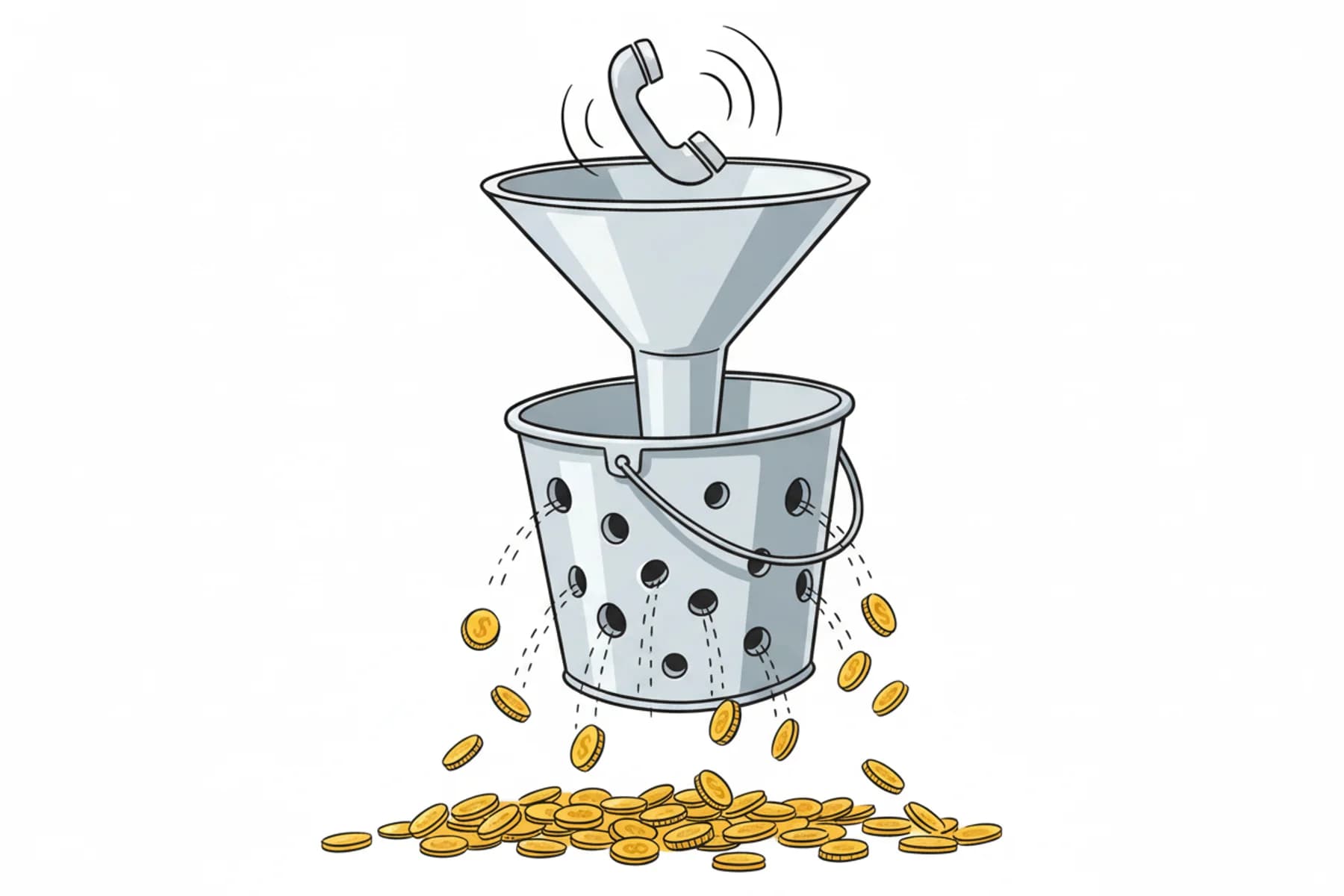 Marketing & Lead Gen
The Google LSA Math: How Much is a Poor Call-Intake Process Costing Your HVAC Shop?
14 min read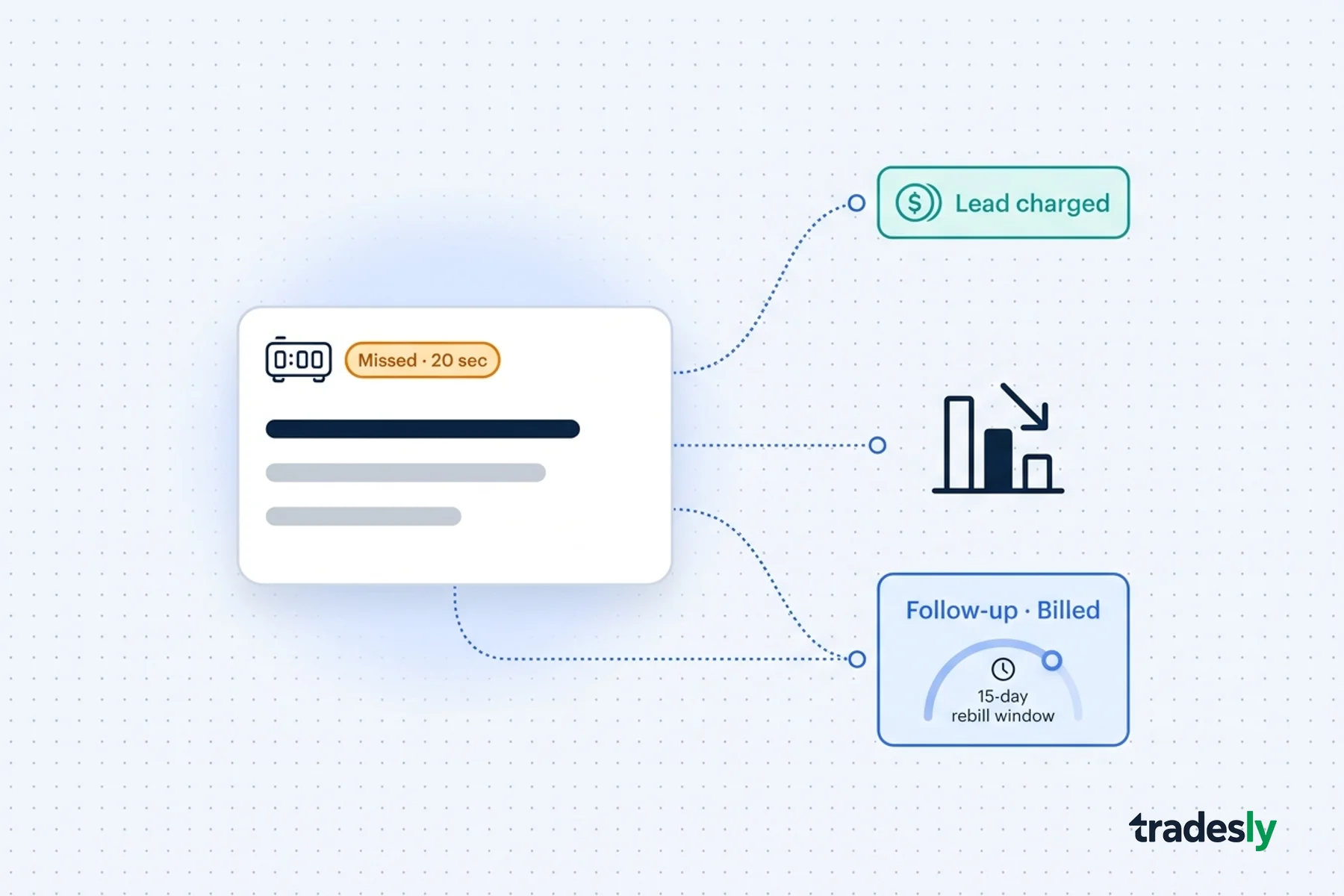 Marketing & Lead Gen
Google To Charge Local Businesses For Missed & Subsequent Calls On LSAs
11 min read