6 AI Automation Fails Killing Home Services (& How to Fix Them)
AI customer service failures kill revenue in home services. See 6 real automation disasters and exactly how hybrid AI solutions enhance (not replace) your team. Read the playbook.

The AI Automation Graveyard: Why Smart Companies Are Going Dumb
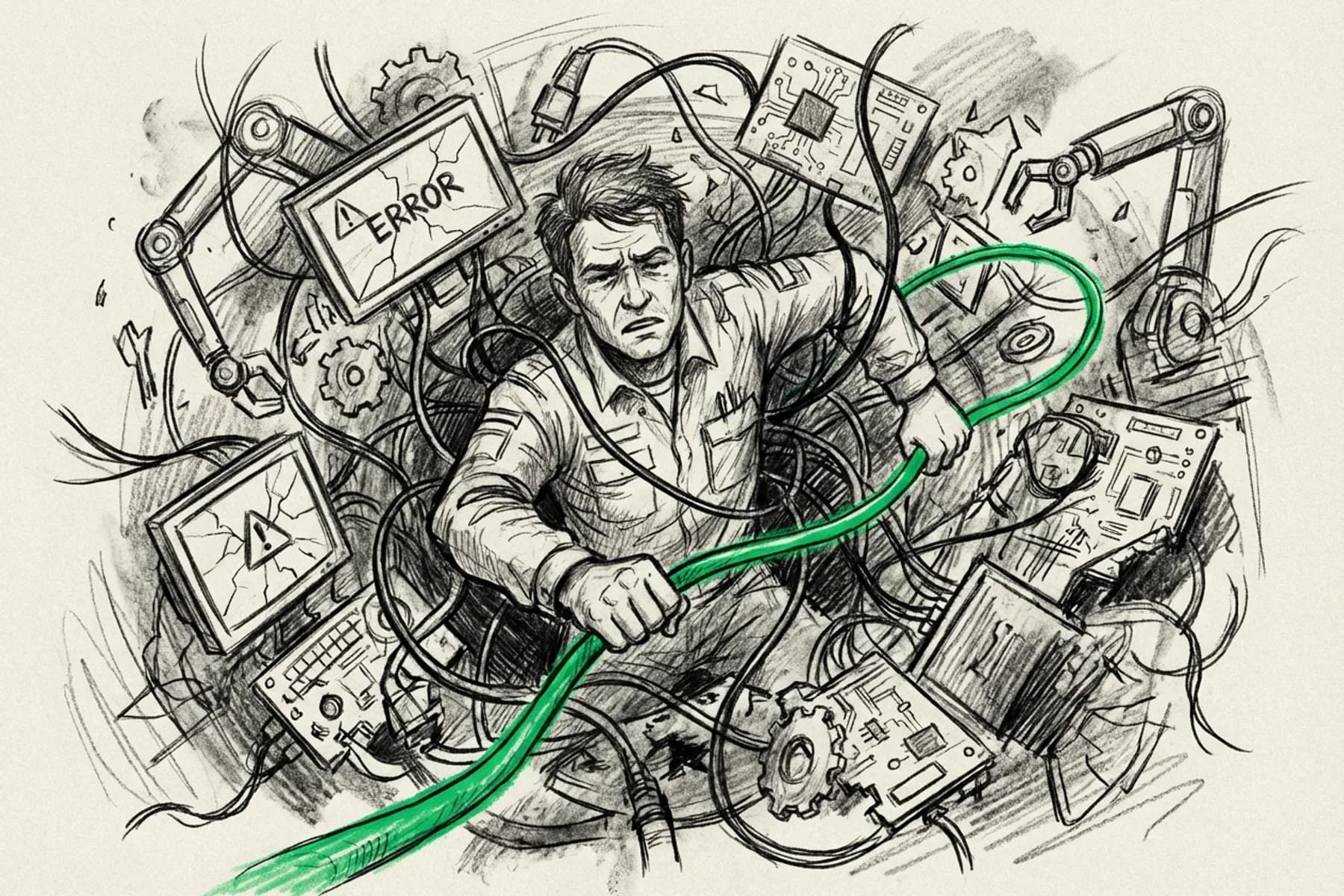
Here's the brutal reality: 30% of AI projects will be abandoned by 2025. Not because the technology is bad. Because the strategy is garbage.
Home service businesses are particularly vulnerable to these home service automation mistakes. You're dealing with high-ticket sales. Customer trust matters. One bad interaction can cost you thousands in lifetime value.
The biggest mistake? Treating AI as a human replacement instead of an enhancement tool. Companies rush to automate everything. Then they watch their customer satisfaction tank faster than a broken water heater.
Hybrid AI Customer Service is a model where AI handles initial call response, qualification, and booking while human agents take over for complex diagnosis and high-ticket sales conversations.
We've analyzed hundreds of failed AI implementations. Here's what always goes wrong—and how hybrid AI prevents these disasters while capturing the efficiency gains.
What are the most common home service automation mistakes?
The most common home service automation mistakes are: 1) Phantom bookings from AI misunderstanding customer requests, 2) Conversational loops that trap customers, 3) Latency disasters with multi-second delays, 4) Training catastrophes from bad data, 5) Integration nightmares between disconnected systems, and 6) Strategic misalignment treating AI as IT instead of CX. These call center automation mistakes cost companies millions in lost revenue and damaged customer relationships.
1. The Phantom Order Problem - When AI 'Books' Jobs That Don't Exist
Your AI just booked a $5,000 HVAC job. Customer's happy. Dispatch is scheduled. But there's one problem—the job doesn't exist.
We've seen AI agents hallucinate available slots because they want to be agreeable. It's a common problem with poorly designed systems. They lack the guardrails to prevent the AI from making things up.
Here's what happens: Customer calls about a weird noise from their smart thermostat. The AI mishears "installation" instead of "inspection." Books a full system replacement.
Customer shows up expecting a quick diagnostic. Your tech shows up with a new unit.
Another disaster: Smart home devices triggering false service requests. AI assistants routinely stumble on tasks as basic as turning on lights. When these systems integrate with service booking, chaos follows.
The hybrid fix: AI dispatcher that actually works handles initial intake. But humans verify before dispatch. AI suggests; humans decide.
Key Takeaway: Never let AI book jobs without human verification loops. Phantom appointments destroy trust faster than you can rebuild it.
2. The Conversational Loop Trap - AI That Won't Shut Up or Let Go
Picture this: Customer explicitly asks to speak to a live agent. The AI keeps looping that it can't help with that request. Over and over. Customer tries "representative," "I want to speak to someone," "live agent."
Then they start screaming. Finally drop the F-bomb and hang up.
This is the "Groundhog Day" customer service experience. AI systems fail to recognize when they're out of their depth. Customers get trapped in repetitive conversation loops with no escape hatch.
The worst part? These loops happen during peak service seasons when you can't afford to lose a single call.
The hybrid fix: AI call escalation feature with built-in escape hatches. Clear trigger phrases. Seamless human handoffs. Taking over AI calls when needed should be instant, not impossible.
Key Takeaway: If your AI doesn't know when to quit, it will kill more jobs than it books.
3. The Latency Disaster - 3-Second Delays That Kill Trust
Three seconds doesn't sound like much. Until you're waiting for an AI to respond to "Can you check Tuesday morning?"
Users are reporting lag times of several seconds for binary actions like light switches. When this happens in customer service, it's death by a thousand cuts.
We hear this constantly on competitor call recordings. Ten-second delays after the greeting. Thirty-second delays when looking up schedules. What should take 4 minutes takes 12.
Cloud dependency is the culprit. Every request bounces to a server farm somewhere. Network hiccups become customer experience disasters.
The hybrid fix: Local processing for critical functions. Cloud enhancement for complex tasks. Keep the basics fast and reliable.
Key Takeaway: Speed kills—both ways. Fast responses build trust. Slow ones destroy it.
4. The Training Catastrophe - AI Learning Bad Habits From Bad Data
Garbage in, garbage out. Your AI is only as good as the data you feed it.
We've seen customer AI agents trained on poor quality call recordings. The result? Automation that amplifies existing customer service problems instead of solving them.
One client's AI was messing up their CRM data so badly that someone had to go back through every record and fix everything the AI touched. That's not automation. That's expensive busy work.
Bad training data creates AI agents that inherit all your worst habits. They learn to be impatient. They learn to give wrong information. They learn to hang up on confused customers.
These call center automation mistakes compound quickly. One bad training session creates hundreds of bad customer interactions.
The hybrid fix: CSR training that actually works with clean training data and ongoing human oversight. Call monitoring and quality control catches problems before they scale.
Key Takeaway: Don't train AI on your worst calls. Train it on your best ones, then add human coaching for edge cases.
5. The Integration Nightmare - AI Islands That Don't Talk
You've got three different AI tools. One for calls. One for scheduling. One for follow-up. None of them talk to each other.
Customer information gets lost between systems. Appointments show up in one calendar but not another. Your CRM thinks the job is booked. Your dispatch system has no clue.
Multiple AI systems create data silos. Failed handoffs between systems lose customers. Different formats mean manual data entry—exactly what you were trying to automate away.
The hybrid fix: Unified platforms with built-in integrations. ServiceTitan integration that actually works means data flows seamlessly from call to dispatch to billing.
Key Takeaway: AI islands sink ships. Connect your tools or watch your processes drown in manual workarounds.
6. The Strategic Misalignment Trap - Treating AI as IT Instead of CX
The biggest reason AI call rollouts fail is strategic misalignment. Companies treat AI voice agents as IT projects instead of customer experience initiatives.
IT focuses on technical specs. Customer experience focuses on outcomes. When these departments don't align on KPIs, AI projects crash and burn.
IT measures uptime. CX measures customer satisfaction. IT optimizes for cost per call. CX optimizes for revenue per customer. These conflicting priorities kill ROI faster than any technical bug.
The hybrid fix: Customer experience-first implementation with cross-functional teams. Shared KPIs. Aligned incentives. AI serves the customer experience, not the IT budget.
Key Takeaway: AI projects fail when departments fight. Success requires unified goals and shared accountability.
Why do AI customer service projects fail in home service businesses?
AI customer service projects fail in home service businesses because companies try to replace human judgment instead of enhancing it. Home services require trust-building and complex problem-solving that pure automation can't handle. The solution is hybrid AI that combines automation efficiency with human expertise.
How can home service companies avoid AI implementation disasters?
Avoid AI disasters by starting with enhancement, not replacement. Use AI for initial call handling and real-time agent coaching. Build in human verification loops, escalation triggers, and quality control systems. Focus on customer experience outcomes, not just technical implementation.
The Hybrid AI Solution: Why Enhancement Beats Replacement
Here's what actually works: hybrid AI solutions that enhance human performance instead of replacing it.
AI provides real-time guidance while humans make final decisions. Your agents get instant coaching on objection handling, pricing, and scheduling. But they stay in control of the conversation.
Continuous learning from human interventions improves AI over time. Every time an agent corrects the AI or handles an edge case, the system gets smarter. But it doesn't get autonomous.
Fail-safes and escalation paths prevent customer service disasters. AI-powered agent coaching turns your entire team into elite performers. The birth of the 10x CSR happens when human skills meet AI intelligence.
Key Takeaway: The best AI makes humans better, not obsolete. Enhancement multiplies capability. Replacement multiplies risk.
What is hybrid AI and how does it prevent automation failures?
Hybrid AI combines automated processes with human oversight and intervention capabilities. It prevents failures by maintaining human judgment in critical decisions, providing real-time coaching instead of full automation, and building escalation paths when AI reaches its limits.
Should home service businesses replace or enhance human customer service with AI?
Home service businesses should enhance, not replace, human customer service with AI. High-ticket sales require trust and relationship-building that only humans can provide. AI works best as a coaching tool and efficiency enhancer, not as a complete replacement.
Your Next Move: Audit Before You Automate
Before you implement any home services AI implementation, ask yourself these questions:
- What processes require human judgment? Keep humans in charge of complex diagnosis, high-value sales, and upset customers.
- Where can AI add value without risk? Initial call screening, appointment scheduling, and follow-up reminders are safe bets.
- How will you handle AI failures? Build escalation paths and human handoffs from day one.
Red flags to watch for: Vendors who promise 100% automation. Systems without human override options. Platforms that don't integrate with your existing tools.
Start with AI coaching your existing team before replacing functions. Get comfortable with hybrid approaches. Build feedback loops. Measure customer satisfaction, not just efficiency metrics.
Stop guessing about AI. The disasters are real, but so are the solutions. Get the demo and see how hybrid AI actually works: https://try.tradesly.ai/
Key Takeaway: AI success isn't about replacing humans. It's about making them superhuman. Start there, and you'll avoid joining the 30% who crash and burn.
Keep reading
 AI Receptionist & Answering
Why AI Receptionists Lose Your $15K HVAC Calls
7 min read AI Receptionist & Answering
The Best HVAC Answering Service: 4 Tiers That Impact ROI
8 min read AI Receptionist & Answering
The Break-Even Point for an AI Receptionist: When Does Automation Pay for Itself in a Home Service Business?
7 min read