

CRM-FSM Integration Fails Because Data Isn't Intelligent—Here's the Fix
Your FSM software isn't broken—your data intelligence is. Discover the three data gaps killing your revenue and how AI creates the missing context layer. Get the playbook.

The $100K integration that moved the needle... nowhere
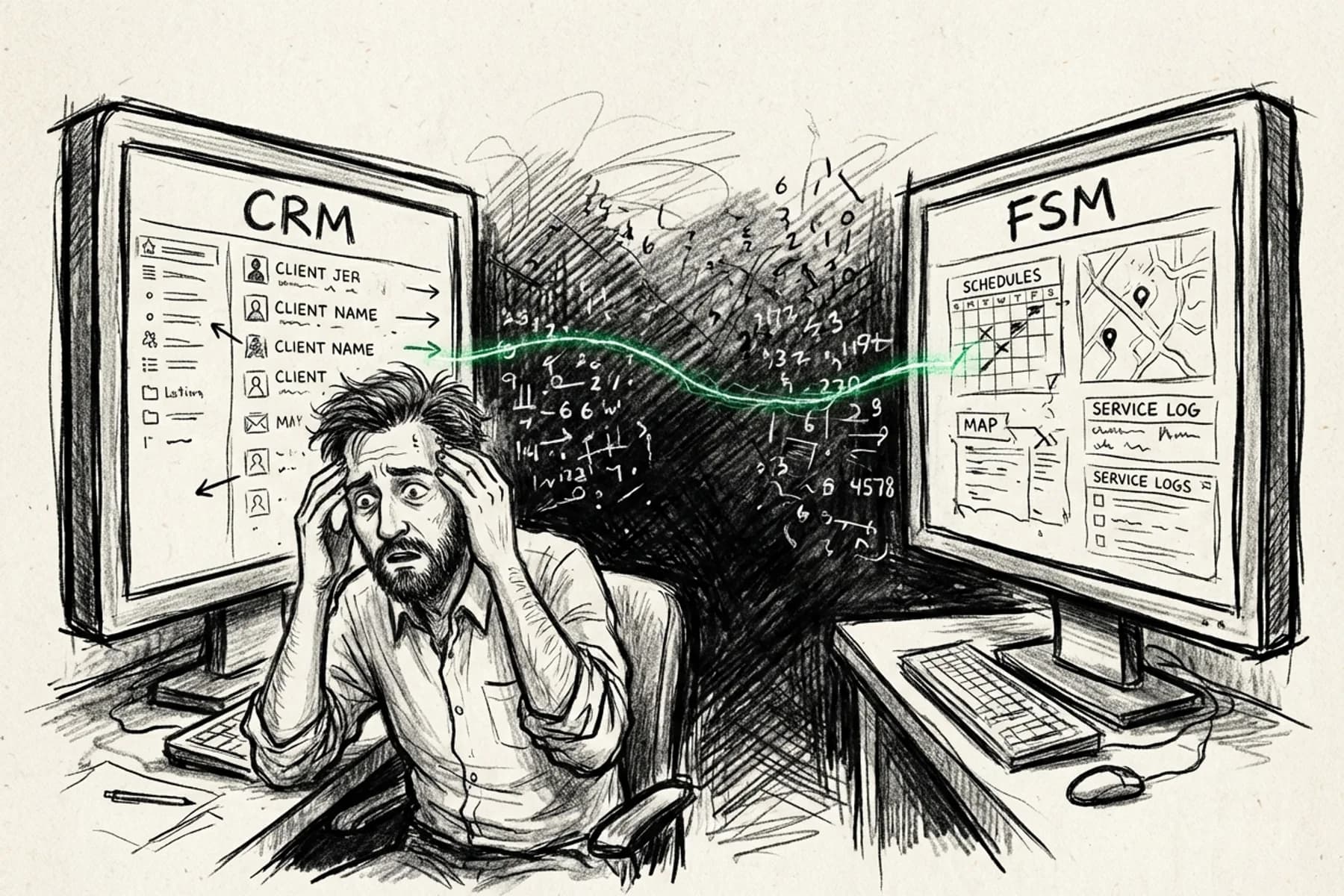
You dropped six figures on integrating your CRM with your field service management platform. ServiceTitan talks to your marketing software. Your lead data flows into dispatch. Everything's connected.
So why is your booking rate still garbage?
Here's what nobody tells you about CRM FSM integration revenue problems: the technology works perfectly. The integration isn't the problem. The problem is that connected systems just give you more garbage data to analyze.
CRM failure rates range between 18% and 69% according to industry analysts. Not because the software breaks. Because having data and using clean data are two completely different disciplines.
Data Hygiene is the practice of maintaining clean, accurate, and consistent data across all business systems to ensure reliable reporting and decision-making.
The promise vs. reality of CRM-FSM integration
The promise: Marketing generates leads. CRM captures them. FSM schedules them. Technicians complete them. Revenue flows like magic.
The reality: You get beautiful reports showing exactly how you're losing money. Your lead cost is tracked perfectly. Your booking rate is measured precisely. Your service completion is documented completely. And your revenue is still flat.
Why? Because integration gives you historical data, not actionable intelligence. Your ServiceTitan integration tells you what happened. It doesn't tell you what to do next.
Why data connectivity doesn't equal revenue growth
Data connectivity is like having a great filing system with misfiled documents. Everything's organized. Nothing's lost. You can find any record in seconds. But if the records are wrong, your filing system just helps you find bad information faster.
The gap between data and revenue is clean, intelligent data. Your systems know a lead came from Google Ads, called at 2:47 PM, spoke to Jennifer for 4 minutes, and didn't book. What they don't know is Jennifer entered the wrong service type, missed the urgency cues, and fumbled the close because her data was garbage from the start.
This is why FSM features gather dust. The platform can do amazing things, but it can't think through bad data.
Why isn't my FSM software improving revenue?
Your FSM software isn't improving revenue because dirty data creates three specific gaps that kill sales before they hit your P&L. Bad data in means bad decisions out. Every home service business has them. Most never fix them.
Your field service management ROI is flat because poor data hygiene prevents your systems from connecting customer intent to service outcomes.
Gap 1: The lead-to-call black hole
Your marketing platform knows a lead clicked your ad. Your CRM knows they filled out a form. Your FSM knows they called. What none of them know is what the prospect actually wanted when they picked up the phone.
Was this a price shopper? An emergency repair? A replacement opportunity? The data says "HVAC inquiry." The context that determines whether this call converts is missing because your CSR didn't capture it properly.
Result: Your CSR uses a generic script for a specific problem. The prospect hangs up. Your systems dutifully record another "unqualified lead."
Gap 2: The call-to-dispatch disconnect
Your call gets booked. Your FSM schedules a technician. But the context from the call doesn't travel to the truck because it was never captured correctly.
The customer mentioned their system is 15 years old and making weird noises. Your CSR noted "AC not cooling." The tech shows up expecting a refrigerant top-off and finds a dying compressor.
No replacement quote prepared. No financing options ready. Lost upsell opportunity.
Your FSM tracked the service call perfectly. It missed the revenue opportunity because the initial data was incomplete.
Gap 3: The service-to-outcome void
Your tech completes the job. Customer pays. FSM updates the status. Case closed. But the intelligence from that service call never feeds back to improve your lead generation or call handling because the completion data doesn't connect to the original lead source.
You just learned this customer has an old system, values quick service, and pays without negotiating. That's gold for future marketing. But your CRM doesn't know because the data wasn't tagged properly. Your ad targeting doesn't improve. You keep buying the same generic leads instead of more customers like this one.
Equipment rental businesses can lose 10-25% of potential revenue to operational inefficiencies. Home services isn't different. The inefficiency just hides in dirty data between systems.
How do I fix CRM integration problems in home services?
CRM integration failure is a data hygiene problem, not a technology problem. Your systems are perfectly integrated but they're processing garbage data.
The fix isn't better connections between systems. It's cleaning up the data that flows through those connections.
The static data problem
CRMs and FSM platforms are databases. They store what happened. They don't predict what will happen or suggest what should happen. They're reactive, not proactive.
When a high-value prospect calls, your system logs the interaction. But if your CSR enters "routine service call" instead of "emergency replacement opportunity," your system can't recognize this is a high-value prospect who needs a different approach.
Static data tells you where you've been. Clean, contextual data tells you where you're going.
Human interpretation bottlenecks
Even with perfect integration, humans have to interpret the data and decide what to do with it. This creates two problems:
First, interpretation takes time. By the time someone analyzes last week's call reports, this week's opportunities are gone. Field technicians spend 18% of their working hours on administrative tasks instead of generating revenue.
Second, interpretation varies by person. Your best CSR captures details your newest hire misses. Your experienced dispatcher makes connections your part-time scheduler doesn't. Inconsistent data capture creates inconsistent results.
Time decay of actionable insights
Revenue opportunities have expiration dates. A prospect who calls about emergency heating repair needs a response in minutes, not hours. A customer considering system replacement has a decision window measured in days, not weeks.
Your integrated systems capture everything perfectly. But if the initial data capture is incomplete or wrong, all your downstream analysis is worthless. Your competitor with worse systems but cleaner data won the job.
Low user adoption is the primary reason for 38% of CRM failures. Why don't people use the tools? Because garbage data makes the tools unreliable.
What causes field service management ROI failures?
Your ServiceTitan revenue optimization fails because dirty data makes optimization impossible. You can't optimize what you can't measure accurately.
Here's what AI changes: instead of just connecting your systems, it cleans and contextualizes your data in real-time.
Real-time pattern recognition
AI identifies revenue patterns humans miss because it processes every interaction simultaneously and spots data inconsistencies instantly. It recognizes that prospects who mention specific problems have different conversion patterns.
It spots seasonal trends in real-time, not after analyzing quarterly reports filled with bad data.
When a prospect calls, AI instantly identifies their intent, priority level, and optimal approach based on thousands of clean, similar interactions. Your CSR gets real-time guidance: "This sounds like a replacement opportunity. Ask about system age first."
The integration flows data. The AI cleans and provides intelligence.
Contextual decision making
AI doesn't just store data. It understands context and ensures data consistency. It knows a 2 PM emergency call in July requires different handling than a 10 AM maintenance inquiry in October. It adjusts scripts, technician assignments, and follow-up sequences automatically.
Your FSM knows the appointment is scheduled. AI ensures the data is clean and knows the appointment is likely to generate a $8,000 replacement quote and suggests sending your best closer.
Predictive workflow automation
Instead of reacting to what happened, AI predicts what will happen based on clean historical data and prepares accordingly. It identifies prospects likely to need emergency service and puts them on priority response. It flags customers approaching replacement timing for proactive outreach.
AI-powered FSM platforms continually analyze IoT sensors, service histories and enterprise systems to prevent problems before they become emergency calls.
Predictive Field Service uses AI to analyze patterns in equipment data, service history, and customer behavior to anticipate service needs and optimize resource allocation before problems occur.
How does AI improve CRM-FSM integration outcomes?
AI improves CRM-FSM integration by ensuring data quality at the point of entry and adding intelligent context to every interaction. Clean data in means profitable decisions out.
The hybrid AI approach doesn't replace your existing systems. It makes them smarter by ensuring the data they process is accurate and actionable.
How hybrid AI layers onto existing systems
Your CRM and FSM keep doing what they do best. Storing, organizing, and flowing data. AI adds the data quality and intelligence layer. It analyzes every interaction in real-time, ensures data consistency, and provides context-aware recommendations.
Customer calls about "AC not working." Your CRM logs the call with AI-verified details. AI instantly analyzes the customer's history, the current weather, and seasonal patterns to determine this is likely a compressor failure, not a simple repair. It alerts your CSR to discuss replacement options immediately.
Your systems capture clean data. AI provides the intelligence. Your team gets actionable insights at the moment they need them.
Real-time revenue optimization
AI optimizes for revenue by ensuring data accuracy and identifying high-value opportunities in real-time. It adjusts workflows to capture them. AI call escalation features automatically route premium prospects to your best closers based on clean, accurate lead scoring.
When patterns suggest a call is headed toward a no-book, AI provides real-time coaching to turn it around. 100% call monitoring with AI catches revenue leaks and data quality issues the moment they start, not weeks later during QA review.
The compound effect of connected intelligence
Every interaction teaches the system and improves data quality. Every successful conversion improves future performance. Every lost opportunity refines the approach and identifies data gaps. The AI gets smarter with each call, creating compound improvements over time.
Your traditional integration connected your data. AI connects your intelligence and ensures it's based on clean information. The result is systems that don't just track revenue. They generate it.
Organizations leveraging route optimization and predictive maintenance report up to 25% cost savings. That's just from operational efficiency with clean data. The revenue upside from intelligent call handling with accurate information is much larger.
Why do home service businesses struggle with data gaps between marketing and operations?
The biggest home services data gaps exist because marketing and operations optimize for different metrics and don't maintain consistent data standards. Marketing wants cheap leads. Operations wants easy installs. Neither ensures the data connecting leads to revenue is accurate.
AI bridges this gap by maintaining data quality standards and tracking leads from first click to final payment. It identifies which lead sources produce customers who pay quickly, tip well, and refer friends. Those insights feed back to improve ad targeting and lead qualification.
Getting started: The 3-step integration assessment
Don't replace your existing systems. Clean up your data and make your systems smarter. Here's how to identify where AI field service automation will have the biggest impact.
Step 1: Identify your biggest data gap
Track one lead through your entire system. From ad click to final payment, note every point where context gets lost, data gets corrupted, or decisions get delayed. The biggest gap is where dirty data is costing you the most revenue.
Most businesses find their biggest leak is between call and book. You know who called. You don't know why they didn't buy because the initial call data was incomplete.
Step 2: Measure current revenue leakage
Calculate the cost of your data gaps. How many leads convert? What's your average ticket? How many callbacks become no-shows due to bad scheduling data? Revenue metrics that matter show exactly where clean data and AI will generate ROI.
A 5% improvement in booking rate on 100 monthly leads at $300 average ticket is $18,000 in annual revenue. AI pays for itself quickly when you measure what matters and ensure the measurements are accurate.
Step 3: Pilot AI in your highest-impact area
Start with the gap that costs the most revenue due to poor data quality. Usually that's call handling and lead qualification. Deploy AI field service automation on your highest-volume, highest-value calls first.
Measure everything. Booking rates, ticket sizes, customer satisfaction, data accuracy. The clean data will show you exactly where AI creates value and where to expand next.
Your CRM and FSM aren't broken. They're just processing bad data. AI fixes that without forcing you to start over.
Stop accepting mediocre ROI from expensive integrations built on dirty data. Your systems should generate revenue, not just track it. Get the demo and see how AI turns your clean data into dollars.