The Trust Divide: Why High-Ticket Trades Need Human-AI Hybrid, Not Full Replacement
The winning play in home services: AI coaches your CSRs on high-ticket calls while humans build trust. Learn when to automate, when to empower, and why hybrid wins.

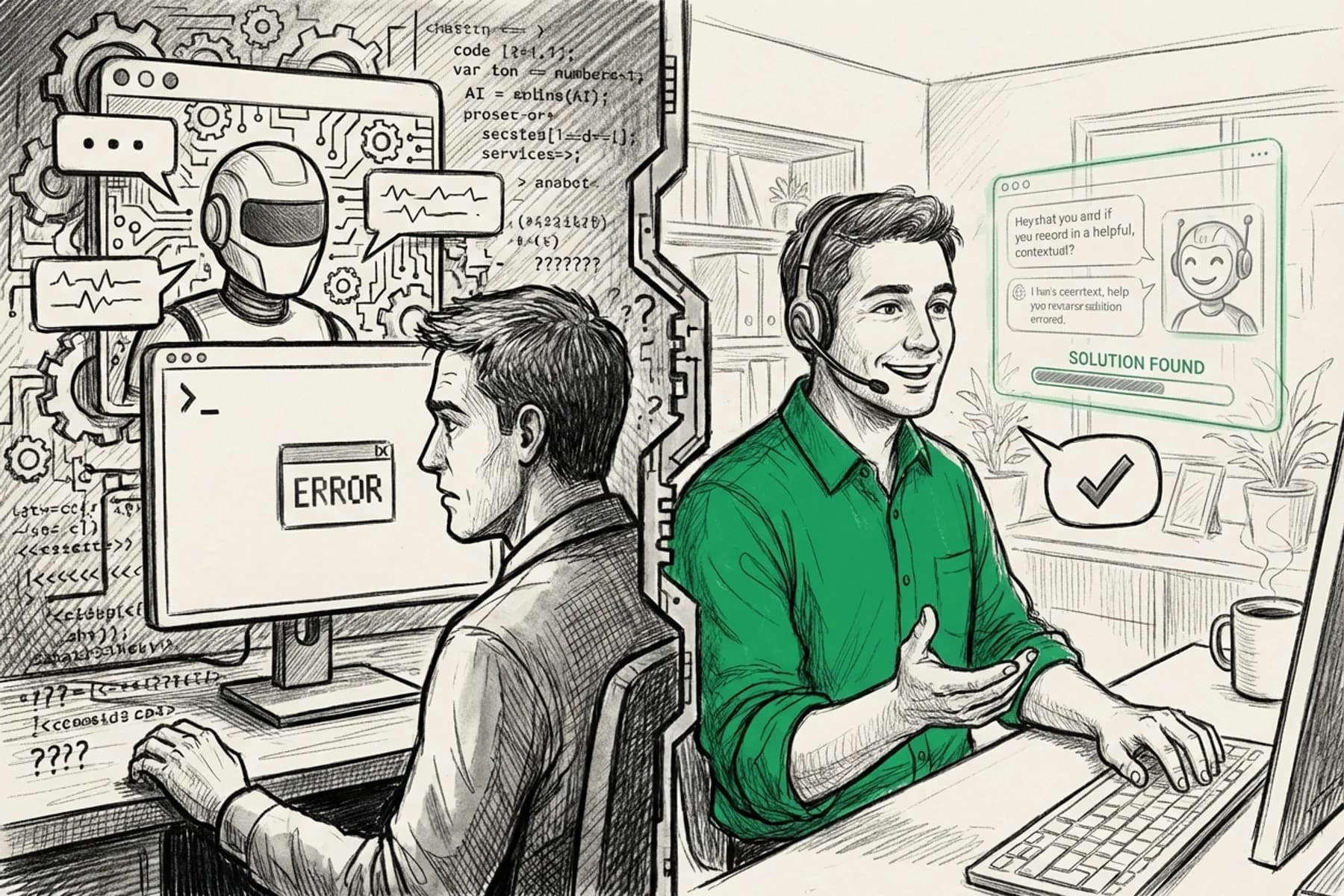
A chatbot just pitched your customer on a $15,000 HVAC replacement. Think they're writing that check?
The AI everything movement missed something crucial. Customers don't buy expensive home services from robots. They buy from humans they trust. The winning play isn't replacing your CSR team. It's making them unstoppable with hybrid AI customer service trades strategy that combines human trust-building with AI precision.
Hybrid AI customer service trades is a model where AI handles routine call response and qualification while human agents take over for complex diagnosis and high-ticket sales conversations with real-time AI coaching support.
The $15K problem: why full-bot AI fails when the stakes are high
Full-bot AI breaks down the moment a customer needs to spend serious money. 88% of customers are more likely to make another purchase after a great service experience. "Great" doesn't mean fast. It means human.
High-ticket buyers need trust. They need to ask questions. They need someone who gets why spending $12K on a new furnace feels scary.
The trust barrier in high-ticket sales
Phone calls generate 10-15 times more revenue than web leads in home services. That's not accident. It's psychology.
When your basement floods, you don't want to text with a bot about water extraction pricing. When your AC dies in July, you need a human who can explain why the $8K system beats the $4K system.
The trust barrier exists because expensive home services are emotional purchases. Nobody wants to replace their roof.
They're also complex decisions. 15-year financing needs discussion. Warranty options require explanation. Brand comparisons demand expertise. All require human judgment.
Finally, they're high-stakes outcomes. Bad plumbing work floods your house.
Bots can't navigate emotion. They can't read hesitation in someone's voice. They definitely can't handle "my wife thinks we should get three more quotes."
Customer psychology on expensive home service purchases
Expensive home repairs trigger loss aversion psychology. Customers aren't excited about spending money. They're scared of making the wrong choice.
A human can acknowledge that fear. "I understand this is a big investment. Let me explain exactly what you're getting for that price." AI can't read the emotional subtext or adapt the approach.
Why automation works for scheduling but fails at selling premium services
AI crushes routine tasks. "When can you come out?" "What are your hours?" "Do you service my area?" Perfect bot territory.
But selling requires finesse. Objection handling. Payment plan negotiations. Reading between the lines when someone says "I need to think about it."
The companies going full-bot on high-ticket sales are bleeding revenue to competitors who kept humans in the loop. Don't damage customer relationships chasing efficiency.
The human-AI trust formula: why hybrid models win
Companies using hybrid AI-human approach saw 20% boost in customer satisfaction scores and 40% increase in agent productivity. The best of both worlds through human AI collaboration customer service.
Trust gets built through exceptions, not rules. When your CSR says "let me check with my manager about that pricing" or "I can have our senior tech call you personally," that's human flexibility a bot can't match.
The psychology of trust in high-stakes purchases
High-stakes buyers test you. They ask edge case questions. They want to know what happens if something goes wrong. AI coaching home services gives your human agents the answers while keeping the human connection.
Pure AI feels scripted. Pure humans are inconsistent. AI-coached humans deliver expertise with empathy.
How AI-coached humans outperform both pure AI and unassisted humans
Pure AI: Fast but robotic. Can't handle complexity.
Pure humans: Warm but inconsistent. Miss objection handling opportunities.
AI-coached humans: Fast, warm, and bulletproof. They get real-time prompts for every objection while maintaining human connection.
Your CSR is on the phone with someone balking at a $18K HVAC quote. AI coaching feeds them the exact script: "I understand that's a significant investment. Let me break down why this system will actually save you money over the next five years..."
Human delivery. AI precision. Customer trusts the person, benefits from the system.
Real-world results from hybrid customer service models
Companies implementing hybrid models report consistent improvements across key metrics. Booking rates increase 20-30% within the first month. Customer satisfaction scores jump because agents handle objections smoothly.
More importantly, customer trust AI automation strategies show that customers prefer AI-enhanced humans over pure bots for complex decisions. The technology makes the human better, not obsolete.
When should home service companies use AI vs humans for customer service?
Use AI for calls under $500 and AI-coached humans for everything above $2K. That's the line where trust beats speed, and hybrid AI customer service trades delivers both efficiency and revenue growth.
AI handles routine maintenance scheduling, basic troubleshooting questions, and appointment confirmations autonomously. Humans with AI coaching handle system installations, major repairs, and emergency services where customer anxiety runs high and purchase decisions require trust-building.
The Tradesly framework: when AI leads vs. when humans take over
How does hybrid AI improve high-ticket sales in trades businesses? Hybrid AI transforms average CSRs into closers by providing real-time guidance during the moments that matter most, resulting in 20-30% higher booking rates and stronger customer relationships on deals over $2,000.
Here's exactly how to structure your call routing for maximum revenue.
Low-value calls: AI autonomous zone
Routine maintenance under $500? Let AI handle it completely:
- Annual tune-ups
- Filter replacements
- Basic drain cleaning
- Scheduling callbacks
These calls don't require trust-building. They require efficiency. AI books them faster than humans and never gets tired of repetitive questions.
High-value calls: AI-coached human zone
Jobs over $2K need human agents with AI coaching support:
- System replacements
- Major repairs
- Emergency services
- Warranty claims
Your CSR sees real-time prompts: "Customer mentioned financing. Offer 0% for 18 months." "They're price shopping. Ask about timeline urgency."
Check out this real-time call scripting case study to see exactly how agents perform with AI guidance.
Emergency situations: human-first with AI support
When someone's basement is flooding, they need immediate human empathy. But AI can still help by:
- Pulling customer history instantly
- Suggesting emergency pricing tiers
- Coordinating dispatch logistics
- Providing step-by-step damage control instructions
The human leads the conversation. AI provides the backbone.
Building customer trust in the AI era: the transparency factor
Customers should know when they're interacting with pure AI vs humans. But they shouldn't feel like they're talking to a robot when a human is involved.
When to reveal AI involvement
Be transparent about AI for routine tasks: "Our AI system can check technician availability and book your appointment right now."
Don't advertise AI coaching during sales calls. The customer experiences excellent human service. Behind the scenes, AI prevents fumbles.
How to position AI as an enhancement tool
Frame AI as making your human team better, not replacing them:
- "Our technicians have access to our entire repair database during your call"
- "We can pull your service history instantly to give you personalized recommendations"
- "Our system ensures consistent pricing across all our locations"
Customers want technology that makes humans more capable. They don't want technology that replaces humans for important decisions.
Managing customer expectations in hybrid interactions
Clear communication about pricing, services, and technician qualifications will become crucial for building customer trust in the AI era.
Set expectations early: "I'm going to check our system for the best options for your specific situation." Customers appreciate when humans leverage technology to serve them better.
Implementation roadmap: from replacement thinking to enhancement strategy
What are the benefits of AI coaching vs full automation in home services? AI coaching preserves customer relationships while fixing human inconsistency, delivering 40% higher agent productivity without sacrificing the trust that drives high-ticket sales.
The sweet spot is obvious once you see it. Use AI where it excels (data, consistency, availability). Use humans where they excel (empathy, judgment, complex problem-solving).
Audit your current call handling gaps
Track where revenue leaks in your current process:
- Missed calls: AI can catch 100% of inbound leads
- Inconsistent pricing: AI coaching ensures uniform quotes
- Poor objection handling: Real-time prompts fix fumbled closes
- Slow follow-up: AI automates the routine, humans focus on the complex
Don't guess about your gaps. Get call center QA with AI to see exactly where calls go wrong.
Start with AI coaching, not AI replacement
Phase 1: Add real-time coaching to your existing team. See booking rates improve 20-30% within 30 days.
Phase 2: Route routine calls to AI while keeping humans on high-value interactions.
Phase 3: Scale the model based on what works for your specific customer base.
The operators who nail this transition will dominate their markets. The ones who go full-bot on everything will watch revenue walk out the door.
Measuring success in hybrid models
Track these metrics:
- Booking rate by call value: High-ticket calls should convert better with coaching
- Customer satisfaction scores: Should increase with hybrid approach
- Average ticket size: AI coaching should drive more upsells
- Call resolution time: Should decrease as AI handles routine inquiries
Quality beats speed in high-ticket trades. Measure accordingly.
The competitive advantage: why hybrid beats both pure AI and pure human
Why do customers trust hybrid AI-human service more than pure automation? Customers trust hybrid models because they get human judgment with AI consistency. Pure automation feels impersonal. Pure human service feels risky. Hybrid feels professional.
Implementation is about enhancing humans, not replacing them. Start with your best CSRs and give them AI superpowers. Then train everyone else to that new standard.
AI customer service empathy coaching shows exactly how this works in practice.
Cost efficiency without trust sacrifice
Hybrid models cut costs while improving satisfaction. AI handles the volume. Humans handle the value.
You're not paying a CSR $20/hour to answer "what are your hours?" You're paying them to close the $15K furnace replacement. AI makes sure they nail it every time.
Scalability that maintains quality
Traditional scaling meant hiring more people and hoping they maintain quality. Hybrid scaling means hiring fewer people and guaranteeing quality through AI coaching.
Your 10th CSR performs like your best CSR from day one. That's the competitive advantage.
Future-proofing your customer service strategy
The companies building trust through hybrid AI-human service will capture market share from competitors stuck in the past or too aggressive with automation.
This home services AI strategy separates winners from losers. Read about offshore replacement vs AI enhancement to understand why enhancement beats replacement every time.
How to implement AI coaching for high-value home service calls?
How to implement AI coaching for high-value home service calls? Start with your existing CSR team and layer AI coaching on top. Train agents to recognize AI prompts, practice objection handling with real-time guidance, and measure booking rate improvements within 30 days.
Don't replace first and ask questions later. Build trust through enhancement, not replacement.
Your competitors are making one of two mistakes. They're either resisting AI completely or replacing humans completely. Both strategies lose.
The winning move is hybrid: AI for efficiency, humans for trust, coaching to connect them.
Stop debating whether to automate your customer service. Start building the system that makes your humans unbeatable.
Ready to see how AI coaching transforms your high-ticket sales calls? Book a demo and watch your booking rates climb without sacrificing customer trust.
Keep reading
 AI Receptionist & Answering
Why AI Receptionists Lose Your $15K HVAC Calls
7 min read AI Receptionist & Answering
The Best HVAC Answering Service: 4 Tiers That Impact ROI
8 min read AI Receptionist & Answering
The Break-Even Point for an AI Receptionist: When Does Automation Pay for Itself in a Home Service Business?
7 min read