5 Ways AI Is Damaging Your Home Service Customers (& How to Fix It)
Your AI is costing you customers. Discover 5 dehumanization traps home service businesses fall into—and the hybrid approaches that actually preserve trust while gaining efficiency.

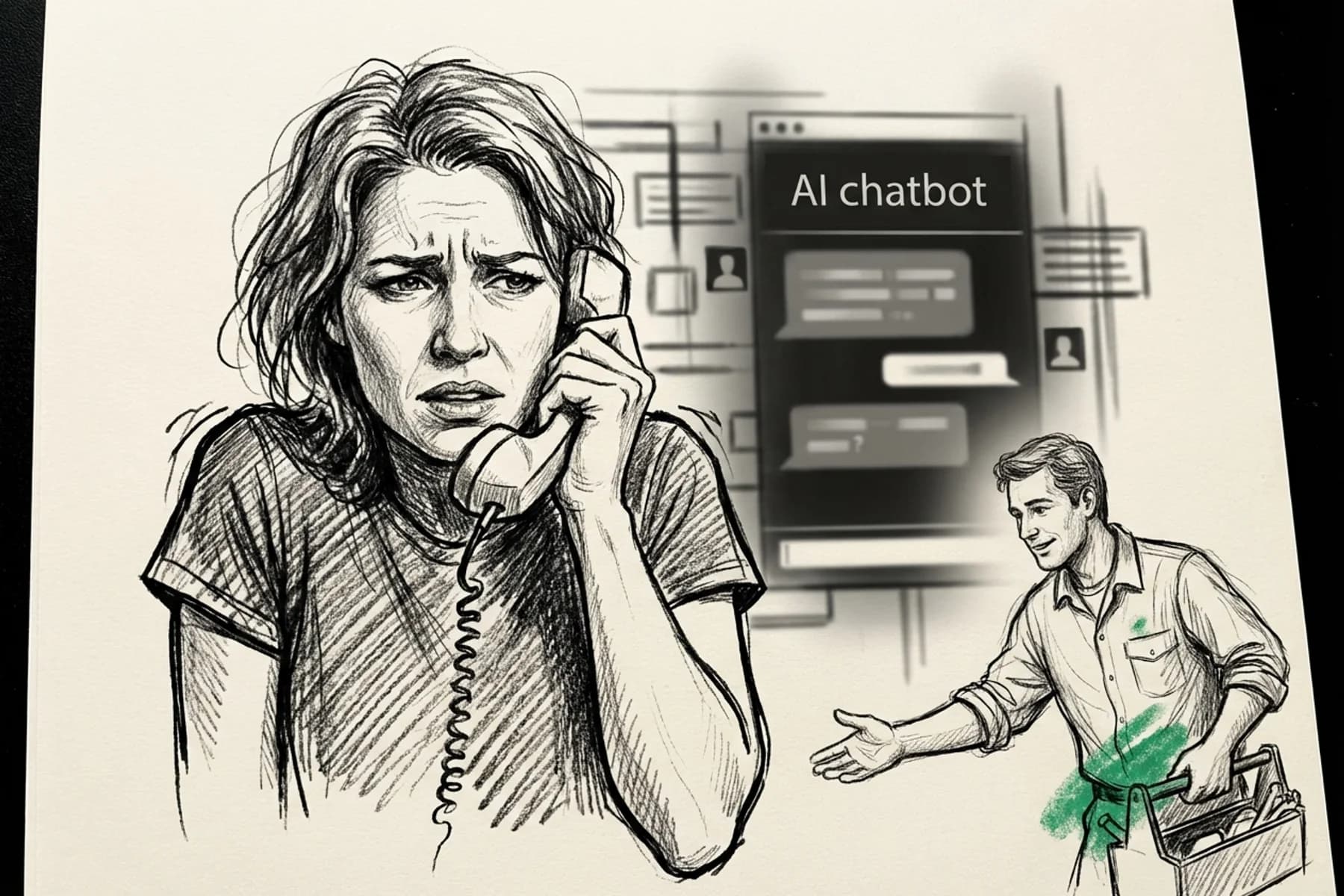
Your AI implementation is hemorrhaging customers. You paid for efficiency but bought customer resentment instead.
The $75 Billion Problem: Why AI Isn't Fixing Customer Service
Here's the brutal reality: US companies still lose $75 billion annually to poor customer service despite massive AI investment. Meanwhile, 79% of Americans strongly prefer interacting with a human over an AI agent.
The problem? Most AI customer service challenges home services because generic automation meets emergency-driven trades where customers need empathy and expertise during vulnerable moments.
Home service emergencies require human judgment that current AI can't replicate. Cost-first implementations create customer experience gaps that destroy trust permanently.
AI Customer Service Challenges in Home Services occur when generic automation meets emergency-driven trades where customers need empathy, expertise, and immediate human judgment during vulnerable moments.
Emergency home service calls aren't just transactions. They're crises. Your AI better know the difference.
1. Emergency calls get the chatbot treatment
Emergency calls need instant human triage, not menu trees. When someone's furnace dies in January, they don't want to explain their problem to a bot that asks if they've tried turning it off and on again.
Your AI can't assess true urgency. It hears "no heat" and treats it like "schedule maintenance." Meanwhile, your customer is calculating hotel costs and questioning why they chose you over the competitor who answers with humans.
The worst part? Emergency misrouting compounds exponentially. A stressed customer who gets bounced through AI menus will never trust your company again. They'll tell everyone.
The Smart Fix: Program emergency keywords that bypass standard AI workflows entirely. "No heat," "flooding," "gas smell," "electrical sparking" trigger immediate human connection.
Your emergency HVAC answering service should recognize crisis language and escalate within 30 seconds.
Key Takeaway: AI efficiency means nothing if it delays emergency response. Build escalation protocols that treat urgency as sacred.
2. Your AI sounds like a corporate robot, not a local expert
Generic AI responses feel cold when customers are vulnerable. Home service customers want local trade experts who understand their specific problems, not customer service representatives reading scripts.
63% of workers expect AI to make the workplace feel less human in 2026 and they're right if you're using off-the-shelf solutions.
Your customers don't want to hear "I understand your frustration" when their water heater exploded. They want to hear "That sounds like a thermal expansion issue. I'm getting our best plumber to you within the hour."
The Smart Fix: Program your AI with trade-specific knowledge and local expertise. Train it to recognize equipment models, common failure patterns, and appropriate urgency levels. Your AI voice control and escalation should sound like it knows HVAC, not customer service theory.
Voice tone matters as much as accuracy. Cold efficiency kills trust. Warm competence builds it.
Key Takeaway: Customers can sense when AI lacks real expertise. Program knowledge, not just politeness.
Why do customers prefer human agents over AI in home services?
Customers prefer human agents because home service emergencies require emotional intelligence, technical expertise, and judgment calls that AI can't replicate. They need someone who understands that "no hot water" means "my family can't function normally."
Home service problems aren't just inconvenient, they disrupt daily life. A broken AC in August isn't a maintenance request; it's a family crisis. Customers need someone who gets the stakes.
AI dehumanization customer service happens when systems can't distinguish between "my toilet is running" (minor annoyance) and "my toilet is overflowing" (active emergency). Humans read between the lines. They hear stress levels, understand implications, make judgment calls.
3. Lost context when customers need continuity most
Poor AI-to-human handoffs create the "start over" problem that customers hate most. Nothing destroys trust faster than making someone repeat their entire story to multiple people.
Complex home service issues require full conversation history, not just call transcripts. When your HVAC system has intermittent issues, the customer needs continuity, not a fresh explanation every time they call.
Only 7% of contact centers offer seamless transitions between channels. That gap costs you customers who give up rather than explain their problem again.
The Smart Fix: Build information transfer systems that pass complete context, not just data. When AI escalates to human agents, it should transfer the customer's emotional state, problem complexity, and attempted solutions, not just transcript snippets.
Your real-time call monitoring should flag when customers are explaining problems they've already described. That's your system failure indicator.
Key Takeaway: Seamless handoffs require emotional context, not just factual data. Transfer understanding, not just information.
What are the biggest mistakes in AI customer service implementation?
The biggest mistake is prioritizing cost reduction over customer experience. Companies implement AI to cut labor costs, then wonder why customer satisfaction plummets and churn increases.
Other critical errors include:
- No emergency escalation protocols, treating all calls as equal priority
- Generic training data, using retail customer service models for trade emergencies
- Poor handoff systems, losing context when transferring to humans
- No feedback loops, failing to track customer sentiment about AI interactions
Success requires designing AI around customer needs, not operational efficiency.
4. Scripted responses during high-stakes moments
High-ticket home service sales need adaptive conversation skills, not rigid scripts. When someone's considering a $8,000 HVAC replacement, they need flexibility and expertise, not chatbot responses.
Customers sense scripted interactions immediately. They lose trust when AI can't adapt to their specific situation or concerns. This is especially deadly during sales conversations where trust directly impacts revenue.
Your $5K+ sales shouldn't run through the same workflow as appointment scheduling. High-stakes moments require human judgment, not automation efficiency.
The Smart Fix: Design AI that recognizes high-value opportunities and escalates appropriately. Train your system to identify buying signals, price discussions, and complex decision-making moments that need human expertise.
Your elite HVAC CSR performance principles should guide when AI steps back and lets humans take over.
Key Takeaway: High-stakes conversations need human adaptability. AI should recognize its limitations and escalate strategically.
How can home service businesses implement AI without losing customer trust?
Implement AI as an augmentation tool, not a replacement system. The best customer service AI best practices trades focus on enhancing human agents instead of replacing them entirely, preserving empathy while gaining efficiency.
Focus on hybrid models that use AI for initial response, basic qualification, and information gathering, then seamlessly transfer to humans for complex problems, emergency situations, and high-value sales conversations.
Success metrics should include customer satisfaction scores, not just cost reduction. If your AI implementation decreases operational costs but increases customer complaints, you're failing.
5. The data black hole: No feedback loop for improvement
Most AI implementations lack proper feedback mechanisms to identify when automation damages customer relationships. Companies track efficiency metrics but ignore sentiment data that reveals AI dehumanization patterns.
Only 25% of call centers have successfully integrated AI automation into their daily operations, largely because they're flying blind without customer experience analytics.
Customer complaints about AI interactions often go untracked. You're measuring call resolution time while missing customer frustration signals that predict churn.
The Smart Fix: Build continuous improvement systems that monitor customer sentiment, not just operational efficiency. Track when customers express frustration with AI interactions, request human agents, or abandon calls entirely.
Your AI call quality analysis should flag dehumanization patterns before they become customer retention problems.
Key Takeaway: AI without customer feedback data is blind automation. Measure customer experience, not just efficiency metrics.
How do you balance AI efficiency with human empathy in customer service?
Balance comes from strategic deployment, using AI for tasks it excels at while preserving human connection for moments that matter most. AI handles routine inquiries, scheduling, and basic information gathering. Humans handle emergencies, complex problems, and relationship-building.
Finding the right balance between automation and human interaction will be critical for customer service success in 2026 and beyond.
The goal isn't cost reduction. It's customer experience enhancement through intelligent automation.
The fix: Hybrid intelligence that actually works
The best AI doesn't replace humans, it makes them superhuman. Smart home service businesses use AI to handle routine tasks while empowering human agents with real-time coaching, conversation context, and expert knowledge systems.
Your AI-powered agent coaching should eliminate performance inconsistencies without eliminating the human touch that emergency situations require.
Hybrid AI customer service model preserves empathy while gaining efficiency. It uses AI for initial response and qualification, then seamlessly transitions to humans for complex problems, emergency situations, and high-value sales opportunities.
Success metrics should include customer satisfaction, not just cost reduction. If your AI implementation decreases operational costs but increases customer complaints, you're failing.
The companies winning with AI aren't cutting labor costs. They're multiplying human capability. They're using technology to make every CSR perform like their best CSR, consistently.
Stop guessing about AI implementation
Your customers' trust is worth more than operational efficiency savings. Implement AI that enhances human capability instead of replacing human judgment.
The future of home service customer service isn't human OR AI. It's human AND AI working together intelligently.
Ready to see how hybrid intelligence actually works? Get the demo and discover why the best home service companies are using AI to make humans superhuman, not obsolete.
Keep reading
 AI Receptionist & Answering
Why AI Receptionists Lose Your $15K HVAC Calls
7 min read AI Receptionist & Answering
The Best HVAC Answering Service: 4 Tiers That Impact ROI
8 min read AI Receptionist & Answering
The Break-Even Point for an AI Receptionist: When Does Automation Pay for Itself in a Home Service Business?
7 min read