Empathy Engines: How AI Coaching Builds Unbreakable Customer Trust
AI and empathy aren't mutually exclusive. Learn how empathy-driven AI coaching makes every agent perform like your best closer—and why 79% of customers demand it. See the playbook.

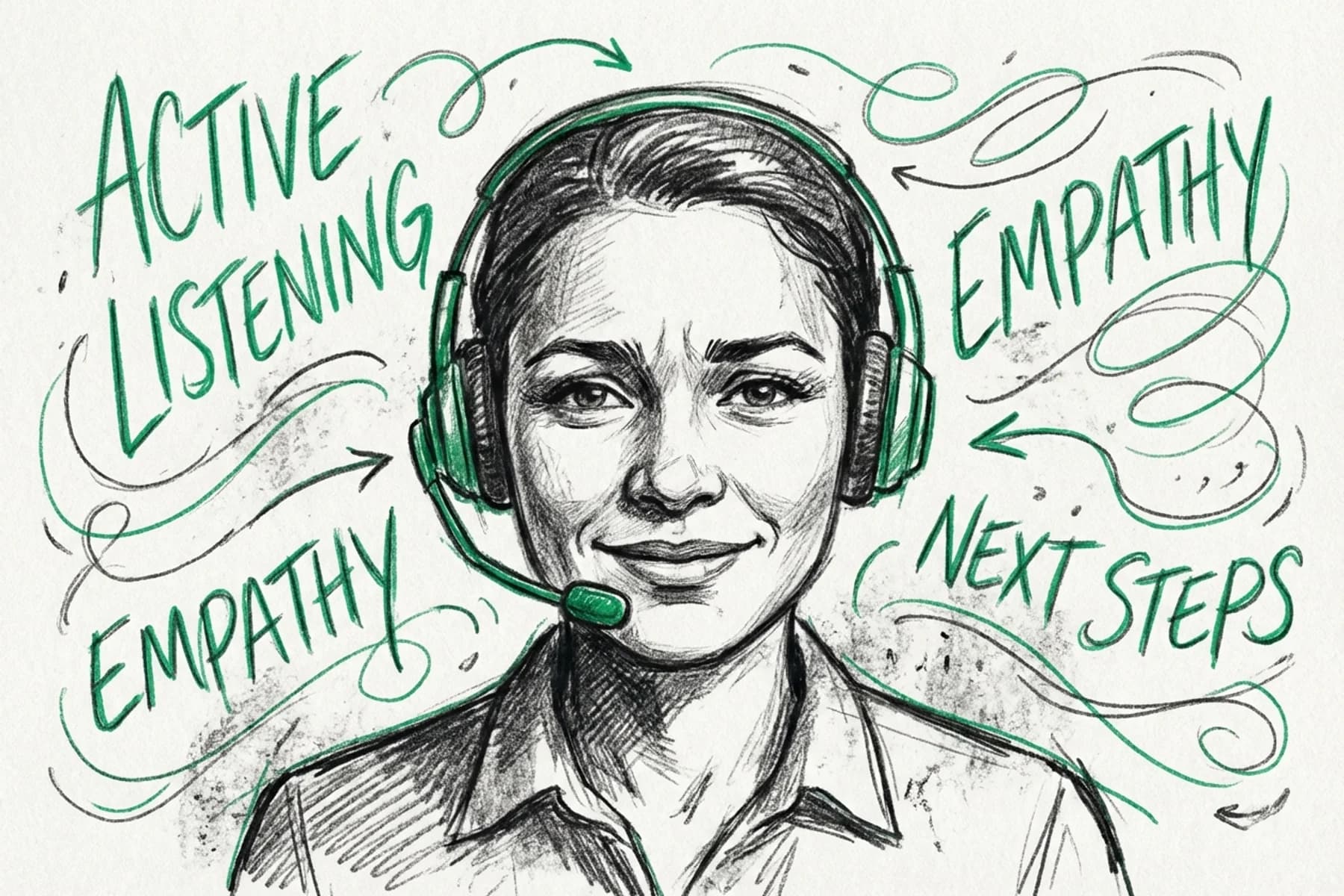

The customer service AI revolution got it wrong: it tried to replace human empathy instead of amplifying it. The result? 79% of Americans still prefer human interaction over AI agents, and companies are hemorrhaging trust faster than they can deploy chatbots.
The empathy gap in customer service isn't solved by choosing humans over AI. It's solved by designing AI systems that make every human agent perform like your most emotionally intelligent closer.
Empathy-driven AI customer service is a hybrid model where AI analyzes customer emotional states in real-time and coaches human agents on the most empathetic responses, creating consistently high-trust interactions at scale.
The empathy crisis hiding behind AI adoption stats
While everyone's celebrating AI deployment numbers, customers are quietly walking away. 68% of customers expect empathy from companies, yet most AI implementations strip emotional intelligence right out of the interaction.
The damage is real. Companies lose $75 billion annually due to poor customer service despite massive AI investment. That's not a technology problem. It's an empathy problem.
The shocking trust gap in 2026
The uncomfortable truth most AI vendors won't tell you: customers can spot emotionally tone-deaf service in seconds. They're not rejecting AI because it's artificial. They're rejecting it because it feels indifferent.
Your offshore team isn't failing because they lack technical skills. They're failing because they can't read between the lines of a frustrated homeowner whose HVAC died on Christmas morning. Standard scripts don't work when someone's basement is flooded at 2 AM.
Why traditional AI implementations fail the empathy test
Most customer service AI is built like a efficiency machine: faster response times, lower costs, higher call volume. But empathy doesn't scale through speed.
It scales through understanding. Traditional AI treats every interaction like a transaction. It misses the stress signals, the urgency cues, the emotional context that separates a routine service call from a family emergency. The result? Customers feel processed, not helped.
The hidden cost of emotionally tone-deaf customer service
Every botched empathy moment costs you twice: once when the customer leaves, again when they tell their neighbors about the experience. In home services, reputation damage spreads through communities like wildfire.
The companies getting this wrong are learning about AI automation mistakes the hard way through lost customers and damaged reviews.
What are empathy engines in AI customer service?
Empathy engines in AI customer service are hybrid systems that analyze customer emotional states in real-time and coach human agents on empathetic responses, combining AI pattern recognition with human emotional delivery for consistent trust-building at scale. Unlike traditional AI that focuses on efficiency, empathy engines prioritize emotional intelligence.
An empathy engine doesn't replace human emotional intelligence. It enhances it. The system analyzes voice tone, word choice, and conversation patterns to identify customer emotional states, then coaches agents in real-time on the most appropriate empathetic response.
This isn't about programming fake empathy. It's about giving every agent—especially offshore teams—the emotional intelligence framework of your best closers. 51% of employees preferred hybrid AI-plus-human coaching models over pure AI or pure human approaches.
The anatomy of empathy-aware AI systems
True empathy-driven AI operates on four levels: recognition, coaching, adaptation, and learning. It spots emotional cues customers broadcast (frustration, urgency, confusion), suggests empathetic language patterns, adapts based on customer response, and learns from high-trust interactions.
The key difference? Instead of following rigid scripts, agents get contextual guidance that matches the customer's emotional state. Frustrated customer gets validation and reassurance. Confused customer gets clarity and patience. Emergency caller gets urgency and action.
How AI coaching enhances human emotional intelligence
The best empathy engines don't just coach responses. They teach pattern recognition. Agents start recognizing emotional cues they previously missed. They develop empathy muscles they didn't know they had.
This is especially powerful for offshore teams who may struggle with cultural or language barriers that mask customer emotions. The AI becomes an emotional intelligence translator, helping agents connect authentically across cultural gaps.
Real-time empathy cues that transform interactions
The magic happens in the micro-moments. Customer says "I guess it's fine" in a dejected tone? AI coaches the agent to probe deeper: "You don't sound completely satisfied. What else can I help with?"
Customer uses urgent language? System suggests acknowledging the stress: "I can hear this is causing you real worry. Let's get this handled immediately." These small pivots turn transactional calls into trust-building conversations.
Combined with proven AI CSR training methods, this creates the foundation for the birth of the 10x CSR—agents who consistently build trust at scale.
The four pillars of empathy-driven AI customer journeys
Empathy-driven AI customer journeys work through four pillars that address specific components of trust-building traditional customer service AI misses. Each pillar builds on emotional recognition, context-aware personalization, seamless human escalation, and continuous optimization.
Pillar 1: Emotional recognition and response coaching
The first pillar analyzes vocal patterns, word choice, and conversation context to identify customer emotional states. Is the customer frustrated? Confused? Urgent? Worried about cost?
Once identified, the system coaches agents on appropriate empathetic responses. Not scripted responses—contextual guidance. "This customer is showing cost anxiety. Acknowledge their concern about budget before discussing price."
The AI doesn't make the agent fake empathy. It helps them recognize emotional cues they might miss and respond authentically to what the customer actually needs.
Pillar 2: Context-aware personalization
True empathy requires context. A repeat customer calling about the same issue needs a different approach than a first-time caller. Someone calling during a holiday weekend emergency has different emotional needs than someone scheduling routine maintenance.
The system layers customer history, call timing, service type, and emotional state. It guides personalized responses based on this comprehensive context. It remembers that Mrs. Johnson always worries about her elderly mother during service calls. Or that the Hendersons had a bad experience with a previous contractor.
Pillar 3: Seamless human escalation
The crucial piece most AI systems botch: knowing when to step aside. 89% believe companies should always offer the option to speak with a human, and the ability to switch easily to a human is the top driver of trust.
Smart escalation maintains emotional continuity. When AI hands off to a human, it transfers the emotional context: "Customer is frustrated about previous no-show. Needs reassurance about reliability."
Advanced systems like AI call escalation and voice control make this handoff feel natural, not jarring.
Pillar 4: Continuous empathy optimization
The system learns from high-trust interactions. Which empathetic responses led to customer satisfaction? Which agents consistently build rapport? What emotional recognition patterns prove most accurate?
This creates a feedback loop where the AI gets better at coaching empathy over time. It's not static programming—it's dynamic learning that improves with every emotionally intelligent interaction.
Can AI actually improve empathy in customer interactions?
Yes, AI significantly improves empathy in customer interactions by amplifying and guiding existing human emotional intelligence. The goal isn't to make machines empathetic. It's to make every human agent as emotionally intelligent as your best closer.
Step 1: Audit your current empathy gaps
Start with brutal honesty. Record calls and identify empathy failures. Where do agents miss emotional cues? When do conversations feel transactional instead of helpful? What customer emotions consistently go unrecognized?
Look specifically at cultural gaps in offshore teams. Are agents struggling to read American customer emotional patterns? Missing urgency signals? Not recognizing when someone needs reassurance versus information?
Step 2: Design empathy-aware conversation flows
Traditional scripts optimize for efficiency. Empathy-aware flows optimize for emotional connection first, efficiency second.
Build decision trees that branch based on emotional state, not just service type. Create response templates for different emotional contexts.
Frustrated customer path: validate, apologize, action plan. Confused customer path: clarify, educate, confirm understanding. Urgent customer path: acknowledge urgency, immediate action, follow-up commitment.
Use proven frameworks from call center scripts but add emotional intelligence layers on top.
Step 3: Train your AI coaching system
Feed the system examples of high-empathy interactions. Let it learn the patterns of agents who consistently build trust. What language do they use with frustrated customers? How do they handle cost objections empathetically?
65% of AI-enabled agents say they now have more time to build real relationships. That's because AI handles the emotional intelligence coaching, freeing agents to focus on authentic connection.
Step 4: Monitor and optimize for trust metrics
Traditional metrics miss the empathy component. Track trust-building indicators: customer sentiment scores, repeat contact rates, referral generation, review mentions of "caring" or "understanding."
Use call QA with AI insights to identify empathy wins and losses. Which coached responses built trust? Which emotional recognition patterns proved most accurate?
What is the difference between AI empathy and human empathy in customer service?
Human empathy is intuitive and authentic but inconsistent. AI empathy is coached and systematic but requires human execution. The magic happens when you combine both: consistent emotional intelligence framework delivered through authentic human connection.
Beyond CSAT: Trust-building KPIs
Stop measuring empathy with generic satisfaction scores. Track specific trust indicators: did the customer feel heard, understood, valued? Did they express confidence in your company? Would they recommend you to family?
Monitor empathy-specific language in reviews and feedback. Customers mention feeling "cared for," "understood," or "valued" when empathy lands correctly. They use words like "professional" or "efficient" when it doesn't.
How empathy impacts customer lifetime value
Empathetic service creates emotional attachment, not just satisfaction. Attached customers call you first, recommend you freely, and forgive occasional mistakes. They become assets, not just accounts.
Measure the downstream effects: referral rates from empathy-coached interactions, repeat business patterns, price sensitivity changes. High-empathy customers typically show 20-30% higher lifetime value.
ROI calculation for empathy investments
Calculate empathy ROI through trust premium: how much more will customers pay for emotionally intelligent service? How much does customer retention improve? What's the referral value of trust-building interactions?
Track these metrics alongside traditional efficiency measures. Use frameworks from revenue metrics that actually matter to build the business case for empathy investment.
How do you build customer trust with AI-powered customer service?
Trust builds through consistency, transparency, and emotional intelligence. AI-powered customer service builds trust by making every interaction feel human-centered, not system-centered. The customer should feel like they're talking to someone who cares, not something that processes.
Why empathy is becoming a competitive differentiator
As AI handles more routine interactions, human emotional intelligence becomes the scarce resource. Companies that master empathy-driven AI will dominate their markets because they'll be the only ones customers actually trust.
Trust becomes the main driver of engagement by 2026. Technical competence is table stakes now. Emotional intelligence is the differentiator.
How to stay ahead of the empathy curve
Start building empathy capabilities before your competitors figure it out. Train your teams on emotional intelligence fundamentals. Implement AI coaching systems that prioritize trust-building over efficiency metrics.
Invest in understanding your customers' emotional journeys, not just their service needs. Map the stress points, confusion moments, and trust gaps in your current process.
Building empathy into your company culture
Empathy can't be a department. It has to be a discipline. Hire for emotional intelligence. Coach for authentic care. Measure for trust-building, not just problem-solving.
Create empathy success stories. Celebrate agents who build trust, not just those who close fast. Share customer feedback that mentions feeling cared for or understood. Make empathy visible and valued.
Consider implementing future-proof CSR strategy approaches that prioritize emotional intelligence development alongside technical skills.
Stop choosing between AI and empathy
The empathy versus efficiency debate is a false choice. The companies winning in 2026 aren't choosing between AI and human empathy. They're using AI to make their humans more empathetic, more consistently.
Your offshore team doesn't lack empathy. They lack the emotional intelligence framework to recognize and respond to American customer emotional patterns consistently. AI coaching solves that gap.
The future belongs to companies that build empathy engines: AI systems designed to amplify human emotional intelligence, not replace it. Systems that make every agent perform like your most trusted closer.
Ready to build your empathy engine? Stop guessing about customer emotions. Get the demo and see how AI coaching can make every interaction feel genuinely human.
Keep reading
 AI Receptionist & Answering
Why AI Receptionists Lose Your $15K HVAC Calls
7 min read AI Receptionist & Answering
The Best HVAC Answering Service: 4 Tiers That Impact ROI
8 min read AI Receptionist & Answering
The Break-Even Point for an AI Receptionist: When Does Automation Pay for Itself in a Home Service Business?
7 min read