


AI Disclosure Laws for Home Services: State-by-State Compliance 2026
Stop guessing about AI disclosure laws. Get state-by-state compliance requirements, copy-paste disclosure scripts, and a 30-day action plan to deploy AI legally without losing leads.

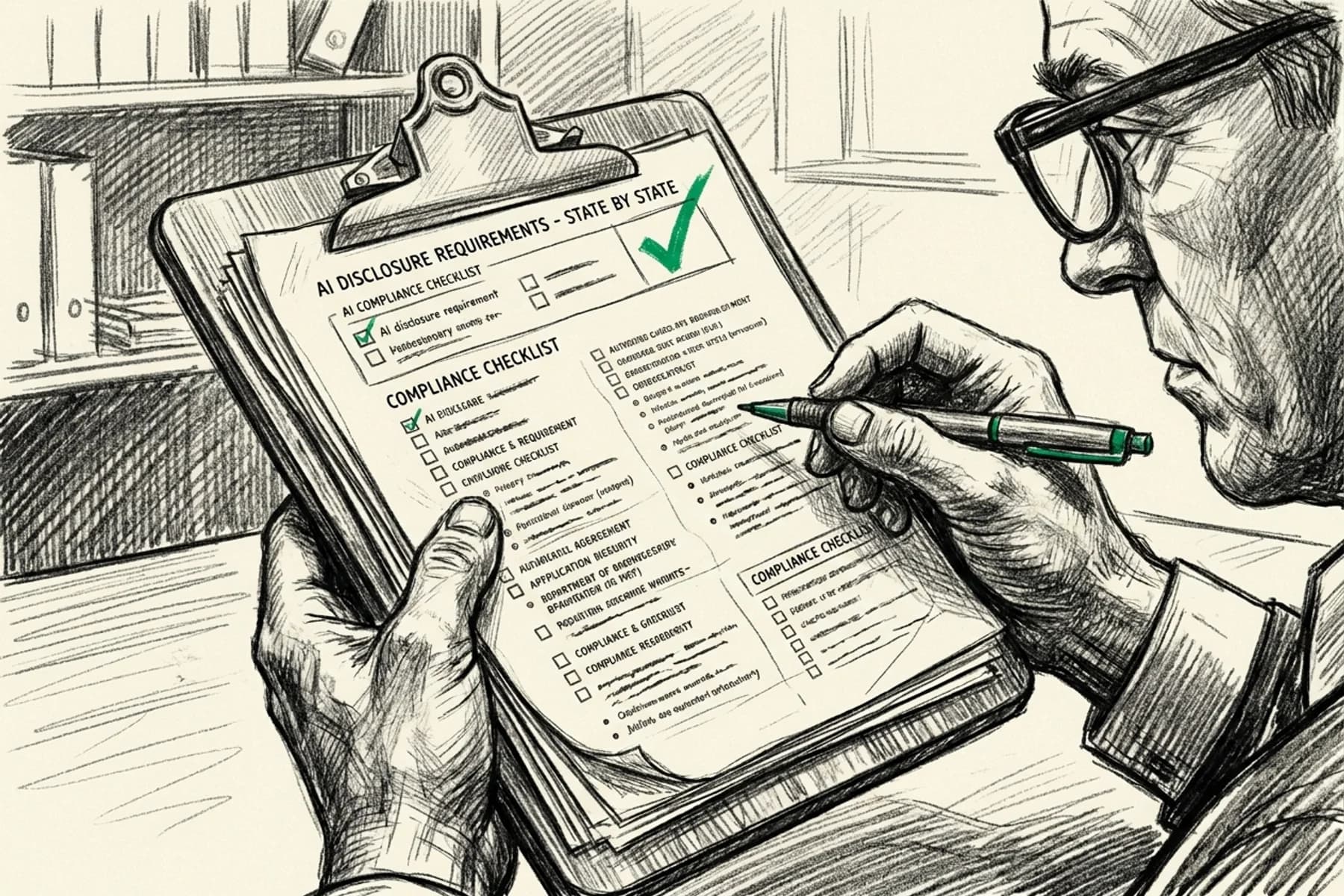
AI disclosure laws home services face in 2026 aren't suggestions. They're legal requirements with real penalties. Most home service operators think they're just "answering phones," but if you're using AI voice agents or SMS automation, you're subject to state disclosure laws that can cost $500 to $1,500 per violation.
Here's what I've learned from working with dozens of operators navigating this compliance maze: the confusion isn't about whether you need to disclose AI. It's about knowing exactly what to say, when to say it, and which state rules apply to your business.
AI Disclosure Laws for Home Services are state-specific regulations requiring businesses to clearly inform customers when they're interacting with artificial intelligence systems during voice calls, SMS messages, or other automated communications.
What AI disclosure laws apply to home service businesses in 2026?
Home service businesses using AI voice agents or SMS systems must comply with state-specific disclosure laws that went into high enforcement mode in 2026. Colorado leads with the most comprehensive AI Act, while California, Illinois, Washington, and Utah have overlapping requirements that create compliance complexity.
The reality check: 2026 marks a major shift in enforcement. States aren't just passing these laws anymore. They're actively penalizing violations. Your AI voice agents for 24/7 lead capture trigger disclosure requirements in most states, even for routine inbound calls.
Here's the misconception killing operators: "We're just answering phones, not marketing." Wrong. If AI interacts with customers in any capacity, booking, qualifying, transferring calls, disclosure laws apply. Colorado has the most comprehensive state AI law with the Colorado AI Act, effective 2026, setting the standard other states follow.
The penalty reality hits fast. At $500 to $1,500 per violation, a busy HVAC shop handling 50 AI-assisted calls daily could face $25,000 to $75,000 in penalties per day if non-compliant. That's not theoretical. It's happening.
The 2026 enforcement landscape: Why this matters now
State regulators shifted from education to enforcement. They're not sending warning letters anymore. They're issuing fines. The trigger? Customer complaints about undisclosed AI interactions. Often from competitors or disgruntled employees who know the system.
Common misconception: 'We're just answering phones, not marketing'
Inbound calls don't exempt you from disclosure requirements. If your AI system qualifies leads, books appointments, or collects customer information, you're subject to the same disclosure rules as outbound marketing systems. Emergency calls to home service companies still count.
Do I need to disclose AI for inbound customer service calls?
Yes, most states require AI disclosure for any customer-facing AI system, including inbound customer service calls. The disclosure must happen within the first few seconds of interaction, before any substantial conversation or data collection begins.
Here are the state-by-state requirements that actually matter for home services operators:
High-impact states: Colorado, California, Illinois requirements
Colorado AI Act: Requires disclosure for "high-risk" AI systems affecting consequential decisions. Booking emergency repairs or qualifying customers for financing counts as consequential. Disclosure must be "clear and prominent."
California: Multiple overlapping laws create compliance layers. The California Consumer Privacy Act affects AI systems collecting personal data. SB-1001 requires chatbot disclosure. Nearly all new state laws require chatbots to make clear, up-front disclosures that users are interacting with an AI system.
Illinois: Biometric Information Privacy Act affects voice AI systems that analyze vocal patterns for sentiment or identification. If your AI "listens" to determine customer mood or urgency, disclosure is mandatory.
Emerging requirements: Washington, Utah, Texas updates
Washington and Utah passed specific chatbot disclosure requirements. Texas updated its regulations to include voice AI systems. AI chatbot safety requirements across 20+ states are converging around disclosure notices.
Best practice I recommend to all operators: Build to the strictest state standard if you operate nationwide. Colorado's requirements cover most other states' rules.
What specific language must I use to disclose AI in customer calls?
AI disclosure language must be clear, unambiguous, and delivered within the first 5-10 seconds of customer interaction. Avoid vague terms like "virtual assistant" or "automated system." State "You're speaking with an AI assistant" or "This call is handled by artificial intelligence."
Here are the copy-paste templates I've tested with operators across different trades:
Inbound call disclosure scripts for AI receptionists
HVAC/Emergency Service:
"Hi, you've reached [Company Name]. You're speaking with an AI assistant. I can help schedule service, provide pricing, or connect you with our team. How can I help you today?"
Routine Maintenance/Non-Emergency:
"Thank you for calling [Company Name]. This is an AI assistant. I can book your appointment, answer pricing questions, or transfer you to a technician. What brings you in today?"
After-Hours Coverage:
"You've reached [Company Name] after hours. You're speaking with our AI assistant. I can schedule emergency service or take a message for first thing tomorrow. Is this an emergency?"
Warm transfer language when moving to human agents
When your AI hands off to a human, preserve the compliance context. Your AI voice agent warm transfers need this language:
"I'm connecting you with [Name], one of our specialists. They have your information from our conversation. One moment please."
Critical detail: AI identification requires clear language and logging the timestamp of disclosure. Document when disclosure happens in every call.
Emergency vs. routine call disclosure variations
Emergency calls present unique challenges. Some states allow delayed disclosure if immediate safety response is required. However, most operators I work with find it cleaner to disclose upfront, then immediately triage for emergency status.
What are the penalties for not disclosing AI voice agents to customers?
Penalties for non-disclosure range from $500 to $1,500 per violation in most states, with California and Colorado imposing the highest fines. A single day of undisclosed AI interactions can generate dozens of violations, resulting in five-figure penalty assessments.
Here's where SMS AI compliance gets tricky. AI-generated messages fall under TCPA rules plus new state requirements.
AI-generated SMS consent requirements
Every AI SMS message needs prior express written consent. This isn't new, but enforcement ramped up significantly. The same consent and disclosure requirements apply to AI-generated or AI-assisted messages as to conventional automated messages.
The game-changer: FCC's one-to-one consent rule, effective January 27, 2026, requires businesses to obtain explicit, individual consent. Shared consent from lead gen companies won't protect you anymore.
One-to-one consent rule changes (2026)
January 2026 eliminated consent loopholes. Each customer must individually consent to SMS from your specific business. Lead aggregators can't bundle consent anymore. Your AI SMS system needs to verify individual consent before sending any automated messages.
Opt-out mechanisms for AI SMS systems
Every AI-generated SMS must include clear opt-out instructions. "Reply STOP to opt out" isn't enough anymore. Include your business name and the AI disclosure: "This message sent by AI from [Company Name]. Reply STOP to opt out."
How do state AI disclosure laws differ from federal TCPA requirements?
State AI disclosure laws layer on top of federal TCPA requirements, creating dual compliance obligations. TCPA governs consent and automation. State laws add AI-specific disclosure requirements. You must satisfy both for complete compliance.
Your 30-day compliance action plan breaks down like this:
Week 1: State law audit and gap analysis
- Identify which states your customers call from
- Map current AI systems to applicable disclosure requirements
- Document gaps in current compliance approach
- Assess penalty exposure based on call volume
Week 2-3: Disclosure language implementation
- Update AI voice scripts with compliant disclosure language
- Modify SMS templates to include AI identification
- Test disclosure timing in actual call flows
- Train staff on new compliance procedures
Week 4: Testing and documentation setup
- Record sample calls to verify disclosure compliance
- Set up audit logs for disclosure delivery
- Create monitoring procedures for ongoing compliance
- Document training completion for all staff
The CSR training for AI coaching systems aspect is critical. Your human agents need to understand compliance requirements for both AI handoffs and hybrid AI customer service approach scenarios.
How does Tradesly simplify AI disclosure compliance for home services?
Tradesly automatically handles AI disclosure requirements for both voice agents and SMS, eliminating compliance complexity while maintaining detailed audit trails. Our hybrid approach means compliance is built into both AI-only interactions and human-coached calls without managing separate disclosure systems.
Here's what makes compliance simpler with our system:
Built-in disclosure management for AI and human interactions
Tradesly's AI voice agents deliver state-appropriate disclosure language automatically. When calls transfer to human agents with AI coaching, the compliance context carries forward. No manual script management. No missed disclosures.
Automatic compliance documentation and audit trails
Every interaction logs disclosure delivery with timestamps. Your audit trail builds automatically. When regulators ask for compliance documentation, you have detailed records of every disclosure delivered.
State-aware disclosure customization
The platform recognizes caller location and delivers appropriate disclosure language for that state's requirements. Colorado callers get Colorado-compliant disclosures. California callers get California-compliant language. Nationwide operations stay compliant without managing multiple systems.
Ready to deploy AI systems with built-in compliance? Book a Tradesly demo to see how our hybrid approach eliminates compliance complexity while capturing more revenue.
Common AI disclosure questions for home services
Do I need AI disclosure for existing customers? Yes, in most states. Existing customer relationships don't exempt you from AI disclosure requirements. Every AI interaction requires disclosure.
Can I use vague terms like 'virtual assistant'? No, disclosure must be clear and unambiguous. Use "AI assistant" or "artificial intelligence" explicitly. Avoid euphemisms.
How does emergency call handling affect disclosure? Most states allow immediate disclosure followed by emergency triage. Don't delay disclosure unless life safety is immediately at risk.
What if my AI only handles scheduling? Still requires disclosure. Any AI interaction with customers, regardless of complexity, triggers disclosure requirements.
How often do I need to update compliance language? Monitor quarterly for new state requirements. Subscribe to regulatory update services or work with compliance-focused platforms that handle updates automatically.
The bottom line: AI disclosure compliance isn't optional anymore. Get ahead of enforcement before penalties hit your bottom line. The operators who build compliance into their AI systems now avoid the scramble when regulators come calling.
Keep reading
 Compliance & Industry Insights
California AB 2905: Why AI Disclosure Is Killing Your Bookings
7 min read Compliance & Industry Insights
When Your AI Agent Makes a Mistake: Understanding Liability for Autonomous Call Handling in Home Services
7 min read Marketing & Lead Gen
Google Ads Call Tracking for Home Services: The Step-by-Step Setup Guide
14 min read