

The ServiceTitan Report That Shows Your CSRs Are Bleeding Revenue (And How to Fix It)
ServiceTitan shows your CSRs are bleeding revenue, but retrospective data can't fix real-time problems. Get the 5 reports + coaching framework.

The ServiceTitan Reports That Expose Your Call Center's $500K Revenue Leak
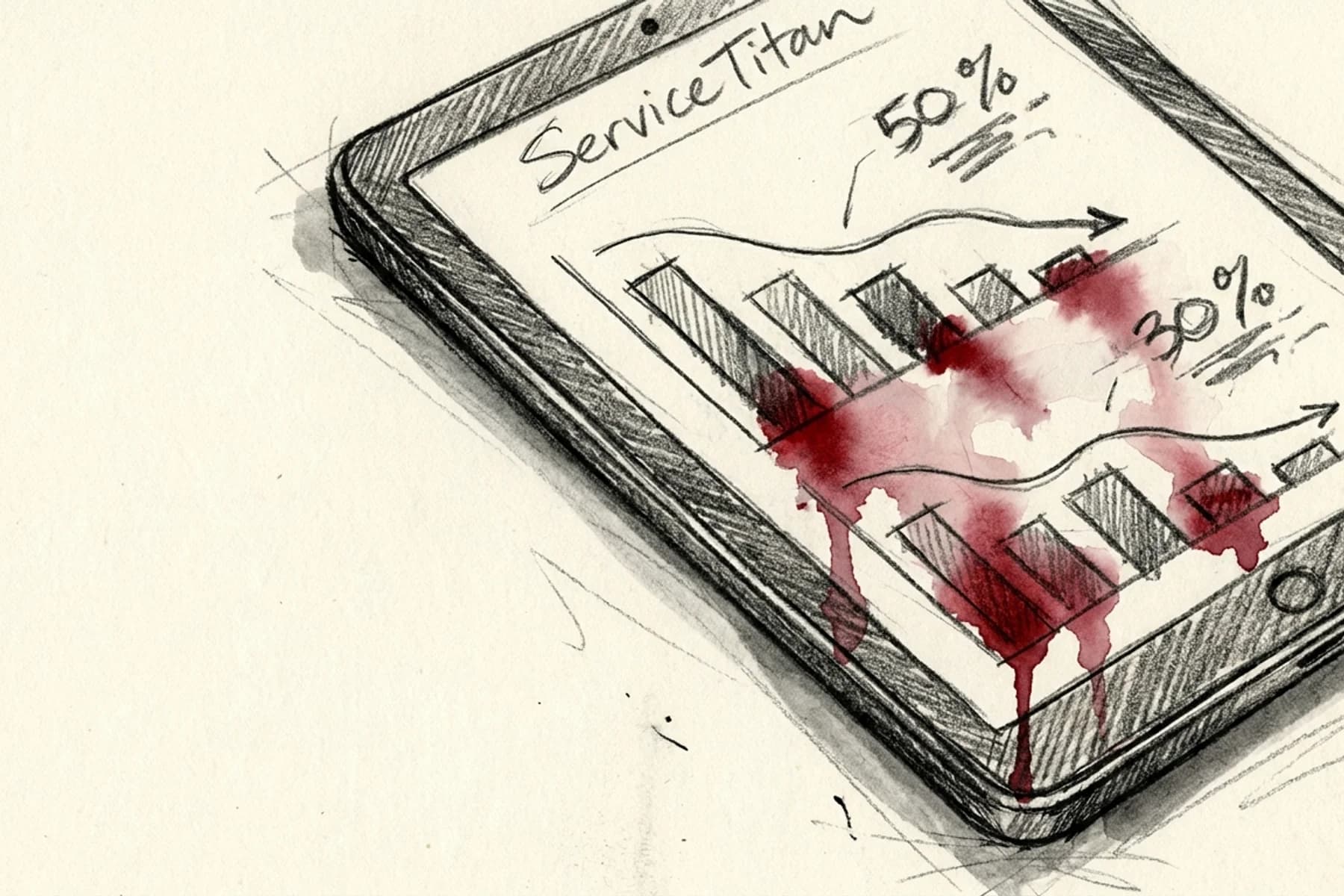
Your ServiceTitan dashboard is screaming at you. That booking rate report shows 42% conversion while your competitor down the street runs at 90%. The revenue gap? About $500K annually for a typical five-tech shop.
Here's the problem: ServiceTitan reporting shows you exactly where your CSRs are bleeding revenue, but looking at last month's data won't fix tomorrow's missed opportunities. You need real-time coaching to turn those ServiceTitan insights into immediate performance improvements.
The $500K problem hiding in your ServiceTitan reporting dashboard
ServiceTitan's own data reveals that the average shop books only 42% of calls while elite shops hit 90%. For a five-tech HVAC operation, that performance gap represents over $500K in lost annual revenue. Yet most operators run these reports wrong, focusing on vanity metrics instead of actionable insights.
I've watched shops celebrate "high call volume" while their CSRs fumble half the opportunities. Volume doesn't pay the bills. Booking rate does.
LZL Home Services Performance Group found that the home services industry loses approximately 30% of potential revenue through mishandled phone interactions. ServiceTitan captures every detail of this failure, but retrospective analysis can't coach a CSR through a live objection.
The performance gap gets worse during peak season. Your reports show declining booking rates precisely when leads cost the most. That's when inadequate training breaks down under pressure.
Your cost per booked job calculator reveals the real damage. If you're paying $200 per lead and booking at 42%, your actual cost per booked job is $476. Competitors booking at 75% pay $267. Same leads, different results.
What ServiceTitan reporting shows CSR booking rate performance?
Five ServiceTitan reports expose exactly where your revenue is leaking. Individual CSR booking rates can range from 15% to 35% within the same call center. Marketing source conversion reveals which lead types need specialized training. Handle time correlation shows if CSRs are rushing or providing proper service according to ServiceTitan best practices.
ServiceTitan reporting provides comprehensive data on call booking performance, CSR individual metrics, and revenue conversion tracking that helps operators identify specific performance gaps and coaching opportunities.
Call Booking Rate by CSR: Navigate to Performance → CSR Scorecards. This report breaks down individual booking performance. Profitability Partners data shows your top CSR might book 25 to 35 percent of total calls as revenue opportunities while your bottom performer books at 15 percent or less.
Call Conversion by Marketing Source: Access through Marketing Pro → Campaign Performance. Different lead sources require different approaches. Angi leads behave differently than Google Ads leads. Your CSRs need source-specific training.
Average Handle Time vs. Booking Success: Found in Call Management → Performance Analytics. CSRs who rush calls to improve handle time often sacrifice booking rate. The sweet spot balances efficiency with thorough qualification.
Peak Hour Missed Call Analysis: Located in Call Management → Missed Calls by Time. Shows exactly when understaffing costs revenue. Most shops lose money between 6-9 AM and 4-7 PM when homeowners call before and after work.
Follow-Up Success Tracking: Performance → Follow-Up Activity. Reveals which CSRs excel at callbacks and estimate recovery. Poor follow-up compounds initial booking failures.
We've seen shops discover 20-percentage-point spreads between their best and worst CSR. A five-point swing in booking rate across your call center can mean hundreds of thousands in annual revenue according to industry data. That variance indicates broken processes, not talent gaps.
Peak season analysis reveals when training collapses. Your August booking rates drop while lead costs spike. The dispatch scheduling problems multiply when CSRs book the wrong jobs or miss qualification details.
How to run each report: step-by-step instructions
Access CSR performance dashboards through Performance → CSR Scorecards for call tracking ServiceTitan analytics. Set date ranges to 30-day rolling windows for trend analysis versus point-in-time snapshots. Export to Excel for comparative analysis between CSRs and time periods.
Step 1: Navigate to Performance → CSR Scorecards in your ServiceTitan dashboard. Filter by individual CSR to see booking rate, handle time, and call volume for each team member.
Step 2: Set your date range to 30 days minimum for meaningful trends. Avoid daily snapshots that show noise instead of patterns. Compare current performance to the same period last quarter.
Step 3: Use Marketing Pro → Campaign Performance to track lead source conversion. Filter by CSR to see who handles which lead types best. Some CSRs excel with emergency calls but struggle with maintenance leads.
Step 4: Export data to Excel for side-by-side CSR comparison. Sort by booking rate to identify your performance spread. Look for CSRs with high handle time but low booking rates—they're providing detailed service but missing the close.
How to analyze ServiceTitan call performance reports? Start with pattern recognition across CSR performance data. Look for consistent failure points like specific objection types or call timing issues. Cross-reference booking rate drops with marketing source performance to identify training gaps. Focus on statistically significant trends over individual call failures. ServiceTitan users can listen to call recordings to identify why any calls were not booked. But manually reviewing dozens of calls per week doesn't scale.
What is a good booking rate for home services CSRs?
Booking rates below 60% indicate systemic training issues, not just individual performance. Large variance between CSRs (more than 15 percentage points) suggests inconsistent processes. Declining performance over time indicates skill decay without reinforcement.
Industry benchmarks vary by trade and region, but consistent HVAC booking rate KPI patterns emerge:
- Emergency calls: 85-95% booking rate. If someone's basement is flooding, they're not price shopping.
- Maintenance calls: 45-65% booking rate. Seasonal tune-ups face more competition and price sensitivity.
- Replacement calls: 60-75% booking rate. High-ticket items require more relationship building but convert well when handled properly.
Power Selling Pros research shows that without training, most CSRs achieve a booking rate of 30-50%, with an average of 42% according to ServiceTitan.
Warning signs in your data patterns include declining performance during peak season, wide variance between similar CSRs, and consistently poor performance from specific lead sources. These indicate process failures, not individual problems.
Use our CSR scorecard template to standardize performance tracking beyond the basic ServiceTitan CSR scorecard metrics. Track objection handling, follow-up completion, and average ticket size alongside booking rate.
How do I improve CSR booking rates using ServiceTitan reporting data?
Target coaching based on specific failure patterns revealed in call recordings to understand how to improve CSR performance. Address systemic issues through team training when multiple CSRs show the same gaps. Implement real-time coaching for immediate improvement during live calls. Track improvement weekly versus monthly to maintain momentum.
Individual coaching based on specific gaps: Use ServiceTitan call recordings to identify exactly where each CSR loses opportunities. One might struggle with price objections while another fails to create urgency for maintenance calls.
Team training for systemic issues: When multiple CSRs show identical failure patterns, fix the process, not the people. If everyone struggles with Angi leads, develop Angi-specific scripts and qualification frameworks.
Real-time support during calls: ServiceTitan shows what happened. Real-time coaching prevents it from happening again. Our AI CSR training framework integrates with ServiceTitan to provide live guidance during customer conversations.
We've seen CSRs trained with AI real-time call coaching achieve 75% booking rates within week one. Compare that to traditional training programs that take months to show improvement.
Track improvement weekly rather than monthly. Booking rate improvements compound quickly when CSRs receive immediate feedback. Monthly reviews allow bad habits to solidify.
Why ServiceTitan can't fix this problem (but AI coaching can)
ServiceTitan shows you what happened yesterday. AI coaching prevents problems during today's calls. Post-call coaching relies on memory and recall, but real-time coaching provides immediate guidance when CSRs need it most. Data analysis takes time, but revenue opportunities happen in real-time.
The retrospective versus real-time gap kills revenue. Your CSR fumbles a $5,000 HVAC replacement call at 2 PM. ServiceTitan captures every detail. You review it Thursday during team meeting. But that revenue is gone forever.
Post-call analysis doesn't prevent future problems. CSRs forget training between sessions. They revert to old habits under pressure. Weekly coaching sessions can't compete with daily practice of bad techniques.
AI real-time call scripting bridges the data-to-action gap. Integration between ServiceTitan data and AI coaching creates a continuous improvement loop. Your CSRs get immediate guidance while calls are happening, not after they're lost.
I've watched shops spend months trying to coach booking rate improvements through weekly meetings. The same shops implement real-time AI coaching and see results in days, not quarters.
Implementation: your 30-day action plan
Run all five reports to establish your current performance baseline. Identify your worst-performing CSRs and their specific gap patterns. Implement targeted coaching for identified issues. Measure improvement weekly and adjust your approach based on results.
Week 1: Data analysis and baseline establishment
- Generate all five ServiceTitan reports for the past 90 days
- Calculate individual CSR booking rates and identify performance spread
- Listen to 3-5 call recordings per CSR to identify specific failure patterns
- Document systemic issues that affect multiple team members
Week 2-3: Targeted coaching implementation
- Address individual gaps through one-on-one coaching sessions
- Implement team training for systemic issues
- Deploy real-time coaching tools for immediate support
- Create lead-source-specific scripts based on conversion data
Week 4: Performance measurement and adjustment
- Run weekly booking rate reports to track improvement
- Adjust coaching focus based on persistent gaps
- Scale successful techniques across the entire team
- Plan ongoing improvement processes
Your ServiceTitan data reveals exactly where revenue is bleeding. But data without action stays bleeding. Book a demo to see how real-time AI coaching turns your ServiceTitan insights into immediate booking rate improvements.
Stop running reports that make you feel bad. Start implementing solutions that make you money.