


CSR Scorecard Template: 7 Metrics to Fix Low Booking Rates
The exact CSR scorecard framework top trades shops use to close the gap between 42% and 70%+ booking rates. Download the template, measure what matters, and fix call quality in 7 days.

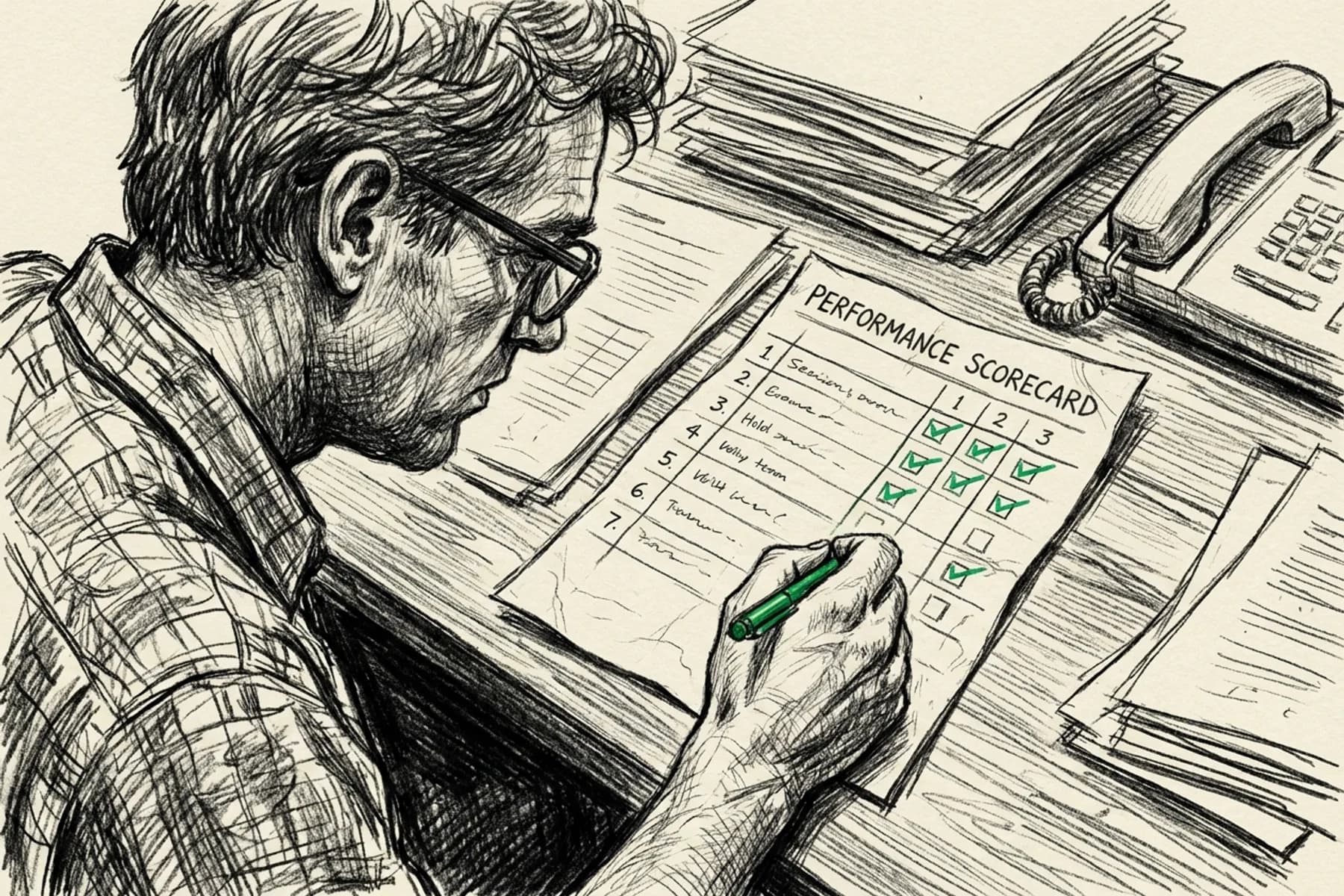
The industry average booking rate is 42%. Top performers book 70% of their calls. The gap isn't talent. It's measurement discipline. Most shops focus on training CSRs on 'soft skills' while ignoring the metrics that actually drive revenue.
Here's the brutal truth: you can't fix what you don't measure. And most home service operations don't measure the right things.
This CSR scorecard template gives you the exact seven-metric framework top-performing HVAC, plumbing, and electrical companies use to turn average CSRs into booking machines. No fluff. No theory. Just the metrics that move the needle.
The Revenue Reality: Why Most CSR 'Training' Fails
Industry average booking rate is 42% while top performers achieve 70%+. ServiceTitan data shows that most home service operations book fewer than half their inbound calls, while top-performing HVAC operations book 62 to 70% of answered calls.
The problem? Most shops focus on soft skills training instead of performance measurement. They send CSRs to communication workshops and role-play scenarios but never track what actually matters: booking rate by call type, objection handling success, and first-call resolution.
CSR Performance Measurement is the systematic tracking of specific metrics that correlate with booking rate success, focusing on objective data rather than subjective 'soft skills' assessments.
Top performers don't have better CSRs. They have better systems. They track booking rates by emergency vs. replacement calls. They measure objection handling effectiveness. They know their first-call resolution rate.
The difference isn't better people. It's CSR training transformation through disciplined measurement and targeted coaching based on hard data, not guesswork.
The Complete CSR Scorecard Framework
Seven essential metrics every CSR scorecard must include: booking rate by call type, first-call resolution, objection handling effectiveness, call quality score, follow-up completion rate, average handle time balance, and customer satisfaction. This isn't a 20-metric dashboard that nobody uses. It's the minimum effective dose for maximum impact.
Different call types require different booking rate targets. Emergency calls should convert at 70%+ because of urgency. Replacement inquiries run 40-55% because customers shop around. Maintenance calls should hit 80%+ because they're lowest risk.
We use a 1-10 objective scoring methodology for quality assessment. No subjective 'they seemed nice' evaluations. Clear criteria, consistent scoring, actionable feedback.
Weekly tracking frequency drives faster improvement than monthly reviews. Monthly data is too old to coach. Weekly data catches problems while they're still fixable.
What metrics should be included in a CSR scorecard for home service companies?
Booking rate by call type, first-call resolution rate, objection handling effectiveness, call quality score, follow-up completion rate, average handle time balance, and customer satisfaction score. Each metric targets a specific revenue driver, from initial call conversion to customer retention.
Most operations track blended booking rate. One number for all call types. That's useless. An emergency repair call and a replacement inquiry have completely different conversion expectations. Track them separately.
Metric #1: Booking Rate by Call Type (Not Blended Average)
Emergency calls should convert at 70%+ while replacement inquiries typically run 40-55% and maintenance calls should achieve 80%+. Tracking only blended booking rate masks specific performance issues and prevents targeted coaching.
Emergency calls convert higher because customers need immediate help. Their water heater died. Their AC quit in July. They're not shopping. They're buying.
Replacement inquiries have lower expectations because customers research, compare, and think about it. A furnace replacement is a $12,000 decision. They're going to call multiple companies.
Maintenance calls should book at the highest rates because the barrier is lowest. It's $150, not $15,000. If your CSRs can't book a tune-up, fix the system.
A booking rate of 55% to 65% on paid channel inbound calls is solid performance, but only if you're measuring by call type. Blended rates lie.
Use AI dispatch qualification to categorize calls consistently and track performance accurately.
How do you measure CSR booking rate performance in HVAC and plumbing businesses?
Measure booking rate by call type (emergency, replacement, maintenance), track first-call resolution rate, and score objection handling effectiveness on a 1-10 scale. Industry benchmarks provide context, but your improvement trajectory matters more than comparing to others.
Metric #2: First-Call Resolution Rate
Industry standard FCR is 70-74%, with best-in-class performance targeting 80%. Standard call center metrics include a 70–74% First Call Resolution (FCR), but home service operations should aim higher.
Failed first-call resolution kills booking rates. When customers have to call back for information, clarification, or scheduling changes, they start shopping competitors. Every callback is a leak in your funnel.
Common resolution failures: CSR doesn't have pricing authority, can't access the dispatch board, or lacks technical knowledge to qualify the job properly. Fix the system, not the person.
Metric #3: Objection Handling Effectiveness
Track objection types and resolution success rates, with price objections requiring specific scripting and conversion rate measurement. Most CSRs crumble at the first price objection. Track how often they recover.
Common objection categories: price ('too expensive'), timing ('I need to think about it'), comparison shopping ('checking other companies'), and urgency questioning ('is it really an emergency?').
Score response quality on a 1-10 scale. Did they acknowledge the objection? Reinforce value? Offer alternatives? Or did they fold immediately?
Price objections convert at 35-45% when handled correctly. Use proven handling price objections scripts that reframe cost as investment and urgency as savings.
What is a good booking rate for home service customer service representatives?
Emergency calls should book at 70%+, replacement inquiries at 40-55%, and maintenance appointments at 80%+. These benchmarks reflect the natural conversion expectations for each call type, based on customer urgency and decision complexity.
Metric #4: Call Quality Score (Soft Skills Assessment)
Structure scoring for communication quality, professionalism, empathy, and technical competency on objective 1-10 scales. Soft skills matter, but only when measured consistently against clear criteria.
Professionalism scoring: Did they answer within 3 rings? Use the customer's name? Sound confident and prepared? Binary yes/no items add up to an objective score.
Empathy assessment: Did they acknowledge the customer's frustration? Ask clarifying questions? Provide reassurance about the solution? Track customer response and satisfaction.
Technical competency: Could they explain the problem clearly? Offer preliminary diagnosis? Build credibility through knowledge? Customers buy from experts, not order-takers.
Use AI empathy coaching to provide real-time guidance on emotional intelligence and customer connection during calls.
How do you evaluate CSR call quality in field service businesses?
Use structured 1-10 scoring for professionalism, empathy, technical knowledge, and problem resolution, measured weekly rather than monthly for faster improvement cycles. Quality assessment must be objective and consistent to drive meaningful coaching conversations.
Metric #5: Follow-Up Completion Rate
Track completion rate of promised follow-up activities, measure estimate follow-up booking conversion, and document lost lead recovery efforts. Promises made during calls must be promises kept, or customers lose trust and shop elsewhere.
Promised callback execution: If the CSR said they'd call back with pricing, did they? Track completion rate and time to follow-up. Late callbacks lose deals.
Estimate follow-up tracking: How many unsold estimates get follow-up calls? What's the conversion rate? Most shops leave 20-30% revenue on the table by ignoring estimates.
Lost lead recovery: When a call ends without booking, is there a systematic follow-up process? Or do you just hope they call back? Hope isn't a strategy.
Metric #6: Average Handle Time vs. Quality Balance
Industry average AHT is 6 minutes, but quality matters more than speed for high-ticket home service sales. A good average call duration is 6 minutes and 3 seconds, but rushing emergency calls kills conversion.
Balance efficiency with thorough problem resolution. A 4-minute call that misses the urgency cues loses the booking. An 8-minute call that builds confidence and urgency wins it.
Identify optimal handle time ranges by call type. Emergency calls need more diagnosis time. Maintenance calls can be efficiently processed. Replacement inquiries require education and value building.
Metric #7: Customer Satisfaction Score (CSAT)
Industry CSAT benchmark is 85% or higher for best-in-class performance, with post-call surveys providing direct feedback on CSR effectiveness. New benchmarks suggest that most businesses should aim for a CSAT score of 85% or higher.
CSAT directly correlates with booking rate and customer retention. Happy customers book. Frustrated customers shop your competitors.
Implement simple 2-question post-call surveys: 'How satisfied were you with today's call?' and 'How likely are you to recommend us?' Track monthly trends and coach to specific feedback.
What are the best CSR performance benchmarks for trades companies?
Target 70%+ booking rate on emergency calls, 80%+ first-call resolution, 85%+ customer satisfaction, 6-minute average handle time, and 90%+ follow-up completion rate. These benchmarks represent best-in-class performance for home service operations with disciplined measurement systems.
Implementation: Your 7-Day CSR Scorecard Rollout
Day 1-2: Set up tracking systems and baseline measurements. Days 3-4: Train CSRs on new metrics and expectations. Days 5-7: Begin weekly scoring and coaching conversations. Fast implementation prevents overthinking and gets you measuring immediately.
Week 1 Setup Checklist:
- Create scorecard template in Excel or Google Sheets
- Establish call recording and review process
- Define scoring criteria for each metric
- Set up post-call survey system
- Schedule weekly review meetings with each CSR
Staff Communication Script: 'We're implementing a CSR scorecard to help everyone improve their booking rates and earn more money. This isn't about punishment. It's about clarity. You'll know exactly what success looks like and get weekly coaching to hit those targets.'
Establish baseline measurements in the first week. Don't wait for perfect data. Start measuring immediately and refine the process as you go.
Use the 72-hour CSR onboarding framework to get new hires productive faster with clear performance expectations from day one.
From Scorecard to System: Making Measurement Stick
Structure weekly 15-minute performance review meetings with each CSR, convert scorecard data into specific coaching actions, and align compensation with measured outcomes. Measurement without coaching is just record-keeping. Coaching without measurement is just conversation.
Weekly Review Meeting Agenda:
- Review previous week's metrics (5 minutes)
- Identify one specific improvement focus (3 minutes)
- Role-play challenging scenarios (5 minutes)
- Set next week's performance target (2 minutes)
Convert scorecard data into specific coaching actions. Low objection handling score? Practice price objection scripts. Poor first-call resolution? Shadow top performers. Weak follow-up completion? Build accountability systems.
Align CSR compensation and recognition with measured outcomes. Bonuses for booking rate improvement. Recognition for quality score increases. Incentives for customer satisfaction gains.
Implement AI real-time call coaching to provide in-the-moment guidance that prevents mistakes instead of reviewing them after the revenue is lost.
Stop Guessing. Start Measuring.
The gap between 42% and 70% booking rates isn't talent. It's measurement discipline. This CSR scorecard template gives you the exact framework to close that gap.
Download the scorecard. Implement it this week. Start your weekly reviews. Watch your booking rates climb.
Your CSRs want to succeed. Give them the clear metrics and consistent coaching they need to win.
Ready to stop losing revenue to poor call handling? Book a demo and see how AI-powered call quality monitoring can turn your scorecard data into automatic coaching that happens during the call, not after.
Keep reading
 CSR Coaching & Call Handling
Plumbing Call Center Scripts That Actually Book Jobs
8 min read CSR Coaching & Call Handling
The 'Diagnostic Fee' Friction: How to Coach CSRs to Address Trip Charges Without Killing the Booking Rate
7 min read CSR Coaching & Call Handling
The Summer Heatwave Blueprint: Handling a 300% Call Spike Without Seasonal Temps
8 min read