


Train Entry-Level CSRs in 30 Days With AI Coaching
Stop waiting months for new CSRs to produce. Real-time AI coaching makes entry-level hires revenue-productive in 30 days. See the 4-week playbook that cuts training time by 90%.

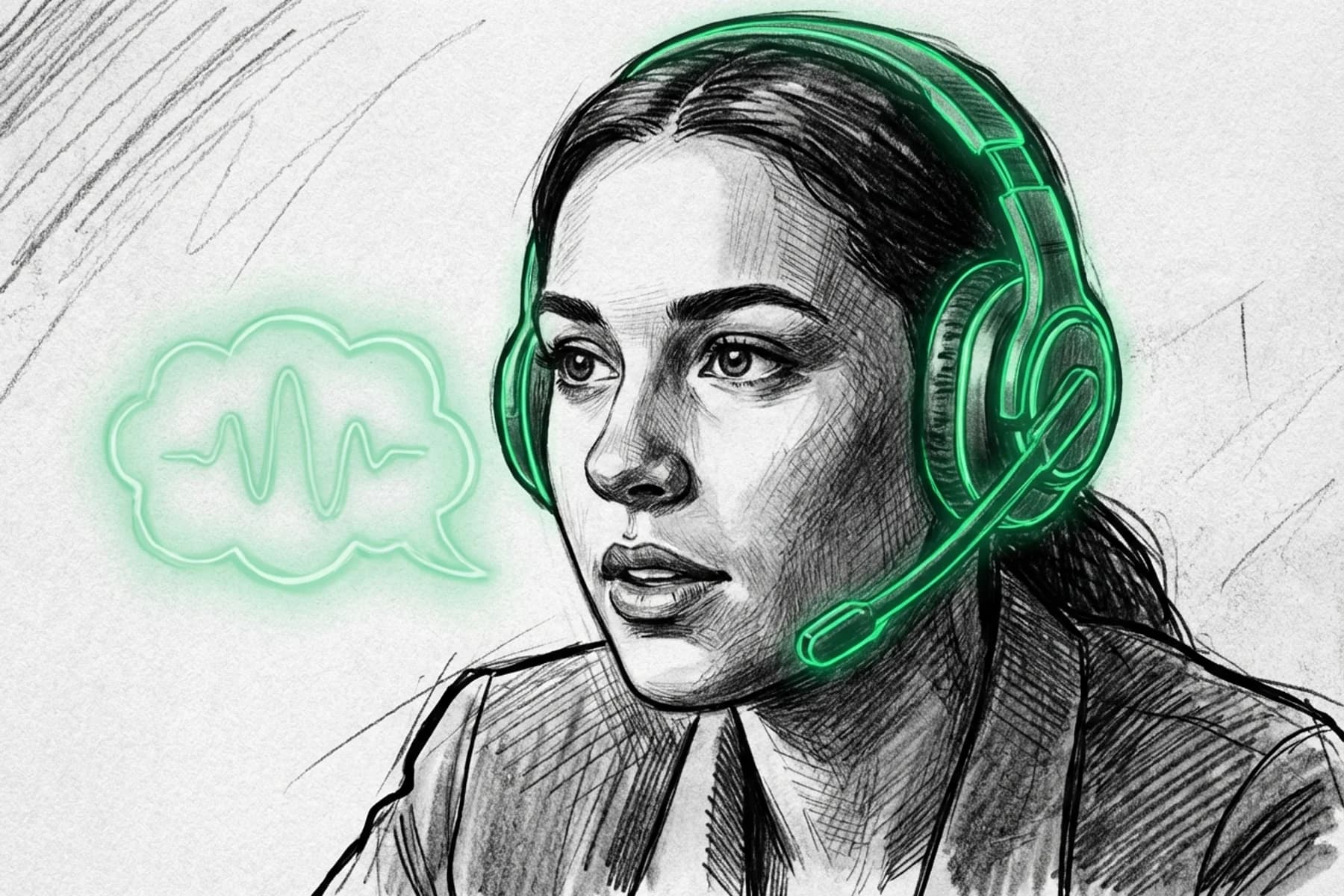
How long does it take to train a new CSR for home services?
Traditional CSR training takes 3-4 months before new hires become revenue-productive, but AI coaching accelerates dispatcher training to just 30 days by providing real-time guidance on every customer interaction. Instead of months of lost revenue, AI-coached CSRs start booking jobs from day one.
I've watched home service companies struggle with the same broken cycle for years. Hire a CSR. Spend months training them. Watch them fumble calls while they "learn." Lose revenue. Repeat.
The math is brutal. A new CSR costs you money for 90+ days before they contribute anything meaningful to your bottom line. Meanwhile, your competitors are booking jobs you're missing.
AI CSR Training is a system where artificial intelligence provides real-time coaching and guidance to customer service representatives during live calls, eliminating the lengthy onboarding period and accelerating performance.
Here's the exact playbook to cut that liability period from months to weeks using AI coaching technology.
The 3-month training drain (and why it's killing your growth)
The home services industry loses approximately 30% of potential revenue through mishandled phone interactions. Most of those fumbles come from undertrained CSRs.
Here's what traditional onboarding actually looks like:
- Month 1: Classroom training, shadowing, role-playing
- Month 2: Taking supervised calls, making mistakes
- Month 3: Finally handling calls independently
- Month 4+: Maybe hitting target booking rates
During those first three months, your new hire is a cost center, not a profit center. Every call they mishandle is revenue walking out the door.
The numbers get worse when you factor in manager time. Each new CSR requires 40+ hours of direct training from your operations manager. That's a full work week where your most valuable people aren't focused on growth.
The hidden costs of slow onboarding
I calculated this with a client last year. Their average CSR hire cost them $8,200 in lost opportunity during the training period.
That includes:
- Salary during non-productive months
- Manager time at $50/hour
- Missed bookings from fumbled calls
- Customer complaints and reputation damage
Multiply that by every hire, and the training liability becomes a growth killer.
Why traditional training creates liability, not assets
Static training materials don't prepare CSRs for real customer interactions. Contact centers typically onboard new reps over four to eight weeks, yet performance gaps persist well past the first 90 days.
The problem is simple: you can't learn to swim by reading about water.
CSRs need practice with actual customer objections, pricing questions, and scheduling conflicts. But giving them that practice on live calls costs you money every time they mess up.
The "experienced CSR" myth
The talent shortage makes hiring experienced CSRs nearly impossible. When you do find one, they're expensive and often come with bad habits from their previous company.
I've seen shops pay $18/hour for "experienced" CSRs who still need months to learn your specific processes, pricing, and service area. You're paying premium wages for the same training liability.
What is AI coaching for customer service representatives?
AI coaching for customer service representatives is a technology that provides real-time guidance during live calls, eliminating lengthy training periods. Think of it as GPS for customer conversations. When a customer asks about pricing, the AI immediately prompts the CSR with the correct response. When they hear objections, the AI provides proven rebuttals.
The difference between static scripts and dynamic guidance is massive. Scripts assume every call follows the same pattern. AI CSR training adapts to what's actually happening on the call.
How AI coaching works during customer interactions
Here's what I see when I watch AI-coached calls:
- Customer speaks: "I'm just shopping around for quotes"
- AI instantly prompts: "Acknowledge their diligence, then ask about timeline"
- CSR responds confidently: "Smart to get multiple quotes. When are you hoping to get this resolved?"
- AI provides follow-up guidance based on the customer's answer
The CSR never has to guess what to say next. They're getting expert coaching on every interaction without a manager hovering over their shoulder.
The difference between static scripts and dynamic guidance
Static scripts fail because customers don't follow scripts. A customer might ask about pricing before you've built value. They might have three different problems instead of one. They might be calling at midnight when your manager isn't available.
Dynamic AI guidance adapts to the actual conversation, not the ideal conversation you planned in training.
Why real-time coaching accelerates learning
Learning happens fastest when feedback is immediate. If a CSR fumbles an objection, waiting until the call review meeting to fix it means they'll fumble it again.
With AI coaching, mistakes get corrected in the moment. The CSR learns the right response while they're still talking to the customer.
That immediate feedback loop is what cuts training time from months to weeks.
How can AI reduce CSR onboarding time?
AI reduces CSR onboarding from 3+ months to 30 days by providing expert guidance on every call from day one, allowing new hires to handle customer interactions productively while they learn instead of fumbling through a lengthy training period.
Here's the exact 30-day playbook we use:
Week 1: Foundation setup and first guided calls
Day 1: New hires learn your CRM and phone system basics. That afternoon, they're taking guided calls with AI coaching.
Days 2-5: Focus on information gathering and basic scheduling. AI prompts for required details, prevents missed information.
Metric to track: Call completion rate (did they get all required info?)
I've seen CSRs book their first job on day two with AI guidance. That never happens with traditional training.
Week 2-3: Building confidence with complex scenarios
Week 2: Handle pricing questions and basic objections. AI provides exact dollar amounts and objection responses.
Week 3: Emergency calls, multiple problems, scheduling conflicts. AI guides through prioritization and solution options.
For HVAC CSR onboarding specifically, this is where new hires learn to differentiate between maintenance calls, repair emergencies, and system replacements. The AI provides industry-specific guidance that traditional training manuals can't match.
Metric to track: Booking rate (what percentage of qualified leads become appointments?)
By week three, AI-coached CSRs are handling situations that would stump traditionally-trained reps with months of experience.
Week 4: Independent performance with AI safety net
Week 4: CSR takes calls independently but AI monitoring continues. Coaching prompts reduce as confidence builds.
End-of-month goal: Match or exceed your target booking rate with minimal supervision.
This is where the magic happens. The CSR feels confident because they haven't been thrown into the deep end. They've been guided through every scenario.
Measuring success metrics
Track these numbers to prove the system works:
- Time to productivity: Days until CSR hits target booking rate
- Revenue per hire: Dollars booked in first 30 days
- Manager hours saved: Direct training time eliminated
- Retention rate: CSRs who stay past 90 days
We see 80%+ of AI-coached hires hit target performance by day 30. Traditional training? Maybe 40% hit targets by day 90.
When CSRs feel successful instead of overwhelmed, they stick around. We've seen retention rates improve 60%+ when you hire for attitude and use AI to deliver expertise.
What are the benefits of AI-powered CSR training?
AI-powered CSR training delivers 90% reduction in manager training time, immediate revenue generation instead of months-long ramp-up periods, and the ability to hire for attitude while AI provides the expertise. This transforms hiring from a liability into a scalable growth engine.
Time savings calculation
Traditional CSR: 40+ manager hours per hire over 12 weeks
AI-coached CSR: 8 manager hours in the first week, then autonomous performance
That's 32 hours of your operations manager's time back per hire. At $50/hour, that's $1,600 in direct labor savings. Multiply by 10 hires per year and you've saved $16,000 in management time alone.
Revenue impact during ramp-up
The revenue difference is staggering:
- Traditional CSR: $0 revenue, months 1-3. Maybe $8K/month by month 4.
- AI-coached CSR: $3K revenue in week 2. $6K by week 4. $8K+ by month 2.
Use our cost per booked job calculator to see the exact impact on your business.
Reduced manager burden
Your operations manager stops being a full-time trainer. They get back to actually managing operations and driving growth.
I've worked with companies where the ops manager spent 50% of their time training CSRs. With AI coaching, that drops to 10%. Suddenly they have time to focus on process improvements, technician efficiency, and revenue optimization.
Improved hiring flexibility
When AI provides the expertise, you can hire for attitude and cultural fit instead of experience. That opens up your candidate pool dramatically.
A motivated 20-year-old with good phone manner can outperform a burned-out "experienced" CSR in weeks, not months. This is the key to maximizing entry-level CSR performance.
How does real-time AI coaching work for new hires?
Real-time AI coaching works by listening to both sides of customer calls and providing instant prompts, objection responses, and guidance to new hires as conversations unfold, eliminating the delay between making mistakes and learning corrections.
Choosing the right AI coaching platform
Look for these non-negotiable features:
- Real-time guidance: Prompts appear during calls, not after
- CRM integration: Pulls customer history and service details
- Customizable coaching: Adapts to your processes and pricing
- Performance analytics: Tracks improvement over time
AI-powered training reduces onboarding time and upskills new employees quickly and effectively, but only if the platform delivers coaching when CSRs need it most.
Integration with existing systems
The AI needs to connect with your phone system and CRM to provide contextual guidance. When a customer calls about a previous estimate, the AI should immediately surface that information for the CSR.
We've seen the best results with platforms that integrate seamlessly with ServiceTitan, Housecall Pro, and other major FSM systems. The right integration makes your entire stack more effective.
Training your trainers
Your managers need to understand how AI coaching works so they can focus on what humans do best: culture, motivation, and strategic thinking.
Train managers to review AI insights, not shadow every call. They become performance coaches instead of script monitors.
Measuring and optimizing results
Track the metrics that matter:
- Booking rate: Percentage of qualified leads converted
- Average handle time: Efficiency without sacrificing quality
- Customer satisfaction: Consistent experience across all CSRs
- Revenue per CSR: The ultimate performance measure
The competitive advantage: Why AI coaching changes everything
AI coaching transforms your fundamental hiring equation. Instead of competing for scarce experienced CSRs, you can hire motivated entry-level candidates and make them perform like experts.
This is the future of home services hiring. While your competitors fight over the same small pool of experienced CSRs, you're building a team that scales with your growth.
The hiring equation transformation
Old equation: Experience + training time = performance
New equation: Attitude + AI coaching = performance
We hire CSRs at $14/hour instead of $18/hour and get better performance because AI eliminates the experience gap.
Scaling without training bottlenecks
Traditional training doesn't scale. Your ops manager can only train 2-3 CSRs effectively at once. AI coaching scales infinitely.
Need to hire 5 CSRs for busy season? No problem. The AI trains all of them simultaneously while your manager focuses on revenue operations.
Consistent performance across all hires
Human training varies based on the trainer's mood, availability, and expertise. AI coaching is consistent every time.
Every CSR gets the same high-quality guidance, whether they're your first hire or your fifteenth.
Future-proofing your team
The labor shortage isn't getting better. AI coaching future-proofs your business by making you less dependent on finding experienced talent.
You become the company that creates expertise instead of hunting for it.
Stop burning 90 days hoping your new CSRs will eventually perform. Use AI to accelerate dispatcher training and turn hiring from a liability into a competitive advantage.
Every month you delay is revenue walking out the door while undertrained CSRs fumble calls.
Get the demo and see how AI coaching transforms new hires into revenue generators in 30 days, not 90.
Keep reading
 CSR Coaching & Call Handling
Plumbing Call Center Scripts That Actually Book Jobs
8 min read CSR Coaching & Call Handling
The 'Diagnostic Fee' Friction: How to Coach CSRs to Address Trip Charges Without Killing the Booking Rate
7 min read CSR Coaching & Call Handling
The Summer Heatwave Blueprint: Handling a 300% Call Spike Without Seasonal Temps
8 min read