


Plumbing Call Center Scripts That Actually Book Jobs
Your booking rate is a script problem — not a lead problem. Get the exact plumbing CSR script for openers, fee objections, and after-hours calls. Learn how.

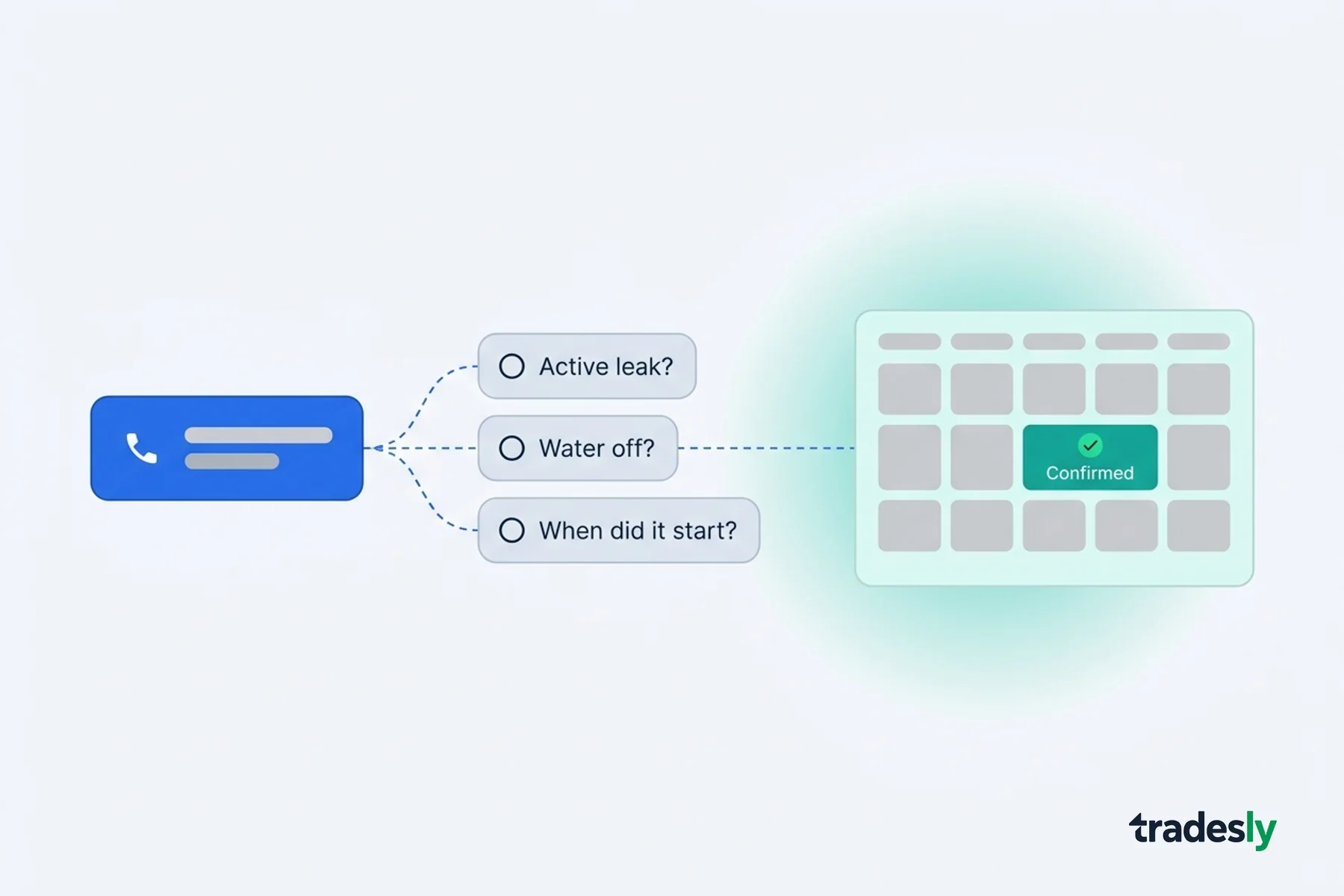
Make your plumbing ad spend more effective with call scripts that actually book jobs (not just take messages).
A plumbing call center script is not optional. It is the difference between a full dispatch board and a $15,000 day that never happened. I've spent years listening to calls from home service companies, and the pattern is always the same: the leads are fine. The script is broken.
ServiceTitan's data from 3,000+ trade businesses puts the average plumbing booking rate at 43%. Top performers hit 77%. That gap is not about leads or techs. It is about what happens in the first 90 seconds after the phone rings.
And it gets worse. Invoca's 2026 Home Services Benchmarks Report, covering 60M+ calls, found only 52% of inbound calls are answered by a live person. Your plumbing phone script only works if someone delivers it. 85% of home-service callers who don't reach a live person don't call back. They move to the next Google result. That is a permanent loss, not a callback opportunity.
Your CSR is not losing jobs because the caller was cheap. They are losing jobs because nobody gave them a system. This is a discipline problem. And it is fixable today. This is not a problem unique to plumbing either — call center scripts that stop losing leads is a cross-trade challenge every home service company faces.
A plumbing call center script is a structured, scenario-specific guide that tells your CSR exactly what to say at every stage of an inbound call: the opener, problem qualification, appointment offer, fee objection, and closing confirmation. A purpose-built plumbing CSR script eliminates improvisation and closes the booking rate gap between average shops (43%) and top performers (77%).
What you need before you use this script
You need three things in place before this script works: a defined service area, a clear dispatch fee policy with an exact dollar amount, and a live booking window open in your FSM.
Get these locked before you hand this to your team. Without them, you are setting your CSRs up to wing it.
What makes a good plumbing call center script for CSRs?
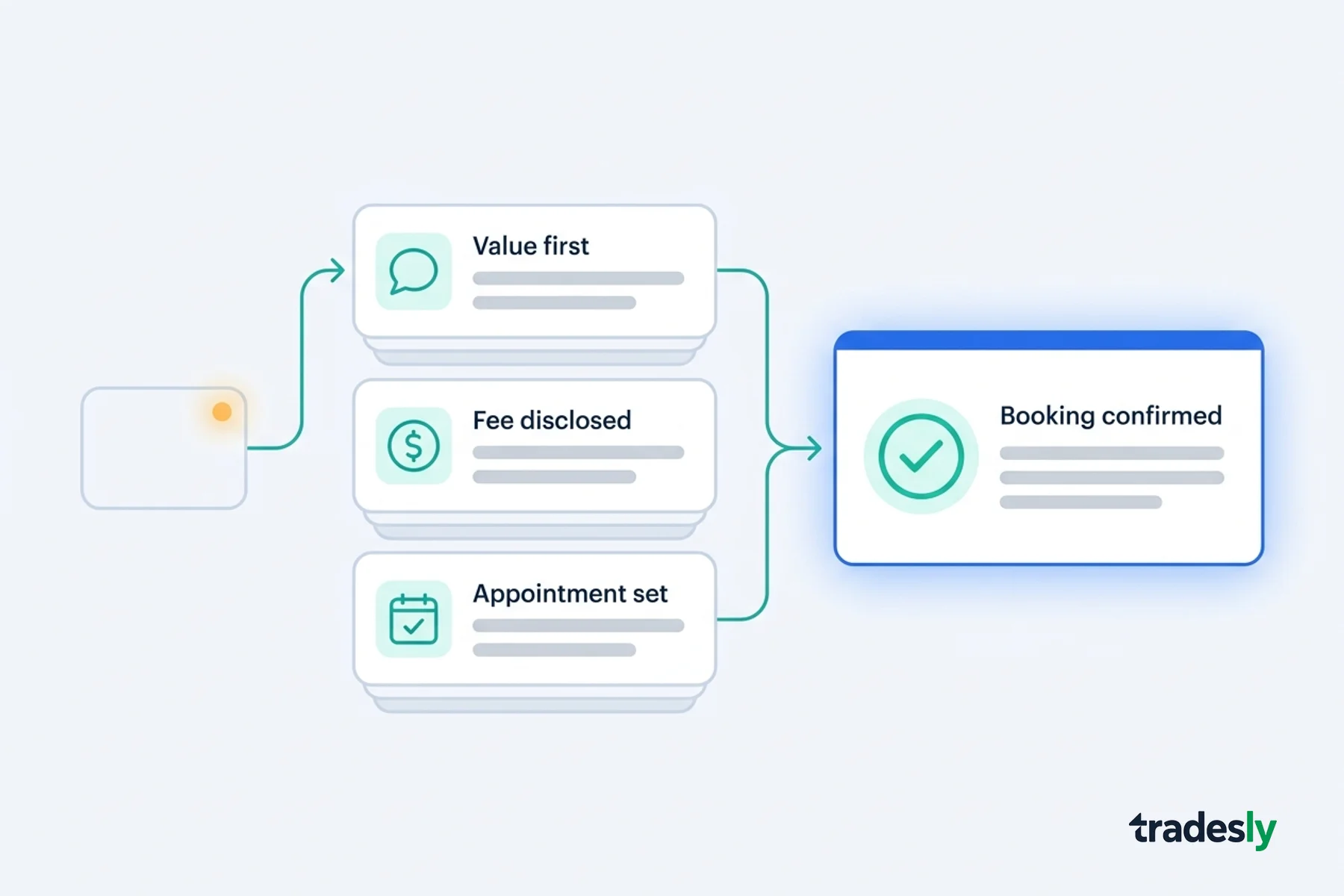
A good plumbing CSR script covers six moments: the opener, problem qualification, the appointment offer, the dispatch fee objection, the spouse stall, and the closing confirmation. Every one of these is a predictable failure point. Every one now has a line.
Part 1: The opener (the first 10 seconds)
The opener must do three things in one breath: name the brand, signal readiness, and open with a question. Most plumbing inbound call scripts get this wrong.
Bad opener: "Thank you for calling ABC Plumbing, how can I help you today?"
Good opener: "Thanks for calling [Company Name]. We handle plumbing emergencies all day — what's going on for you right now?"
The word "emergency" does real work. It tells the caller your shop is equipped, not inconvenienced. That framing changes the entire tone of the call.
Part 2: Problem qualification (the 3 questions that matter)
Only ask questions that change the dispatch decision or create urgency. Three questions do that job:
- "Is there active water on the floor right now?"
- "Have you been able to shut off the water to that area?"
- "When did this start?"
These are not small talk. They pull the caller into problem-solving mode with your CSR. A caller working through the problem with you is a caller who books. Skip the questions that don't change anything.
Part 3: Booking the appointment (creating urgency without pressure)
Do not ask "Would you like to schedule?" That is an open door to "I'll think about it." Instead: "I have a tech available this afternoon between 2 and 4 — does that work, or is morning better?"
Two specific options force a decision. Give the time window before they ask about price. Once a caller is mentally choosing between morning and afternoon, the price conversation gets easier.
Part 4: How do you handle the dispatch fee objection on a plumbing call?
Most guides on how to handle dispatch fee objection plumbing tell you to justify the fee. That is the wrong frame — say the number flat and explain what it buys.
Knowing how to handle the dispatch fee objection on a plumbing call is the single highest-ROI line your CSR will memorize. You say the number flat, without apology, and you frame what it buys. The fee is not a problem. Flinching about it is.
Script: "Our dispatch fee is $[X]. That covers your tech getting out there and giving you a full diagnosis. If you move forward with the repair, that fee gets applied directly to your job total — so you're not paying it twice."
Say it the same way every time. No rising inflection at the end. No "it's just" before the number. I've watched CSRs lose calls in the half-second of hesitation before they say the fee. The caller hears that hesitation and goes cold. The script fixes that by making the framing automatic.
Part 5: The "I need to check with my spouse" stall
This is not a hard no. It is a soft exit. Don't chase it — work with it.
Script: "Totally makes sense. Here's what I can do — I'll hold that 2–4 window for the next 20 minutes while you check. What's the best number to reach you if it opens up?"
You are not pressuring. You are being practical. Most callers will either book or reveal the real objection. Either outcome moves the call forward.
Part 6: Closing confirmation and callback text
Confirm three things out loud before ending every call: name, address, and appointment window. Then: "You'll get a text confirmation in the next few minutes with your tech's name and that window. If anything changes, just reply to that text and we'll sort it."
This sets a professional expectation and cuts same-day cancellations. It also signals that your shop has its act together — which matters for first impressions.
How do plumbing companies handle after-hours emergency calls without losing the lead?
After-hours plumbing calls require live coverage or a structured voicemail script with a hard callback commitment. Voicemail alone, with no urgency framing, loses the lead almost every time. After-hours and evening calls represent 25–40% of inbound volume in home services. Plumbing skews even higher — leaks and no-hot-water calls don't wait for business hours. That's per CallRail industry data.
Two options: live after-hours coverage via a dedicated CSR or AI voice agent, or — if voicemail is unavoidable — a structured script with a hard callback commitment:
Voicemail script: "You've reached [Company Name] after hours. We handle emergencies 24/7 — leave your name, number, and what's happening, and a dispatcher will call you back within 15 minutes. If this is active flooding, press 1 to reach our emergency line directly."
A missed emergency plumbing call can represent $400–$15,000 in job value depending on scope. A structured plumbing after-hours call script is the last line of defense on your highest-value call category.
Why is my plumbing company's call booking rate so low?
Low plumbing booking rates almost always trace back to three specific script failures: a weak opener that lets callers go straight to price, a fumbled dispatch fee moment that kills confidence, and no live coverage after hours. These are process failures, not people failures.
Every operator asking how to improve plumbing booking rate is looking in the wrong place. It is not the ads. It is the script. The fastest way to find your leak: listen to calls where no booking happened — not to evaluate the CSR, but to evaluate the script. The system failed before the person did.
Using negative feedback systematically is one of the most underused tools in call handling. Our guide on turning customer complaints into better call scripts walks through exactly how to do that.
What does real-time coaching do that a printed plumbing call script cannot?
Real-time coaching surfaces the exact rebuttal on-screen while the call is live, so the CSR never has to remember the script or improvise under pressure. A printed plumbing call booking script is a starting point — it works when the CSR is calm, disciplined, and has it in front of them. It breaks when the caller goes off-script, when a new hire hasn't memorized the flow, or when the dispatch fee question comes fast and the CSR flinches.
The next level is a script that adapts in real time. A live on-screen prompt that hears the call and surfaces the right rebuttal as the conversation unfolds. The CSR doesn't need to remember anything. The right words appear at the right moment.
This is how top-quartile plumbing shops are pushing booking rates above 75%. Not by hiring better people. By building a system that makes their current people perform at their best on every call. See how real-time AI scripting improves CSR performance for shops already running this approach.
How much does a broken plumbing call script cost you each month?
A broken plumbing call script costs most shops between $5,000 and $30,000 per month — the gap between your current booking rate and 65%, multiplied by your monthly call volume and average job ticket. Run the math before you hand this to your team. Take your monthly call volume, your current booking rate, and your average job ticket. Then run the same numbers at 65%. The gap between those two figures is what a broken script costs you every month. Calculate what a missed plumbing call actually costs you.
What should a plumbing company say when answering the phone to maximize bookings?
Start with the brand name, signal emergency readiness, and ask an open question in one sentence. "Thanks for calling [Company Name]. We handle plumbing emergencies all day — what's going on for you right now?" Then qualify with only the three questions that change the dispatch decision. Offer a specific two-option time window before the caller asks about price. That sequence alone will move most shops 10–15 points up their booking rate.
Start Using This Plumbing Call Center Script Today
The six parts above — opener, qualification, appointment offer, dispatch fee, spouse stall, and closing confirmation — cover every predictable failure point on an inbound plumbing call. The script is the system. The system is the discipline. For a deeper look at handling price objections on plumbing calls, the full breakdown is one click away.
For shops that want this enforced in real time, Tradesly's Whisper Coaching puts live prompts on the CSR's screen while the call is happening. No memorization required. No coaching lag. The right words at the right moment, every time.
Stop guessing what your CSRs are saying. Get the demo.
Keep reading
 CSR Coaching & Call Handling
The 'Diagnostic Fee' Friction: How to Coach CSRs to Address Trip Charges Without Killing the Booking Rate
7 min read CSR Coaching & Call Handling
The Summer Heatwave Blueprint: Handling a 300% Call Spike Without Seasonal Temps
8 min read CSR Coaching & Call Handling
The 'Garbage Call' Epidemic: How to Stop Inexperienced CSRs from Misallocating Your Best Technicians
8 min read