


The 'Diagnostic Fee' Friction: How to Coach CSRs to Address Trip Charges Without Killing the Booking Rate
Your CSR is dodging the diagnostic fee — and losing the job. Use this dispatch fee script to train your team to disclose, reframe, and book. Learn how.

The Counterintuitive Data: Charging a Diagnostic Fee Boosts Booking Rates — Here's the Script
Your CSR is protecting the booking — and losing it
That is a CSR decision made two hours earlier, under pressure, with no HVAC call booking script to lean on. Here's the failure mode I see on repeat: a customer calls about a broken AC unit. The CSR senses the fee question coming and sidesteps it. Call ends. Booking confirmed. Tech drives 40 minutes, pulls tools from the truck, and the customer opens the door with one question — "Wait, you're charging me just to show up?"
That is not a tech problem. That is not a lead quality problem.
The avoidance is a discipline failure — not a personality flaw, not a bad lead. The rep made a choice. They skipped the fee conversation because they were afraid of pushback. Nobody gave them a confident framework. So they improvised, and improvisation under pressure produces silence every time. If you need a starting point for how to train CSRs to protect your service fees, you already know the cost of skipping it.
Here is the counterintuitive part: the silence costs more than the fee ever could. ServiceTitan analyzed more than one million residential service jobs and found that booking rates when the diagnostic fee is $0 are 3–10 percentage points lower than when a fee between $0.01 and $49.99 is charged — across all company sizes. (ServiceTitan — Contractor Playbook)
Waiving the fee does not win the call. It just removes your margin and trains your team to apologize for their expertise.
Diagnostic Fee Disclosure is the practice of proactively naming the trip charge or service call fee during the initial phone booking — before the technician is dispatched — using a diagnostic fee disclosure script that anchors the fee to the value of the assessment, not the cost of the visit.
Does charging a diagnostic fee hurt HVAC booking rates?
No. The data is clear: charging a diagnostic fee does not hurt HVAC booking rates — CSR silence does. ServiceTitan's million-job analysis shows $0 fees produce 3–10 percentage point lower booking rates than modest fees. Operators who waive the fee to "win the call" are solving the wrong problem.
Booking rates hold steady across trades up to roughly $89.99. HVAC contractors cluster around $69.99–$89.99. Large plumbing companies land similarly. Residential electricians run $90–$150. These are market calibration points, not rules. The number matters less than how confidently the rep delivers it.
The $0 fee myth
The logic sounds reasonable: remove the barrier, win the booking. But the data does not support it. Free diagnostics signal uncertainty — to the customer and to the tech. A fee signals that the visit has value. Customers who expect a professional assessment expect to pay for one.
Where booking rates fall — and what top CSRs do differently
The industry average HVAC booking rate sits around 42%. The top quartile books 62–70% of answered calls. Within a single company, the spread between a top CSR and a bottom CSR can reach 35 percentage points — that gap is not a talent gap, it is a consistency gap. (Built on Tenth — HVAC CSR Booking Rate Benchmarks, March 2026)
Top-quartile CSRs state the fee without hesitation, anchor it to the value of the assessment, and bridge immediately to appointment confirmation. Enterprise DNA's June 2026 analysis identifies refusing to give price information as the second most common reason inbound service calls do not convert. (Enterprise DNA — How to Handle Price Objections on Service Calls, June 2026) Their method works — the problem is that it lives in their head, not in a system. Read more on what separates elite HVAC CSRs from average ones.
Why CSRs go silent: understanding the avoidance pattern
Smart Service's market data confirms that "surprise" trip charges generate more negative reviews than the charge itself. The recommended practice: the fee appears in the dispatcher's call script and is confirmed in the booking text or email before the tech arrives. (Smart Service — Average Service Trip Charge: HVAC, Plumbing & Electrical)
This is the foundation of how to handle price shoppers plumbing — give the rep a framework, not just awareness.
What is the best script for handling trip charge objections on a home service call?
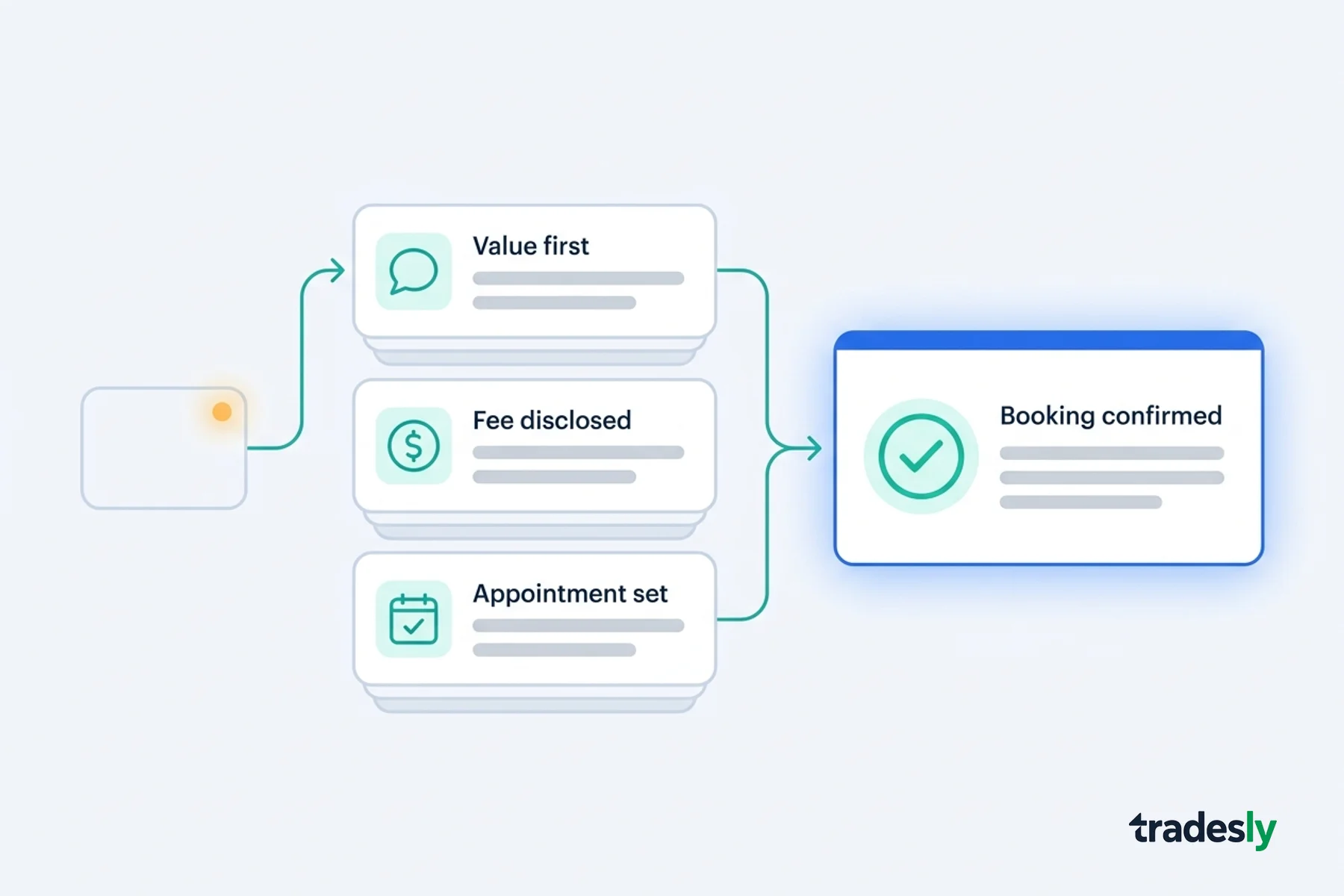
The best script for handling trip charge objections leads with the value of the diagnostic assessment before naming the fee, states the number with no hedging language, anchors it to the outcome, and immediately bridges to booking confirmation after any pushback. The Quick-Reference Script Block below is the complete framework.
Quick-Reference Script Block
- Value first: "Our tech will do a full diagnostic and give you a clear breakdown of what's happening and what it'll cost to fix."
- Fee disclosure: "There's a diagnostic fee of $[X] for that visit."
- Anchor: "That covers the diagnostic and gets applied to the repair when you move forward."
- Pushback reframe: "Because you deserve an answer, not a guess. The diagnostic is how we make sure the assessment is done right."
- Bridge: "We have [day] or [day] available — which works better?"
Market fee ranges (2026, per Smart Service): HVAC ~$89 | Plumbing $75–$100 | Electrical $125–$175 | After-hours/weekend 1.5x–2x standard. (Smart Service)
What is the average HVAC diagnostic fee in 2026?
The average HVAC diagnostic fee is approximately $89, with plumbing running $75–$100 and electrical $125–$175, per Smart Service 2026 market data. (Smart Service — Average Service Trip Charge: HVAC, Plumbing & Electrical)
Why Static Scripts Fail — and What Replaces Them
A plumbing phone script or printed checklist does not survive contact with a real call. The CSR is managing call volume and typing into the CRM. They are navigating a live customer at the same time. A PDF on the desktop is not coaching. It is decoration.
Enterprise DNA's June 2026 analysis confirms what I see in call audits constantly: static scripts are inconsistently used — one CSR uses it, another doesn't. That inconsistency IS the 35-point intra-company booking rate gap. (Enterprise DNA — How to Handle Price Objections on Service Calls, June 2026) HVAC phone handling objections do not improve through awareness alone — they improve through scripted repetition under pressure. HVAC CSR training software can close that gap, but only if it delivers live prompts — not retrospective review.
Training events improve performance after the fact. QA reviews catch failures after the booking is lost. The only thing that changes behavior in the moment is a prompt that appears in the moment. That is the core logic behind real-time coaching: the talk track surfaces when the trigger phrase is detected, not three days later in a debrief. Read more on how real-time coaching lifts HVAC booking rates — and why the mechanism of delivery matters as much as the script itself.
How do I train my plumbing CSRs to disclose dispatch fees confidently?
For a plumbing business fielding 60–90 inbound calls per week, fee hesitation costs $50K–$120K in recoverable annual revenue — that number is how you open the fee-disclosure training conversation with your team. Start there, then build the scripted talk track so every rep has a confident path through the fee question. That scripted path is the core of how to handle price shoppers plumbing: structure first, confidence follows.
Build the habit across the whole team — not just your best rep
The goal is to make the top performer's instincts the team standard — through scripted, repeatable talk tracks that any rep can execute, not through personality replication. A clear dispatch fee strategy — fee level, disclosure timing, waiver policy — removes the guesswork before the call starts.
Managers: audit five calls per bottom-quartile rep this week. You will find the exact moment the fee conversation gets dropped.
Once you locate the pattern, the fix is structural — not motivational.
Build a pre-call checklist that includes fee disclosure as a standard item. Then build the in-call prompt that surfaces the talk track the moment a pricing trigger is detected.
Stop Improvising Your HVAC Call Booking Script — Use This Instead
The diagnostic fee is not friction — untrained silence is. Your HVAC call booking script needs this talk track built in before the tech leaves the shop. The three-part fix:
- Build the talk track using the diagnostic fee disclosure script above.
- Eliminate static delivery — PDFs and training decks do not help in the live moment.
- Get the prompt in front of the rep during the call using csr coaching software that triggers on live pricing conversations.
If this post revealed a gap you already knew existed, Real-time AI coaching delivers these talk tracks in the moment, on every call, for every rep. Book a demo and see how it works.
Keep reading
 CSR Coaching & Call Handling
Plumbing Call Center Scripts That Actually Book Jobs
8 min read CSR Coaching & Call Handling
The Summer Heatwave Blueprint: Handling a 300% Call Spike Without Seasonal Temps
8 min read CSR Coaching & Call Handling
The 'Garbage Call' Epidemic: How to Stop Inexperienced CSRs from Misallocating Your Best Technicians
8 min read