


Speed to Lead for Home Services: Why the First 30 Seconds Matter
Missing Google LSA calls doesn't just lose jobs — it tanks your future placement too. Here's what speed to lead home services actually costs you.

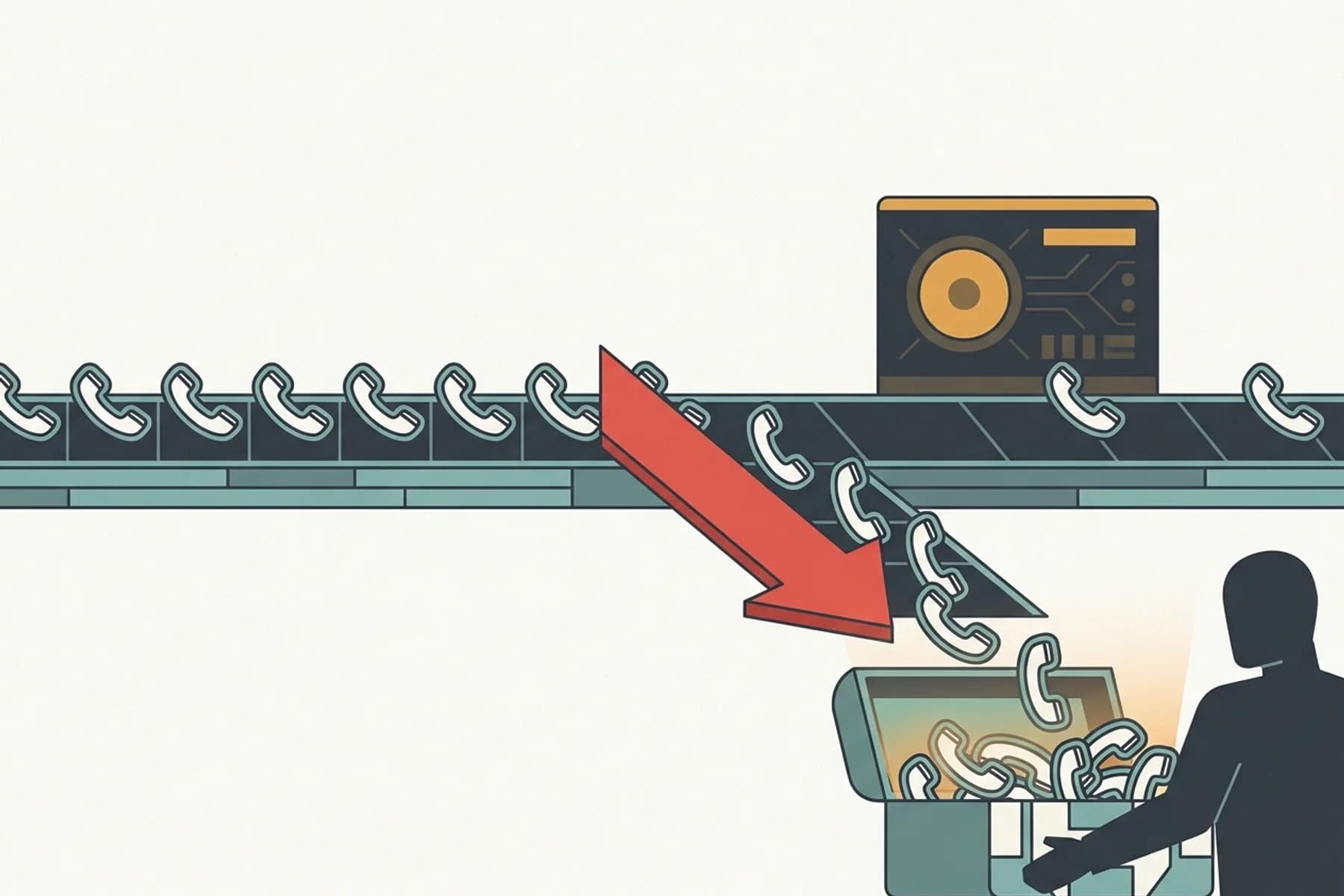
Speed to lead measures the time between a prospect contacting your business and receiving a meaningful response. For home-service phone leads, the practical goal is to answer immediately; for forms and messages, respond while the homeowner is still actively choosing a contractor.
If you're running Google LSA home services ads and not answering within 30 seconds, you're not generating leads. You're generating leads for the contractor one spot below you. Speed to lead home services is the mechanic most operators are failing — and it's where your LSA budget bleeds into your competitor's next booked job.
LSA charges per contact. Not per booked job. Not per answered call. Per contact. Google bills you the moment a homeowner taps your number. Whether you pick up or not is your problem.
That alone is expensive. But there's a second penalty most operators never see coming.
Every missed call is a negative ranking signal. Google's algorithm tracks responsiveness. Miss enough calls and your placement drops. You're now paying more per lead while competing from a weaker position. How missed calls hurt your Google LSA ranking compounds faster than most operators realize — and LeadTruffle's 2026 contractor guide makes the scale plain: 74.1% of contractor calls go completely unanswered. If that number includes yours, you're already in the hole.
The 30-second window: what Google is actually measuring
LSA Responsiveness Score is Google's measure of how reliably and how quickly a contractor answers incoming calls from Local Services Ads. It factors into ad placement — contractors who respond faster and miss fewer calls rank higher and pay less per lead over time.
Yes — Google logs missed calls as negative ranking signals. Contractors who miss calls consistently are deprioritized in their service area and pay more per lead over time. It compounds: the more you miss, the worse your position, the more each lead costs.
Google doesn't publish an exact formula. But Surefire Local's 2026 LSA analysis confirms that response time and call quality now directly affect ad ranking. Missed calls HVAC operators dismiss as minor are logged by Google as ranking penalties. A missed call isn't neutral. It's a logged event. Repeat it enough and Google deprioritizes your listing in the service area you're paying to dominate.
How LSA ranking signals work (without the jargon)
Google scores contractors on call responsiveness — answered calls improve your ranking, missed calls lower it. Think of it as a credit score for your phone line. Every answered call adds a point. Every missed call subtracts one. Google uses this to decide which contractors show up first when a homeowner searches at 7 PM on a Thursday. The contractor with the better score wins the impression. The one with the missed calls gets buried.
The compounding effect is the part that hurts. Miss 10 calls a week for a month. That's 40 negative signals. Your placement softens. Your cost per lead creeps up. You're now spending $1,500 a month to reach fewer homeowners than you did 60 days ago.
What happens to your placement after a missed call
A missed call lowers your LSA responsiveness score, which softens your placement and raises your cost per lead going forward. Run this number to see what that means for your budget. You spend $1,500 a month on LSA. You miss 30% of calls. That's $450 you paid Google for leads you never closed. The remaining $1,050 now has to work harder to deliver the same number of impressions — because your responsiveness score has declined. You didn't save money by not answering. You spent more to get less. See where phone leads actually leak in home services to understand every point in this chain.
What is the average response time for HVAC and plumbing companies on Google LSA?
88% of home services operators take longer than 5 minutes to respond to a new lead. That's not a statistic about bad operators — it's the industry baseline. Hatch's analysis of 132,188 speed-to-lead campaigns, cited by Apten's 2026 benchmarks, makes it clear: most contractors are already losing this race before they know it started.
The 88% problem
The average HVAC lead response time across the industry is well past five minutes — and that alone is a losing position. When a homeowner submits through LSA, they submit to multiple contractors at once. The first one to call wins. That's not an edge case — that's the structure of the platform. You are in a race from the moment Google charges you. Most operators don't start running until the gun fired four minutes ago.
Speed to lead HVAC and plumbing operators face is not a soft metric — it is the primary determinant of whether a paid lead converts or gets handed to your competitor. The 30-second benchmark isn't aggressive. It's what the platform rewards. Anything slower and you're not just slower — you're already behind whoever answered.
After hours is where the money goes to die
41% of home services jobs are booked after business hours. That's Housecall Pro's own platform data. Your LSA ads run 24/7. Your phones go to voicemail at 5 PM. Google keeps charging. Homeowners keep calling. Nobody picks up.
This isn't a staffing failure. You didn't hire wrong. You built a system that goes dark while Google keeps sending paid leads into the void. An after-hours answering service for home services is not a luxury — it's what closes the gap between the 41% of bookings that happen after 5 PM and the revenue you're leaving on the table. What a missed LSA call actually costs per booked job gets worse when you factor in that after-hours callers have higher urgency — and higher job values.
How much revenue am I losing from slow response times on paid leads?
The revenue loss from slow HVAC and plumbing lead response has two components: the immediate job you didn't book, and the ranking decay that makes every future lead more expensive. For a shop missing 30% of LSA calls at $1,500/month in spend, that's $450 in wasted CPL plus compounding placement loss that inflates every subsequent lead cost.
The real price of a missed LSA call
Here's the math that should bother you. An average HVAC service call runs $150 to $500. A system replacement runs $3,000 to $12,000. When a homeowner calls at 8 PM about a furnace that won't start in January, they're not looking for a callback in the morning. They're booking whoever answers.
You paid $75 for that LSA lead. Your competitor answered in 20 seconds. They booked an $8,000 install. Your LSA budget funded their job. That's not hypothetical — that's what happens every time your phone goes to voicemail on a paid lead.
Plumbing lead conversion suffers the same math — a $400 drain service or a $6,000 repipe that went to voicemail is a job you paid to lose.
The compounding effect on your ranking
The missed call doesn't just cost you the job. It costs you placement on every job that comes after it. Your ranking softens. Your cost per lead climbs. The contractor who answered your missed call is now ranked higher, paying less per lead, and winning more jobs per dollar spent. The gap widens every week you don't fix it.
Run your own numbers: take your monthly LSA spend, multiply by your estimated missed call rate, and that's the floor of your waste. Then factor in ranking decay and the true cost is higher. Calculate how much after-hours missed calls are costing you with a framework built for home services operators — not generic marketing averages.
How fast do I need to respond to Google Local Services Ads leads to maximize booking rate?
30 seconds or less. That's the target. Not 5 minutes. Not a callback within the hour. Thirty seconds. That's the window where the lead is still warm, still on your page, and hasn't moved on to the next contractor in the results.
What "fast enough" actually looks like
There are four structural options, in order of coverage:
- Dedicated CSR coverage during peak hours. Solid for business hours. Does nothing for evenings, weekends, or overflow spikes.
- Overflow answering during high-volume periods. Patches the busiest gaps but still leaves after-hours exposure.
- After-hours coverage. Closes the 41% gap. Still dependent on human availability.
- AI-powered 24/7 response. Answers in seconds. Never misses. Runs while you sleep.
The operators winning on LSA right now aren't just hiring faster or training harder. They're closing the 30-second window structurally. A system that answers before any human could — every call, every hour, every day.
What is the best way to answer after-hours calls for a home services business?
The answer that works at scale is AI. Not because humans aren't good at the job — they are. But humans have shifts. AI doesn't. An AI answering service for home services closes the 30-second window structurally — answering in seconds, every call, every hour, without a shift change. For the after-hours emergency call, the Sunday afternoon inquiry, the 10 PM furnace replacement lead: the only way to close the 30-second window every time is a system that never clocks out.
How AI Intercepts the Lead Before Anyone Else Can
The operators taking market share right now have figured out that how AI intercepts leads before your competitor picks up isn't a future advantage. It's the current baseline for anyone serious about LSA ROI.
Stop funding your competitor's next job
Here's the full picture, tight:
- LSA charges per contact, not per booked job. Slow response means money spent, job lost.
- Missed calls are a negative ranking signal. You lose the job now and pay more for leads later.
- 88% of operators are failing the 5-minute benchmark. The 30-second window is where the real competition happens — and most aren't even in the race.
- 41% of bookings happen after hours. Your ads run 24/7. Your phones probably don't.
- The fix isn't hustle — it's structure. A system that closes the window before any human could.
- Your home services marketing ROI starts at the phone, not the ad.
Every call your competitor doesn't answer is a lead you can take. The reverse is also true. Stop leaving it to chance.
See how Tradesly closes the speed-to-lead window before your next LSA call hits voicemail. Stop guessing. Get the demo.
Keep reading
 Marketing & Lead Gen
Google Ads Call Tracking for Home Services: The Step-by-Step Setup Guide
14 min read Marketing & Lead Gen
The Google LSA Math: How Much is a Poor Call-Intake Process Costing Your HVAC Shop?
14 min read Marketing & Lead Gen
Google To Charge Local Businesses For Missed & Subsequent Calls On LSAs
11 min read