


Your Google Business Profile is Ranking #1, But the Missed Calls are Costing You the Job
Ranking #1 means nothing if your calls hit voicemail. See how missed calls home services businesses ignore drain real revenue — and what to do about it.

Ranking #1 Means Nothing at 8 PM: The After-Hours Voicemail Problem Nobody Talks About
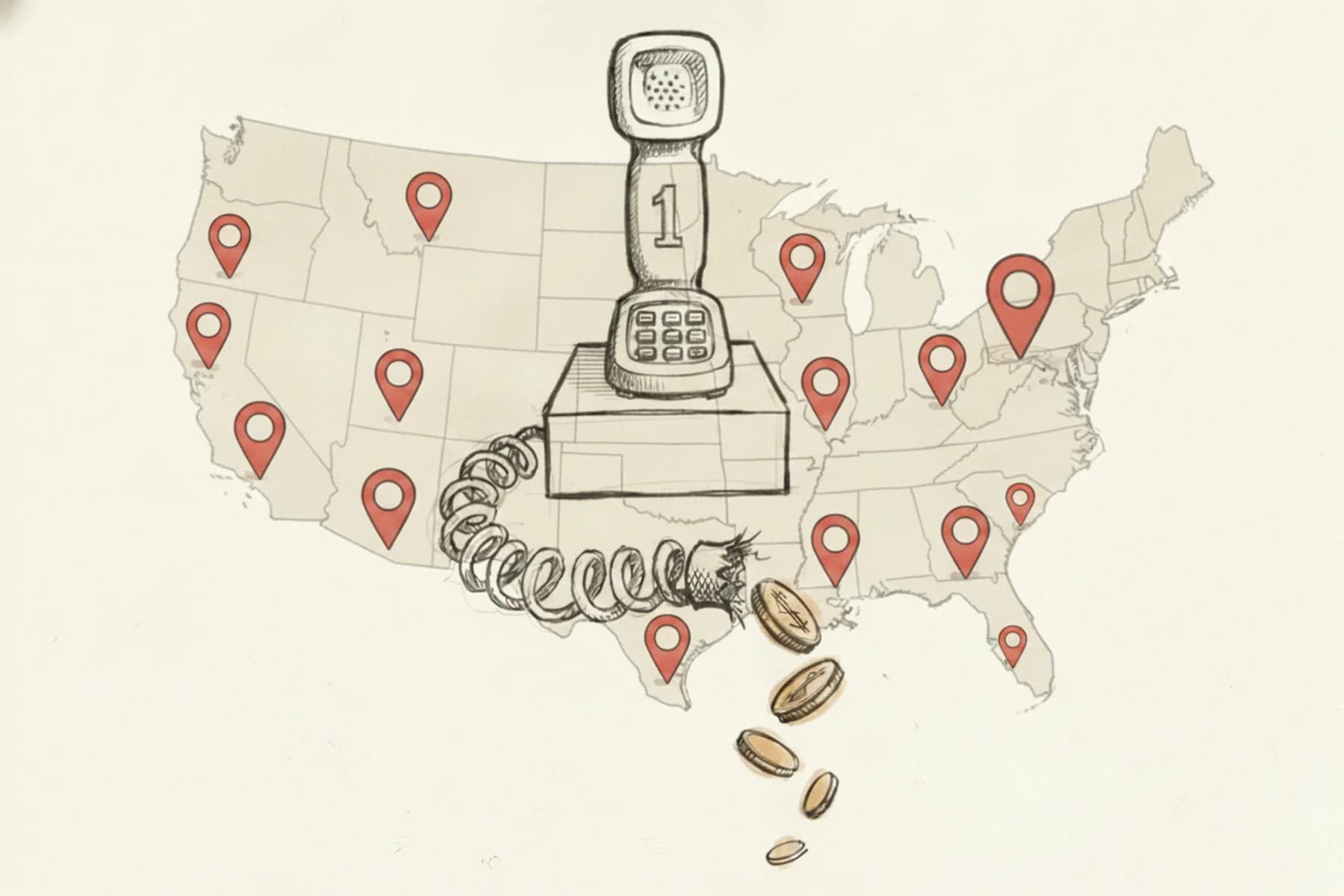
It's 7:47 PM. Someone's AC dies. They pull up Google, your Google Business Profile is the first result, they tap your number. Your phone goes to voicemail. They hang up and call the #2 result. That shop gets the job. You paid for that ranking. They cashed the check. This is what missed calls from your Google Business Profile actually cost you — and most operators never see it coming.
This is not an edge case. This is happening to home services businesses every night, during every lunch window, every time a tech is on a job and can't get to the phone. Missed calls from Google Business Profiles are not an occasional inconvenience — they are a structural revenue drain hiding behind a marketing dashboard that looks fine.
This post diagnoses where the leak is, how large it likely is, and what you can actually do about it.
There is a second consequence most operators miss — how missed calls can hurt your Google LSA ranking. We will get to that.
Missed Google Business Profile calls — customers that find your listing, dial your number, and reach voicemail or no answer — are the single largest gap between marketing spend and booked revenue in the trades. Phone leads convert at up to 46%; voicemail captures under 3% of them.
Home service leads that go to voicemail convert at under 3% — the other 97% hang up and call your competitor.
Google Business Profile call history: the numbers behind the drain
At least 27% of inbound calls to home services businesses go unanswered, according to Invoca platform data. Broader SMB research cited by CallJolt (March 2026) puts that number as high as 62% for contractors who are out in the field. Twenty-seven percent is the floor. Sixty-two is plausible on a busy Tuesday in August. The home services call answer rate floor is 27% — meaning at minimum 1 in 4 inbound calls goes unanswered.
Here is the stat that should end all debate about voicemail as a fallback: fewer than 3% of callers who hit voicemail leave a message. The other 97% hang up and call someone else.
What do callers do when they hit voicemail?
Fewer than 3% of callers who hit voicemail leave a message — the other 97% hang up and call the next result on Google. For a burst pipe or a dead AC in July, the decision window is under 60 seconds. You either answer or you lose the job. There is no second chance for emergency home services calls. Read more about what actually happens when an after-hours HVAC call hits voicemail.
Why speed to lead determines who wins the job
Responding to a web lead within 60 seconds lifts conversion 391%. Waiting just 5 minutes drops qualifying odds 80%, per PipelineOn (citing CallRail 2026 research). Speed to lead home services is not a competitive advantage — it is table stakes. And voicemail is the opposite of fast.
The after-hours dimension makes this worse. Roughly 41% of home service jobs booked online come in outside business hours, according to PipelineOn (citing WebFX 2026). A shop with no after-hours coverage is systematically giving away nearly half its potential booking volume. Every night. No drama. Just math.
What this is costing you — in real numbers
Phone leads in home services convert at up to 46%, and 37% close on the very first call, per Invoca. These are not weak leads. These are people with their credit card ready.
The per-call math
Say your average HVAC ticket is $400. You miss 10 calls a week. At a conservative 30% conversion assumption, that is 3 jobs per week you never booked — $1,200 a week, $62,400 a year.
What the annual exposure looks like for a mid-size shop
Modeled estimates from CallJolt (March 2026), based on average ticket and conversion assumptions, put the range for a mid-size HVAC operation at $45,000 to $252,000 per year in missed-call revenue. Missed calls plumbing revenue loss ranges from $18,000 to $234,000 per year for a mid-size operation (modeled estimates, CallJolt March 2026). Plug in your own numbers: calculate how much after-hours voicemail is costing your business.
The full-funnel reality: of 100 contractor website visitors, roughly 4 become booked jobs, per PipelineOn (June 2026). Most operators try to fix only the top of the funnel — more ads, better SEO — while the leak at the bottom keeps draining.
Answering the call is only half the problem
The HVAC booking rate benchmark sits at 42% for the average operator — and top performers run 62 to 70%. Elite shops clear 85%, according to Revin's HVAC operator analysis (June 2026). If your team is booking at 42%, you are leaving the same jobs on the table — just at a different stage of the call.
Why answer rate and booking rate are not the same thing
Answer rate measures whether a call was picked up; booking rate measures whether a job was scheduled — and only about 35% of CSRs actually ask for the appointment.
The caller gets information. The conversation ends. No job is scheduled. The call was answered. The revenue was still lost. Five booking-rate points on a mid-size operation outweighs answering thousands of extra calls. Fix the discipline gap first. You need to close both gaps, not just one.
When your voicemail is working hardest against you
Voicemail costs you the most during three windows: after-hours (5 PM–8 AM), the lunch window (11 AM–1 PM), and peak demand surges during extreme weather. Know them. Cover them.
After-hours (5 PM to 8 AM). With 41% of bookable jobs coming in after business hours, any shop with no coverage here is structurally surrendering nearly half its potential volume.
The lunch window (11 AM to 1 PM). Owners are in the field. Techs are on job sites. The office thins out. This is where the 62% missed-call estimate becomes plausible — not because anyone is being lazy, but because the crew is stretched.
Peak demand surges. A heat wave in July. A cold snap in January. The days when your phone rings the most are also the days your team is the most overwhelmed. The calls you need most are the ones most likely to hit voicemail.
In every one of these windows, the caller's next move is identical: scroll down, tap the next Google result, get someone on the line. There is no loyalty at the moment of a plumbing emergency. The ranking got you the ring. The voicemail gave the job to someone else.
How do I stop losing jobs to voicemail after hours without hiring more staff?
Three coverage approaches exist today. Each has a different cost profile and capability ceiling.
The coverage options available today
Option 1: Hire additional CSRs for extended hours. High cost. High training burden. High turnover risk. The coverage is real, but so is the overhead.
Option 2: A 24/7 answering service for HVAC and plumbing — AI voice agent answers every call, qualifies the lead, and books directly into your FSM. ServiceTitan, Housecall Pro, whatever you run. No humans required on the coverage side. This is where after-hours missed calls in HVAC and plumbing stop being a structural problem and start being a solved one.
Option 3: Hybrid AI and human coverage. AI handles the routine volume and after-hours calls. Trained human agents take the high-value, high-complexity calls that need negotiation or urgency.
What to look for — and what to avoid
Whatever you choose, it must book directly into your FSM, handle emergency calls with urgency, and cover all three high-risk windows.
Avoid message-taking services. A callback is not a booking. By the time you call back, the job is gone.
For the tactical detail, here is a playbook for capturing leads your voicemail is currently losing. Tradesly's AI Receptionist covers all three windows with direct FSM integration. If you want to see it in action, book the demo.
Your marketing ROI has a voicemail-shaped hole in it
You are spending real money on GBP optimization, Google Ads, LSA, maybe Angi or Thumbtack. Every one of those platforms is driving calls. Every unanswered call is a direct write-down on that spend.
Here is the distortion most operators never see: if your dashboard shows 80 calls generated and you booked 20 jobs, you might think your conversion rate is 25%. But if 30 of those calls hit voicemail, your real conversion is 40%. The problem is not your marketing. The problem is your coverage.
You can't outrank your way out of a coverage problem. More impressions feeding a broken intake is just a faster drain. Fix the intake, and the ranking compounds in your favor instead of against you. Read more on why your marketing ROI numbers may be masking a call-handling problem.
The short version
- At least 27% of inbound calls go unanswered — up to 62% during field hours.
- Fewer than 3% of callers who hit voicemail leave a message.
- 41% of bookable jobs come in after hours.
Stop guessing at your booking numbers. Find out exactly what your missed calls are costing you, then decide what to do about it. Get the demo.
Keep reading
 Marketing & Lead Gen
Google Ads Call Tracking for Home Services: The Step-by-Step Setup Guide
14 min read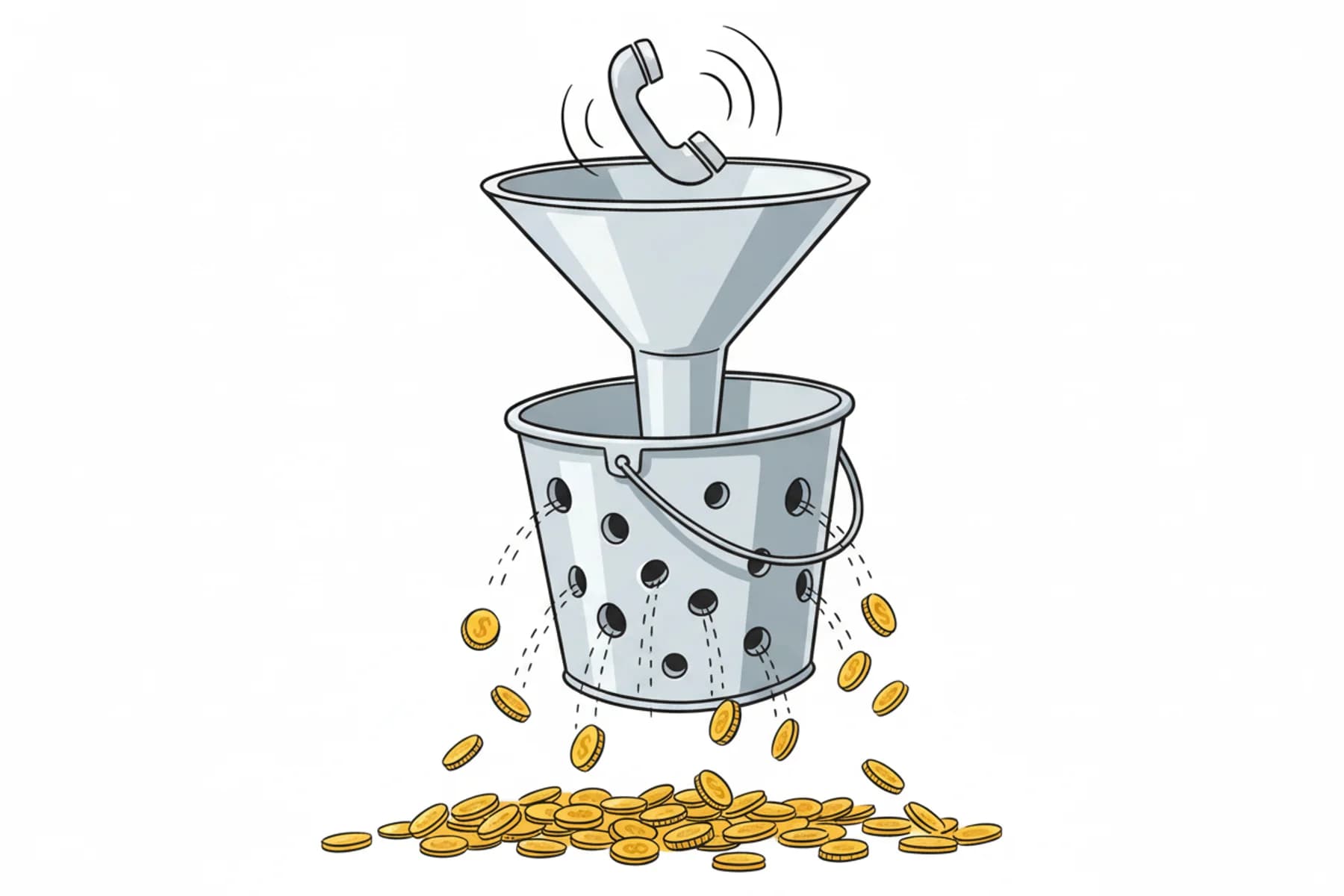 Marketing & Lead Gen
The Google LSA Math: How Much is a Poor Call-Intake Process Costing Your HVAC Shop?
14 min read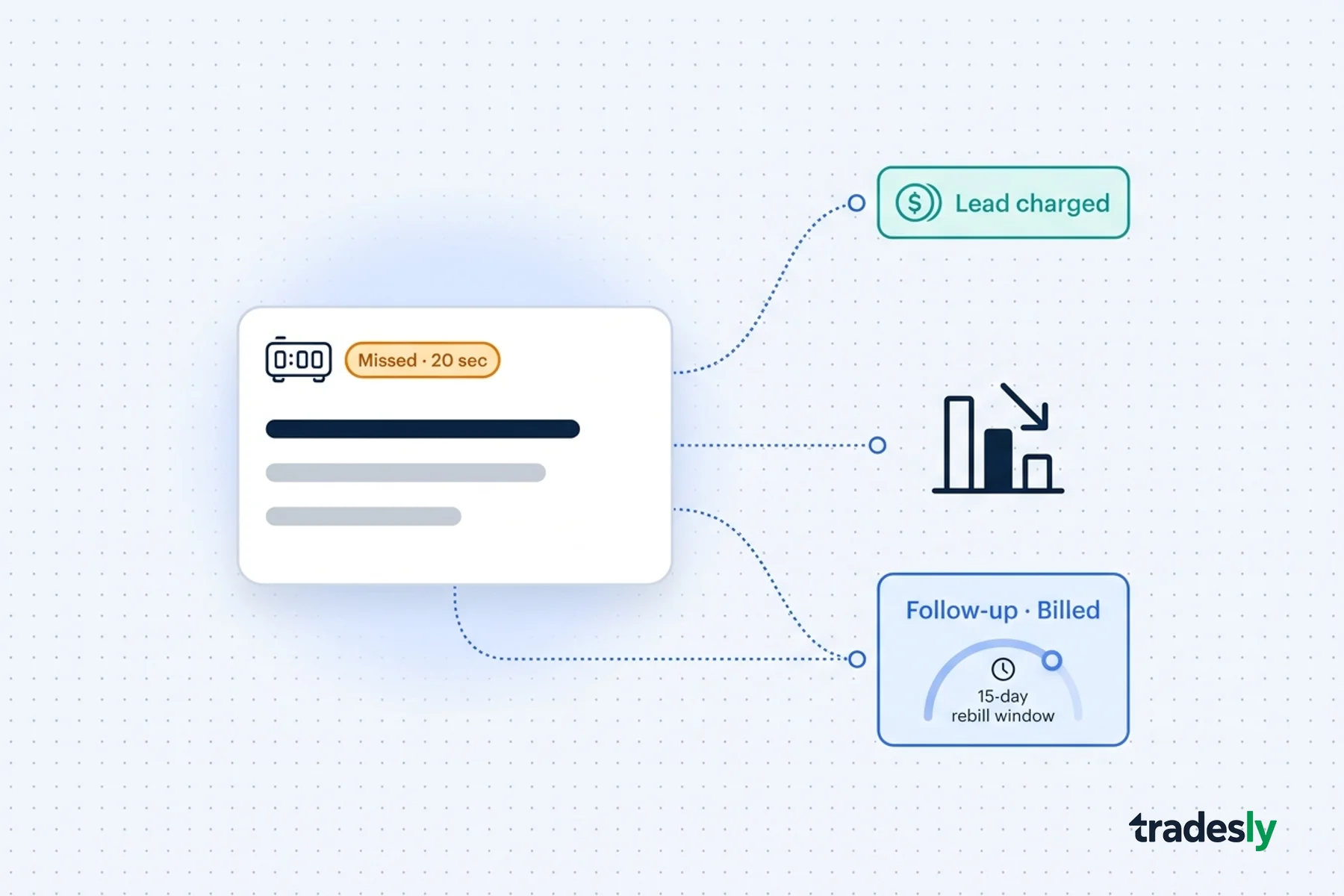 Marketing & Lead Gen
Google To Charge Local Businesses For Missed & Subsequent Calls On LSAs
11 min read