


Google To Charge Local Businesses For Missed & Subsequent Calls On LSAs
Starting Oct 1, 2026, Google bills LSA advertisers for missed calls that ring 20+ seconds. Miss a call, pay for it, and drop in rankings. Here's how to fix it.

Google's October Trap: Why Every Missed LSA Call Now Has a Price Tag
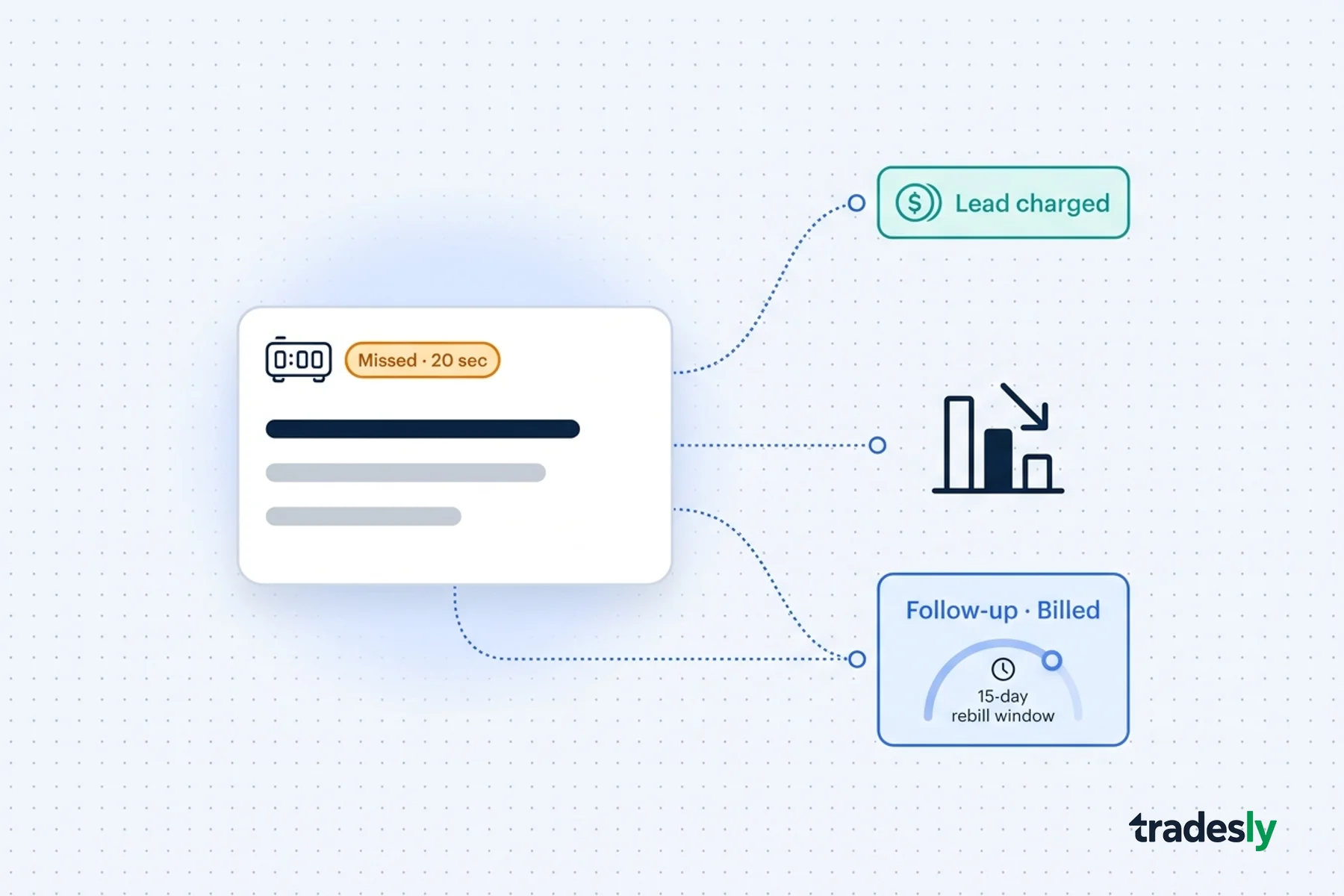
Starting October 1, 2026, Google will charge LSA advertisers for missed calls. The trigger for this Google Local Services Ads missed calls charge is 20 seconds of ringing during your listed business hours. Not a conversation. Not a voicemail. Not a callback. Just the clock running out while your phone goes unanswered.
Google sent email notifications to LSA advertisers around August 24–25, 2026 confirming the change. Most landed during peak late-summer service volume. Most got skimmed. Most owners had no idea they were reading a policy that would rewrite the economics of their ad spend. According to Search Engine Roundtable, Google confirmed that missed calls ringing more than 20 seconds during business hours will be billed as valid leads — and that subsequent follow-up calls from the same user can also be charged.
One note: most sources cite October 1 as the effective date. At least one advertiser received a November 1 date in their notification. Check your own Google email to confirm your specific deadline.
This isn't a minor billing tweak. It's a fundamental shift in what counts as a payable lead. Here is exactly how the new policy works — and why most contractor call setups will trigger it.
What Is the Google Local Services Ads Missed Calls Charge Starting October 2026?
Starting October 1, 2026, Google bills you for a missed LSA call if the caller stays on the line for more than 20 seconds during your listed business hours — whether or not anyone picks up. The billing trigger is the caller's patience, not your response.
Google LSA Missed Call Billing (2026) — the core of the updated Google LSA billing policy 2026 — is a policy under which Google charges Local Services Ads advertisers for unanswered calls that ring for more than 20 seconds during listed business hours, treating them as valid leads regardless of whether the business responds.
Before October 1, a missed call with no voicemail left only became a billable lead if your business called the customer back. Your action created the charge. After October 1, the trigger is passive. According to Search Engine Land and Promotive Marketing, the caller's 20 seconds on the line is all Google needs to call it a valid lead.
How does the 20-second rule work for Google Local Services Ads?
The 20-second rule is simple: a caller dials your LSA number during listed business hours, nobody answers, the phone rings for 20 seconds, Google bills you. You don't have to pick up. You don't have to call back. The clock is the only judge.
Subsequent and follow-up calls
Google Local Services Ads subsequent calls are also billable: if the same caller tries again within 15 days of that initial missed call, and that follow-up meets valid-lead criteria, it can be billed as a separate charge. Google has confirmed advertisers are only charged once per user within the 15-day window for follow-up calls — but the original missed-call charge still stands.
The IVR exception — and why it only partially helps
If your phone system requires callers to press a key before being connected, the 20-second timer does not start until that key is pressed. A caller who hangs up before pressing anything: no charge. This is a real mitigation. But it requires a specific phone setup, and it does nothing about an unanswered call once the caller is in your queue.
What is not changing: the dispute process
The existing lead dispute process stays in place. You can still flag leads you believe don't meet valid-lead criteria. What has changed is which calls qualify as valid leads in the first place. Disputing after the fact is not a strategy — it's a cleanup job.
One important framing note: Google's public "How leads work" help center page had not been updated to reflect this policy as of late August 2026. The policy currently lives in advertiser email notifications only. The trade press coverage from Search Engine Land and Search Engine Roundtable is the confirmation on record.
How do missed LSA calls affect Google ad ranking for contractors?
Missed LSA calls directly lower your responsiveness score. A lower responsiveness score drops your ad placement. Lower placement means fewer leads per dollar of budget — so your effective cost per booked job rises even if the nominal per-lead price stays flat.
Most LSA policy coverage is written for businesses that sit in an office. Plumbing and HVAC don't work that way. Your techs are under crawl spaces, on rooftops, in attics. The phone rings. Nobody answers. That's not a process failure — that's Tuesday.
One mid-sized plumbing contractor: 142 paid LSA calls in 30 days, 43 missed during business hours — that's 30% — and the owner guessed two or three a week.
Your Google LSA responsiveness ranking takes a direct hit every time a call goes unanswered. Per NextPhone's 2026 LSA guide citing Google's Local Services Help documentation, businesses that miss calls receive lower ad placement — fewer leads shown per dollar of budget. For HVAC and plumbing contractors, where LSA lead cost is already one of the highest per category, the compounding effect is brutal.
Before October 1: miss a call, your ranking softens, your next leads cost more. After October 1: miss a call, you're billed for it, your ranking softens, and your next leads cost more. Same missed call. Bigger bill. Worse placement.
Read more about how missed calls on LSAs already hurt your Google ranking — the October 1 policy just stacks a direct charge on top of a penalty that was already bleeding you.
What does this tell you about where Google is heading?
Google is moving closer to the transaction — billing for caller intent, not just referrals — and contractors who miss calls will pay for it twice. The 20-second threshold isn't arbitrary. It's a proxy for intent. Google is saying: a caller who waits 20 seconds is a real, motivated lead. If your business doesn't catch that call, Google still did its job — so Google is paying itself when you don't pick up.
Google is moving closer to the transaction itself — not just the referral. This connects directly to Google's move toward agentic booking and direct-call automation. Contractors who see this pattern adapt. Those who don't keep paying more for the same leads.
What are you actually paying per missed LSA call?
A single missed LSA call now triggers three separate financial consequences: the lead charge from Google, the revenue from the job you didn't book, and the ranking drop that makes your next lead more expensive. Three hits from one unanswered phone.
| Hit | What happens | When it lands |
|---|---|---|
| 1. Lead charge | Google bills you for the missed call as a valid lead | Immediately after the 20-second threshold |
| 2. Lost job revenue | The caller books a competitor instead | Same day — they're not waiting |
| 3. Ranking drop | Lower responsiveness score, worse ad placement, higher future cost-per-lead | Compounds over days and weeks |
The LSA missed call fee for contractors isn't just the lead charge — it's the compounding cost that follows. Scale three missed calls a week across a year. The ad spend burns. The missed tickets compound. And the ranking drop makes every subsequent lead cost more. Don't guess — calculate your true missed-call cost with LSA charges factored in.
For the full breakdown of what a single missed call costs in lost revenue, read what a single missed LSA call is actually costing you in lost revenue.
What should you do before October 1? Five steps to stop paying for silence.
Start by checking your own Google LSA email notification to confirm your specific effective date — then work through these five steps before the billing clock starts. The LSA 20-second rule for home services is already in effect; your job is to cut your exposure before it costs you.
| Step | Action | Why it matters |
|---|---|---|
| 1 | Confirm your effective date from your Google email | October 1 for most; some received November 1 |
| 2 | Tighten LSA business hours to match real answering coverage | Missed calls outside listed hours aren't charged |
| 3 | Add a 15-second rollover to a backup line or answering service | Stops calls crossing the 20-second billing threshold |
| 4 | Pull your LSA call history and count missed calls during business hours | That count = your current monthly charge exposure |
| 5 | Add capacity to answer — routing, overflow service, or AI coverage | The only fix is answering more calls |
Step 1: Check your own Google notification
Google sent emails to LSA advertisers with their specific effective date — most cite October 1, 2026, but at least one advertiser received November 1. Find it, read it, know your date.
Step 2: Audit your business hours settings in LSA
The 20-second rule only applies during your listed business hours. Check that your LSA profile hours match your actual answering coverage — not your aspirational schedule. Tighten the hours to reality. It's a free fix.
Step 3: Review your call routing setup
The LSA 20-second rule for home services means any call reaching 15 seconds without an answer should roll to a backup line or live answering service before it crosses the billable threshold. If you use an IVR or key-press system, the timer doesn't start until the key is pressed — that's real protection. If calls route directly to a ringing phone, you're fully exposed.
Step 4: Find where calls are falling right now
Pull your LSA call history. Count the calls marked as missed during business hours. Those are your future charges after October 1. That number is your baseline exposure. If you don't know that number, you can't manage this problem.
Step 5: Put coverage in place before the deadline
The only real fix is answering more calls. Not disputing more leads after the fact — answering more calls in the first place. Whether that's better routing, overflow coverage, or AI that picks up when your team can't, the answer is capacity. A missed call after October 1 isn't just lost revenue. It's lost revenue you also paid for.
The bottom line: your phone has to answer
Google changed the billing trigger. A missed call used to cost you a ranking point. Now it costs you a ranking point and a lead charge. The fix is the same either way — answer the phone.
The policy is what it is. The operator's job is to adapt. Start with a practical playbook for capturing every inbound call before it becomes a paid miss — it's the natural next step if you understand the problem and want to act on it.
If you want to see how Tradesly covers your calls before one of them becomes a paid miss, book a demo at try.tradesly.ai. Stop waiting.
Keep reading
 Marketing & Lead Gen
Google Ads Call Tracking for Home Services: The Step-by-Step Setup Guide
14 min read Marketing & Lead Gen
The Google LSA Math: How Much is a Poor Call-Intake Process Costing Your HVAC Shop?
14 min read Marketing & Lead Gen
Google LSA Missed Calls Cost You Twice - Here's How to Stop It
12 min read