Google LSA Missed Calls Cost You Twice - Here's How to Stop It
Google charges you for missed LSA leads AND tanks your ranking for 90 days. Discover why 74% of contractors miss calls—and the AI-powered fix that captures every lead.

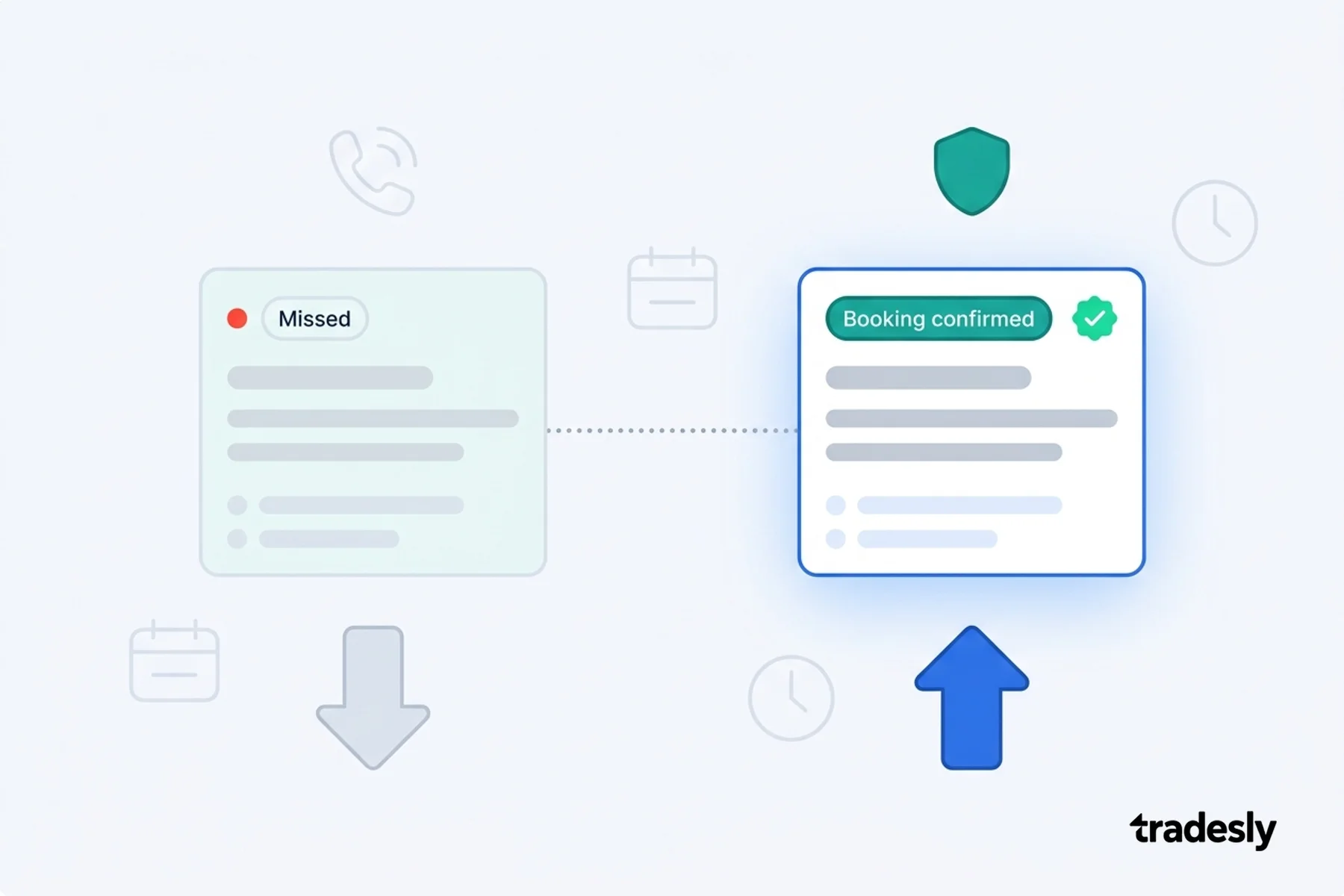
Google does not publicly document a single “phone response score” formula, but it explicitly says responsiveness, missed calls, average response time, reviews and profile quality can affect Local Services Ads ranking. Higher-quality profiles may also pay lower costs per lead. “Phone response score” is best understood as shorthand for these responsiveness signals—not a published numeric score.
Google Local Services Ads missed calls are bleeding contractors dry: not just from wasted lead fees, but from ranking penalties that compound over months. Any LSA call lasting 30 seconds or longer is automatically billed as a lead—even if you never picked up. Meanwhile, Google's AI listens to every conversation and tanks your visibility for poor responsiveness.
I've watched HVAC contractors burn $15K per month on this exact problem. They pay $80 for a flooded basement emergency, miss the call because their CSR went to lunch, then watch their ranking drop for 90 days while competitors capture the overflow.
Here's what Google doesn't want you to know: the LSA algorithm is rigged against manual operations. But once you understand how it works, you can flip it into an unfair advantage.
Why am I paying for Google LSA calls that I never answered?
Google bills you for any LSA call that rings for 30+ seconds, regardless of whether you answer. Ring time starts the moment a customer dials your LSA number. If you're on another call, in the truck, or your CSR stepped away, that countdown doesn't pause. That $85 emergency plumbing lead? You paid for it even though it went to voicemail.
Most contractors discover this the hard way. They see their LSA dashboard showing "leads" they never spoke to, then spend weeks fighting disputes that rarely get approved. The math is brutal: 74.1% of contractors are literally paying for leads they never had a chance to convert. Miss 3 out of 4 calls at $60 per lead and you're burning $135 for every $60 of actual opportunity.
Why 'verified' doesn't mean profitable
Google's "verified" badge means you passed a background check — nothing more. It doesn't measure whether you answer the phone or close the job. Yet contractors treat verification like a magic conversion wand.
The verification process screens for legitimacy, not operational excellence. Home services phone lead conversion depends on what happens after the phone rings—and that's where most verified businesses fail spectacularly.
The hidden cost most contractors miss
Beyond the wasted lead fees lies a bigger problem: opportunity cost. That missed $5,000 HVAC replacement doesn't just cost you today's revenue. It costs you the lifetime value of that customer, their referrals, and their repeat service calls over five years.
We calculated the true cost for a client: one missed high-value customer equals roughly $50,000 in lost lifetime revenue when you factor in annual maintenance, future replacements, and referral business. Most contractors only see the immediate $80 lead fee.
How do missed calls and response time affect Google LSA ranking?
Responsiveness, reviews, proximity and service-area relevance, and profile quality are the factors Google explicitly ties to LSA ranking and lead costs. Miss calls consistently, and your placement drops regardless of budget. That much is clear. How the individual signals are weighted, and what thresholds trigger changes, is not publicly documented.
What Google confirms
Google states that responsiveness affects LSA ranking. That includes your answer rate, how quickly you respond, and how customers rate their experience. Google transcribes and analyzes LSA calls with AI to evaluate responsiveness, tracking answer rates, call duration, and satisfaction signals. Reviews, proximity, and profile quality are also confirmed ranking inputs. Higher-quality profiles may pay lower costs per lead over time.
What is reasonable inference
Consistently answering calls quickly and handling them well improves the inputs Google says it measures. A rolling answer rate and response time over 90 days shapes your profile quality score. Contractors who miss calls have been observed losing significant LSA volume, with recovery taking months. This matches the logic of how Google's responsiveness signals would compound: fewer answered calls means fewer positive data points, which means worse placement, which means fewer opportunities to improve. AI call quality monitoring helps prevent this spiral by keeping answer rates near 100%.
The business impact is real. I've seen contractors lose 60% of their LSA volume after a bad week of missed calls. Their ranking recovery took four months, during which competitors captured their overflow traffic.
What is not publicly known
Google does not publish the exact weights assigned to each signal, the specific thresholds that trigger ranking changes, the formula combining responsiveness and reviews, or how long a penalty period lasts. Statements like "miss 3 calls and your ranking drops for 90 days" are patterns observed in practice, not figures Google has confirmed. Treat them as directional, not precise.
What Do Google Local Services Ads Missed Calls Actually Cost?
Missing LSA calls creates a 90-day penalty cycle where reduced ranking leads to fewer leads, making recovery nearly impossible without operational changes. Respond within five minutes, and you're eight times more likely to convert that lead, but more importantly, you avoid the ranking death spiral.
Why speed beats everything in LSA
Speed matters more than price in LSA conversions. 78% of customers hire the first contractor who responds, not the cheapest one. When a homeowner has a flooded basement, they want immediate help, not a callback in two hours.
Contractors answering within five minutes report LSA conversion rates 3–4x the industry average. Google's algorithm reflects this customer behavior. Fast responders get better placement, more trust signals, and higher conversion rates. The platform rewards businesses that match customer urgency with operational urgency.
The 'Usually responds within minutes' badge advantage
Google's "Usually responds within minutes" badge appears automatically when your average response time drops below five minutes. This badge increases click-through rates by 40% because customers see immediate reliability.
The badge creates a trust signal that competitors without it can't match. Customers assume badged contractors are more professional and available. Customers pick badged contractors. Every time. That lead you paid for goes to whoever has the badge.
What happens when competitors answer faster
When competitors consistently answer faster, they steal your market share through Google's preference algorithm. Your LSA placement drops, your lead volume decreases, and your cost per conversion increases as you compete for scraps.
Speed-to-lead response time becomes the ultimate competitive advantage in LSA because it's measurable, trackable, and directly impacts both customer experience and Google's ranking algorithm.
Beyond the lead fee—the compounding costs
The real math is brutal. Missing one $5,000 HVAC replacement doesn't just cost $5,000. It costs the maintenance contract, the referrals, the repeat business, and the Yelp review that drives future customers. Over five years, that single missed call represents $50,000+ in lost opportunity.
Then add the ranking penalty. Miss enough calls, and your LSA visibility drops 40-60% for 90+ days. During that penalty period, competitors capture your overflow while you rebuild trust with Google's algorithm.
How ranking penalties multiply over time
LSA ranking penalties create compound damage because lower visibility reduces your opportunity to improve metrics. Fewer calls mean fewer chances to demonstrate responsiveness. Poor responsiveness scores persist longer, extending the penalty cycle.
Recovery requires operational changes, not just time. You can't wait out the penalty—you need perfect responsiveness to earn Google's trust back. Most contractors never recover because they don't fix the underlying availability problem.
Case study: HVAC contractor's $15K monthly loss
Here's a composite example based on patterns we consistently see at this spend level: an HVAC contractor spending $15K monthly on LSA with terrible results. They answered 32% of calls, had a 2.8-star responsiveness score, and ranked on page 3 for their primary keywords.
The math: $15K spend ÷ 32% answer rate = $46,875 in theoretical lead value if they captured everything. They left $31,875 monthly on the table through missed calls alone. Cost per booked job calculator revealed their true cost per conversion was 3x higher than necessary.
How to improve Google LSA response time without hiring staff?
AI answering systems deliver 100% LSA response rates without additional staff costs. Contractors miss 60-80% of incoming calls, but AI never calls in sick, takes breaks, or handles multiple conversations poorly. The technology responds in seconds, qualifies urgently, and routes appropriately.
Why hiring more staff isn't the answer
More staff doesn't solve the LSA problem because human limitations remain. Staff get sick, take vacations, handle calls poorly when rushed, and cost $40K+ annually with benefits. You're trading a responsiveness problem for a profitability problem.
Even with adequate staffing, human error rates stay consistent. CSRs fumble high-pressure calls, miss qualification details, and struggle with multiple phone lines during peak periods. The reliability gap persists regardless of headcount.
How AI triage solves the LSA problem
AI for Google LSA is the only way to hit 100% answer rate without adding headcount. AI triage answers every call instantly, qualifies the lead properly, and routes urgent situations to humans with full context. Most contractors see 200-600% ROI from AI answering services because they capture 100% of opportunities while reducing staff costs.
The AI handles routine inquiries autonomously (hours, pricing, availability) freeing humans for complex diagnosis and high-ticket sales conversations. You answer every call. You close the high-ticket jobs. That's the system.
The hybrid approach that outperforms human-only teams
Hybrid AI customer service combines perfect availability with human expertise for complex situations. AI handles initial response and qualification, then transfers high-value calls to humans with complete context and recommended next steps.
24/7 AI voice agents eliminate the availability gaps that kill LSA performance. No missed calls means no ranking penalties, no wasted lead fees, and no lost lifetime value from opportunities that slip through the cracks.
Turn Google's algorithm against your competitors
Perfect LSA responsiveness creates a virtuous cycle that competitors can't match manually. 100% answer rates trigger Google's trust algorithm, leading to better placement, more leads, higher conversion rates, and increased reviews. This compound advantage becomes nearly impossible for competitors to overcome without operational changes. Your home services marketing ROI starts the moment the phone rings, not the moment you launch the campaign.
How perfect responsiveness boosts LSA ranking
Google's algorithm rewards consistent responsiveness with priority placement and trust badges. Perfect answer rates signal operational excellence, leading to the "Usually responds within minutes" badge and higher click-through rates.
The ranking boost compounds monthly. Better placement generates more leads, providing more opportunities to demonstrate reliability. Each successful interaction reinforces your responsiveness score, creating momentum competitors can't match.
The compounding effect of captured calls
Every captured call creates multiple value streams: immediate revenue, customer lifetime value, referral potential, and review opportunities. Missing zero calls means maximizing every stream. Every captured call pays you back multiple times over with AI real-time call scripting.
The math is simple. Brutal for your competitors, but simple. Capture 100% of calls, convert 40% to jobs, generate 5-star reviews from satisfied customers, earn referrals from quality work. Each piece feeds the others. That's the system. Every call captured makes the next one easier to win.
Why this creates an unfair advantage
Perfect responsiveness creates an unfair advantage because most contractors can't achieve it manually. They're stuck in the 60-80% answer rate range while you operate at 100%. Google's algorithm amplifies this gap through preferential ranking.
Competitors can't bid their way out of poor responsiveness. Higher bids don't overcome missed calls or slow response times. They're forced to pay premium rates for inferior placement while you capture their overflow at lower costs.
Frequently Asked Questions
How does speed-to-lead affect Google LSA performance scores for contractors?
Speed-to-lead response time is one of the heaviest inputs into Google's LSA responsiveness signals. Google tracks how fast you answer each call and folds that data into your profile quality score. Fast responders earn better placement and unlock the "Usually responds within minutes" badge. Slow responders get deprioritized regardless of bid. There is no bid-based workaround for a chronically slow answer rate. Speed is the score.
How does fast lead response with AI affect Google LSA cost-per-lead?
AI-powered call handling lowers your effective cost per booked job by pushing your answer rate toward 100% and improving your LSA ranking simultaneously. Better placement means more impressions without raising your bid. AI call quality monitoring ensures every billed call is properly qualified, converting a higher share of leads you're already paying for. Google has also indicated that higher-quality profiles may receive lower costs per lead over time.
How do reviews and response time affect LSA performance for contractors?
Reviews and response time are the two most visible quality signals in Google's LSA ranking framework. Response time drives real-time placement; reviews build the longer-term trust score. The cycle connects them: fast response leads to booked jobs, booked jobs produce satisfied customers, satisfied customers leave 5-star reviews, and strong reviews earn better placement. Poor response time breaks that chain at the first link.
How does Google LSA ranking work for HVAC and plumbing companies?
For HVAC and plumbing, LSA ranking is dominated by three factors: responsiveness, reviews, and service area match. Google weights response speed aggressively for high-urgency trades. In practice, a company with a 95% answer rate and 4.7 stars will outrank a competitor with a 4.9-star rating but a 60% answer rate. Bid amount matters last. Strong responsiveness and reviews earn competitive placement without outspending the market.
Can AI respond to a new Angi or Google LSA lead within 30 seconds?
Yes. 24/7 AI voice agents answer inbound LSA calls on the first ring and trigger outbound callbacks for marketplace leads within 30 seconds of a lead hitting your CRM — any hour, any day. 78% of customers hire the first contractor who responds, and conversion rates collapse after five minutes. Human CSRs cannot maintain sub-30-second response at scale. AI can — consistently.
How do answering services affect lead quality and booking rates for contractors?
Traditional answering services lower booking rates because off-script agents misqualify leads and miss urgency signals. AI answering trained on trade-specific workflows captures job type, urgency, location, and scheduling preference accurately every time. Hybrid AI customer service layers human judgment on top for high-ticket situations. Contractors using this model see booking rates improve because every call is handled consistently — no bad days, no lost details.
What happens to leads when an answering service is unavailable or at capacity?
When a human answering service hits capacity, calls queue, go to voicemail, or drop. For LSA, any call that rings past 30 seconds and hits voicemail still bills you as a lead — you paid, the customer got nothing, and they called the next contractor. AI real-time call scripting systems have no capacity ceiling. Whether one call or fifty come in simultaneously, every caller gets an immediate answer. That reliability gap is exactly where LSA ranking advantage is won or lost.
Stop paying Google for calls you never answered. Stop watching your ranking tank because your CSR went to lunch. Get the responsiveness audit that shows exactly where your LSA budget is leaking, and fix it before your competitors figure out what's happening. Schedule a demo and turn Google's algorithm into your competitive weapon.
Keep reading
 Marketing & Lead Gen
Google Ads Call Tracking for Home Services: The Step-by-Step Setup Guide
14 min read Marketing & Lead Gen
The Google LSA Math: How Much is a Poor Call-Intake Process Costing Your HVAC Shop?
14 min read Marketing & Lead Gen
Google To Charge Local Businesses For Missed & Subsequent Calls On LSAs
11 min read