


Why Your Google Ads Lead Just Cost You $285 (And How AI Fixes It)
Your marketing attribution is lying to you. The real conversion battle happens in 30 seconds after the call lands. Learn the true cost of poor phone response—and how AI fixes it.

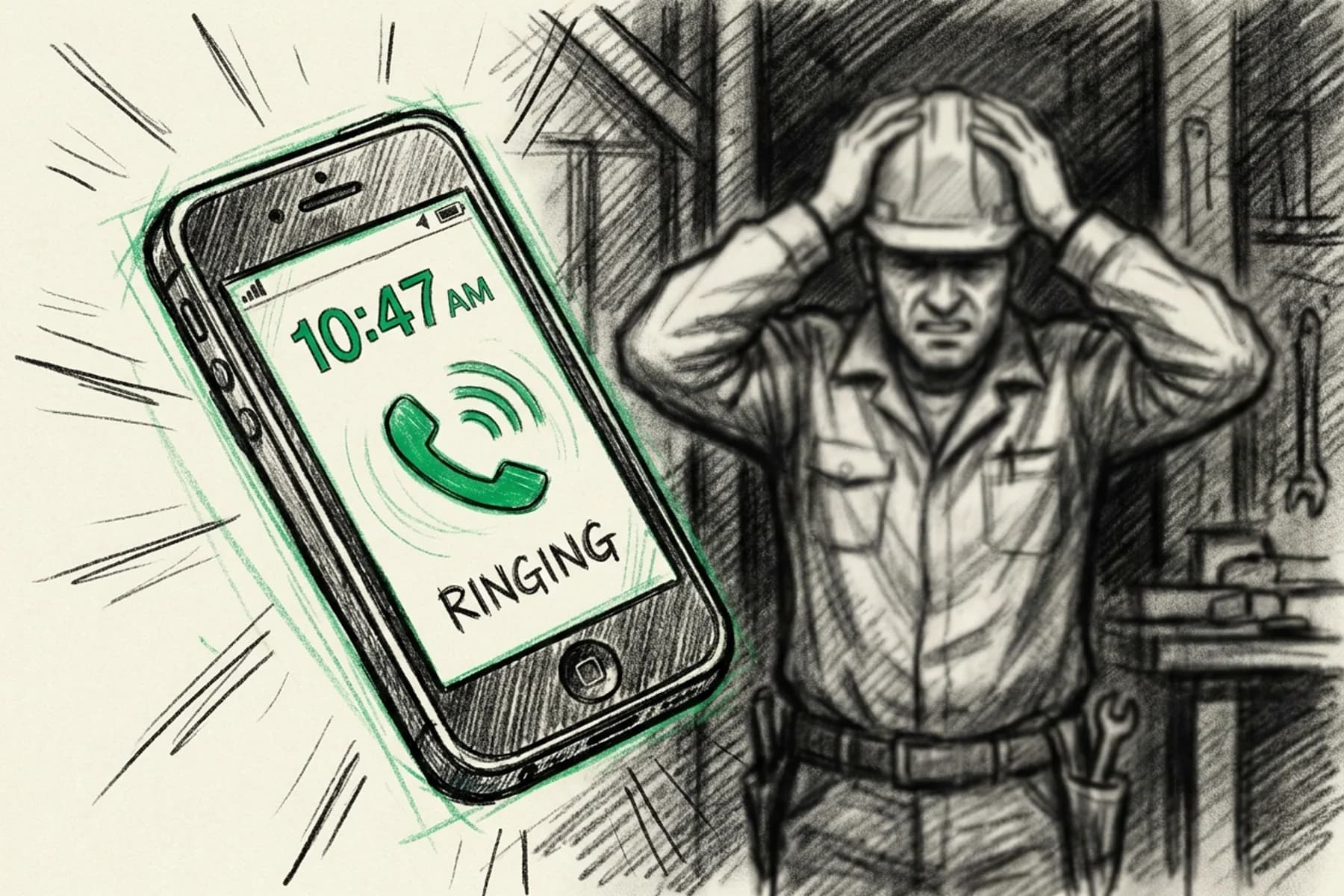
Your Google Ads dashboard says you're winning. Cost per click is down. Quality Score is up. Lead volume is steady. But your revenue isn't following the curve.
Here's what your marketing attribution won't tell you: home services phone lead conversion battles are won or lost in the 30 seconds after someone clicks your ad and dials your number. Not in your campaign optimization. Not in your landing page A/B tests. In those 30 seconds when the phone rings.
I've watched contractors celebrate $50 cost-per-lead numbers. They're bleeding $285+ in revenue per missed opportunity. The math is brutal, and most operators don't see it until it's too late.
Why do home service leads not convert after clicking ads?
85% of callers don't leave voicemail, and 78% hire the first contractor who responds. Your $50 lead just became a $285 loss the moment your phone went unanswered.
Home Services Phone Lead Conversion is the rate at which incoming phone calls from marketing campaigns turn into booked jobs, typically measured from initial call to confirmed appointment or service completion.
Let's break down the real cost of that missed call:
- Average home service job value: $285+ (HVAC service calls average $400, plumbing emergencies hit $500+)
- Voicemail callback rate: 15% (most people calling for urgent repairs won't wait)
- Speed-to-lead conversion advantage: 78% of customers hire the first contractor who responds
Your competitor answers on ring two while you're stuck in traffic. Game over. They didn't win because their ad was better. They won because they picked up the phone.
The speed-to-lead problem has turned into an arms race. Emergency service calls are happening at 9 PM, 6 AM, and during your kid's soccer game. The old "I'll call them back in an hour" approach kills revenue.
Why don't Google Analytics show true marketing ROI for contractors?
Google Analytics tracks clicks, not closed jobs. Your marketing attribution is measuring the wrong conversion event.
Here's what the data actually shows:
- Phone leads convert at 46% vs 7.8% overall digital average
- Only 35% of digital marketing calls are qualified leads (the rest are price shoppers and time-wasters)
- 37% of phone leads convert during the initial call (not after follow-up)
Traditional marketing attribution home services companies use doesn't capture the phone performance layer. Your CRM shows "Lead Created" but not "Lead Answered Professionally" or "Objection Handled Correctly."
We track cost per lead. What we should track is cost per booked job. The gap between those two numbers is where your revenue disappears.
Most operators I work with discover their real cost per acquisition is 3-4x what they thought. A $50 cost-per-lead becomes a $200+ cost-per-booking once you factor in phone performance, no-shows, and callbacks. Use our cost per booked job calculator to see your real numbers.
After-hours leads get completely missed by traditional attribution. Your Google Ads don't stop running at 5 PM, but your phone coverage does. Those emergency service calls happening at 8 PM Saturday? Pure revenue loss if nobody answers.
What is the best response time for home service leads?
Under 60 seconds. Responding within 60 seconds can increase conversions by 391%.
The 5-minute response window that marketing blogs talk about is already too late for emergency service calls. When someone's basement is flooding or their AC dies in July, they're calling multiple contractors simultaneously. First response wins.
Response speed beats ad quality every time. I've seen contractors with terrible ads and basic websites steal jobs from premium competitors because they answer the phone faster.
Here's why lead response time conversion matters more than your Quality Score:
- 58% of home service calls involve urgency (broken systems, emergencies, comfort issues)
- Emergency calls have 40% higher average ticket values (rushed jobs, after-hours premiums)
- Speed creates trust (fast response signals reliability and availability)
After-hours calls are the highest-value opportunities most contractors miss entirely. Emergency service calls at 10 PM Saturday pay double the standard rate, but only if someone answers. Our after-hours revenue analysis shows most contractors lose $40K+ annually to unanswered weekend and evening calls.
Your competitors aren't sleeping. They're using 24/7 lead capture systems to answer while you're offline.
How do AI voice agents improve lead conversion rates?
AI voice agents home services respond in under 600ms versus the human average of 42 minutes. They never miss calls, never take lunch breaks, and handle emergency service requests at 3 AM.
Here's the response time reality check:
- AI voice agent response: Under 600ms latency
- Human CSR average: 42 minutes to first response
- AI callback capability: Can dial leads within 3 seconds
But here's where most AI solutions get it wrong: they try to replace humans entirely. Missed call revenue loss happens because of response speed, but high-ticket jobs close because of human connection.
Our hybrid AI approach solves both problems:
- AI handles initial response: Answers every call, qualifies the lead, books basic service appointments
- Warm transfers for complex jobs: High-value opportunities get transferred to human CSRs with full context
- 24/7 coverage: Emergency calls get handled even when your team is sleeping
The warm transfer capability is critical. When a homeowner needs a $15K HVAC replacement, they want to talk to a human. But they want that conversation to happen immediately, not after 45 minutes of phone tag.
AI voice agents for home services integrate with your existing FSM systems (ServiceTitan, Housecall Pro, Jobber) and maintain your current dispatch workflow. You're not replacing your process. You're making sure it gets triggered every time the phone rings.
How much revenue do missed calls cost home service businesses?
The average 5-truck HVAC company loses $87K annually to missed calls alone. Multiply that by poor qualification, slow response times, and after-hours gaps.
Here's your 30-day action plan to plug the revenue leak:
Week 1: Audit your current phone performance
- Track your answer rate for one week (aim for 90%+)
- Measure average response time to missed calls (target: under 5 minutes)
- Calculate your booking rate from qualified phone leads
- Use our missed call revenue calculator to quantify current losses
Week 2: Implement proper attribution tracking
- Set up call tracking numbers for each ad campaign
- Connect phone leads to closed job revenue in your FSM
- Track cost per booked job, not just cost per lead
- Monitor your marketing ROI attribution at the phone level
Week 3: Test AI voice agent integration
- Trial AI coverage for after-hours and overflow calls
- Test warm transfer protocols for complex jobs
- Integrate with your existing FSM for seamless booking
- Follow our AI CSR implementation guide
Week 4: Measure the revenue difference
- Compare booking rates: before vs after AI implementation
- Track the revenue metrics that matter
- Calculate ROI on AI voice agent investment
- Scale successful protocols across all marketing channels
Your Google Ads are working. Your leads are coming in. The breakdown happens in those 30 seconds after the click. Fix the phone, fix the revenue.
Stop celebrating cost per lead metrics that don't pay the bills. Start tracking cost per booked revenue. The difference will shock you.
Ready to see what your real conversion numbers look like? Get the demo and we'll audit your phone performance for free.
Keep reading
 Marketing & Lead Gen
Google Ads Call Tracking for Home Services: The Step-by-Step Setup Guide
14 min read Marketing & Lead Gen
The Google LSA Math: How Much is a Poor Call-Intake Process Costing Your HVAC Shop?
14 min read Marketing & Lead Gen
Google To Charge Local Businesses For Missed & Subsequent Calls On LSAs
11 min read