

The Google LSA Math: How Much is a Poor Call-Intake Process Costing Your HVAC Shop?
At $51/lead and a 68% answer rate, your LSA budget is bleeding. Run the intake math on your HVAC shop and find out what it's actually costing you per booked job.

You're Paying $51 Per HVAC Lead and Answering 68% of Them — Do the Math
Your LSA budget has a leak — and it's not Google's fault
I've watched shop owners fire their marketing agency, hire a new one, and get the exact same results three months later. The leads weren't the problem. They never were.
The Google LSA cost per lead HVAC shops pay averages $51, according to SearchLight Digital's February 2026 dataset tracking $6.72M in spend across 888 contractors and 126,650 leads. That number is solid. What happens after the lead hits your phone line is where most shops destroy the return. By the end of this post, you will have a formula to calculate your own true cost per booked job — and know exactly what fixing each variable is worth.
What is the average cost per lead for HVAC on Google Local Service Ads in 2026?
The HVAC industry average Google LSA cost per lead is $51 in 2026, based on $6.72M in tracked spend across 888 contractors. That figure ranges from $51 to $120 depending on your market and competition level — dense metros run higher. But the CPL variance isn't your biggest problem. Your answer rate and booking rate are.
The Industry Benchmarks Most HVAC Shops Have Never Seen
These are the two HVAC lead conversion rate benchmarks every LSA spender needs to know. Before the math makes sense, you need both. Most HVAC shops have never looked at either one.
Answer rate: what the average shop is actually doing
The HVAC answering rate benchmark 2026 puts the industry average at 68%. Top-quartile shops answer 91% or more of inbound calls. Bottom quartile sits at 51% — meaning roughly half of every lead generated gets no live answer. These numbers come from Built on Tenth's HVAC CSR benchmarking research.
68% is not a marketing metric. It is a revenue multiplier. And for most shops, it is already working against them.
What is a good booking rate for HVAC inbound calls?
A good HVAC call booking rate for inbound calls is 62–70%, which is where top-performing shops operate. The industry average is 42%. Booking rate is calculated on answered calls — not total inbound volume. That distinction matters more than most operators realize.
A 42% booking rate means your CSR is converting fewer than half the calls they actually pick up. Combined with a 68% answer rate, you are starting every single lead with two structural disadvantages already baked in. Now let's run the actual math.
How do I calculate my true cost per booked job from Google LSA spend?
Your true cost per booked job equals your total LSA spend divided by the number of jobs actually booked — not leads generated. Apply your answer rate and booking rate in sequence, and the number you get is almost always worse than what shows up in your campaign dashboard.
Cost Per Booked Job HVAC is your total LSA spend divided by the number of booked appointments that resulted from those leads, after applying your answer rate and booking rate. It is the only CPL number that reflects actual revenue output from your campaign.
Here is the formula. Run it on your own numbers.
Step 1 — Calculate your true call volume
Pull your last 30 days of LSA data. Total calls delivered by Google. That is your starting number. For this example: 100 calls/month × $51/lead = $5,100 in LSA spend.
Step 2 — Apply your answer rate
At the industry average of 68%: 100 calls × 0.68 = 68 calls answered.
At top-quartile performance of 91%: 100 calls × 0.91 = 91 calls answered.
Step 3 — Apply your booking rate
Your HVAC LSA booking rate is the second multiplier in the formula. At the industry average of 42%: 68 answered × 0.42 = ~29 jobs booked.
At top-quartile performance of 65%: 91 answered × 0.65 = ~59 jobs booked.
Step 4 — Calculate your real cost per booked job
Industry average: $5,100 ÷ 29 = $176/job.
Top-quartile: $5,100 ÷ 59 = $86/job.
Same budget. Same leads. Same channel. The only variable is what happens when the phone rings.
Step 5 — Run the gap scenario
At 300 calls per month and a $1,800 average ticket, the gap between a 42% and a 65% booking rate is over $1M per year in gross revenue opportunity. (These are gross opportunity figures based on stated assumptions — not guaranteed outcomes. Your actual ticket mix and close rate will vary.)
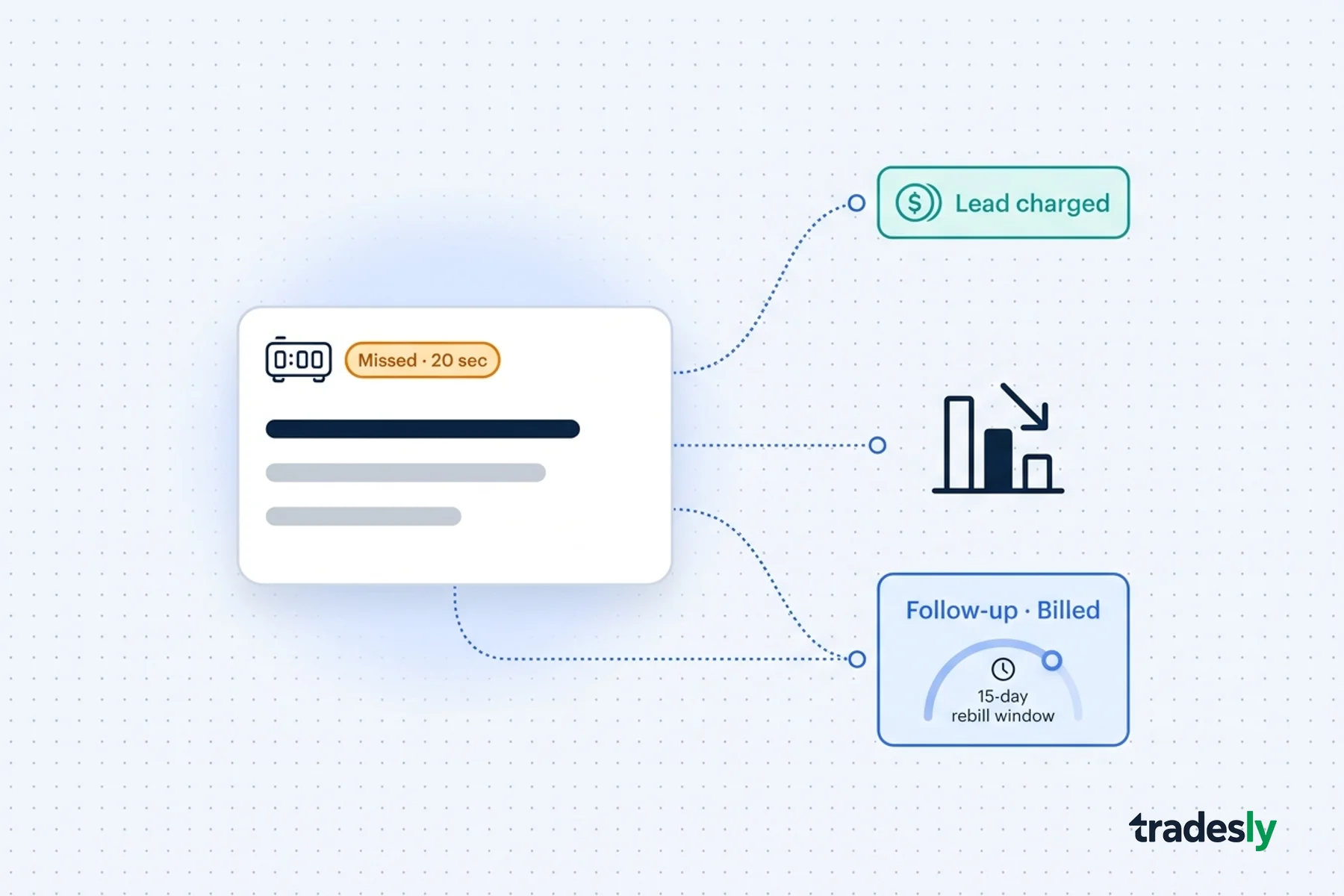
Note: Built on Tenth's 2026 HVAC marketing benchmarks confirm this pattern directly — a company with a 68% answer rate and 40% booking rate turns a $140 CPL into a $514 cost per booked job on the same channel and market. And per Google's updated billing policy on unanswered LSA calls, calls that ring past the 20-second threshold are charged regardless of whether anyone picked up. Each unanswered call is not just a missed lead. It is a charged lead.
How does call answer rate affect Google LSA rankings for HVAC companies?
Google tracks a responsiveness score for each LSA listing — and for HVAC companies, a low Google LSA responsiveness score HVAC directly suppresses ad placement. Missed calls reduce that score, which reduces impressions, which delivers fewer leads at the same spend. The revenue loss compounds invisibly.
LeadWinner's analysis of Google's official LSA ad rankings documentation confirms it in Google's own language: "Missed calls may negatively affect your responsiveness." There is no published hard-percentage threshold. But the mechanism is confirmed: answer rate is a direct ranking signal.
For the full mechanical breakdown, read how missed calls trigger Google's LSA ranking penalty.
What percentage of HVAC LSA calls go unanswered — and how much does that cost?
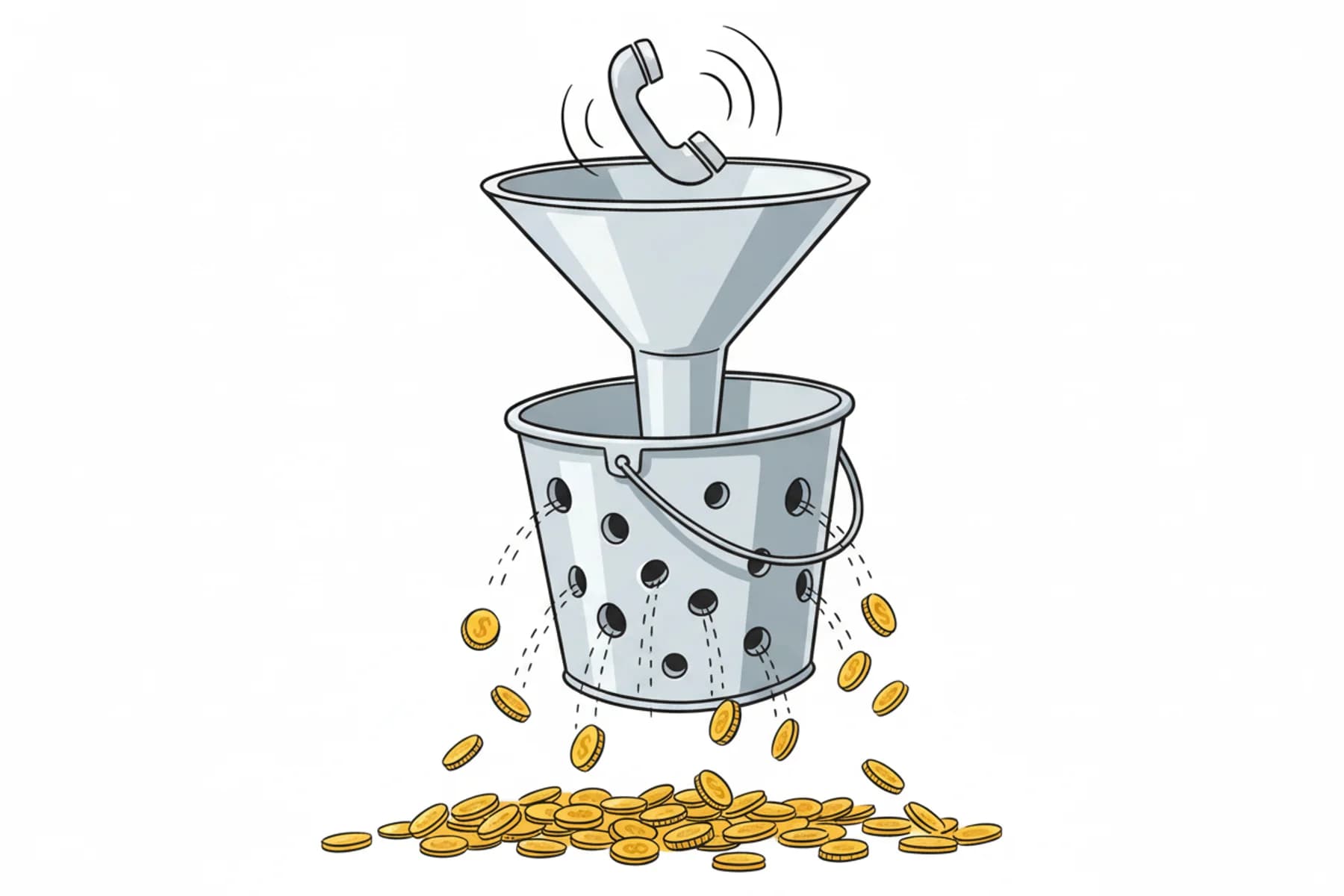
Missed calls on HVAC Google ads carry a double penalty. At the industry average, 32% of HVAC LSA calls go unanswered. At $51/lead and 300 calls/month, that is roughly $4,896 in monthly LSA spend that generated zero booked jobs from missed calls alone — before accounting for the ranking penalty. At bottom-quartile performance, it is nearly 50%.
Here is the part that stings: most shop owners think they are doing better than the average. I have seen call logs tell a different story. One HVAC contractor's actual LSA data showed 22 calls per day and 9 answered. That is a 41% answer rate on a channel they were certain they were managing.
Owners estimate based on memory. Call logs don't agree. That gap is where your money goes.
Three intake failure modes show up consistently:
- Field techs receiving forwarded calls while under a crawlspace. They cannot answer. The call goes to voicemail.
- A single CSR on a high-volume day. Overflow routes to voicemail. You never see it in your CRM because nothing was logged.
- After-hours calls during freeze and heat events. The highest-ticket leads in your LSA mix hit a dead line at 9 PM on a Saturday.
All three are fixable. Read how real-time call monitoring exposes the intake gaps eating your LSA budget to see where your calls are falling through.
How to close the gap without adding payroll
These three fixes maximize HVAC call intake ROI without adding payroll.
Fix #1 — Measure your baseline this week
Pull the last 30 days of LSA call data. Calculate your answer rate: calls answered divided by total calls delivered. Calculate your booking rate: jobs booked divided by calls answered. Plug both into the formula from the math section above. That number — your real cost per booked job — is the only metric that tells you whether your LSA campaign is working. Use the CSR scorecard template for tracking booking rate and call-to-job conversion to set up a repeatable measurement system.
Fix #2 — Cover the high-dollar surge windows first
Emergency HVAC calls — January freeze events, August heat waves, holiday weekends — carry the largest average tickets in your LSA mix. They are also the calls most likely to hit when no one is at a desk. Covering those windows with a consistent, always-on intake process is the single highest-ROI fix available. Whether that is an AI receptionist, a live answering service, or a combination, the math is the same: the ticket is large and the call would otherwise go unanswered. Read more on capturing high-intent emergency calls during peak demand without adding payroll.
Fix #3 — Score every call, not just the ones that booked
Most HVAC shops only review calls that had a complaint. That means they never see the pattern — the consistent objection their CSR fumbles, the moment the booking rate drops, the script gap that turns a warm lead cold. A consistent call scoring system creates visibility. Visibility makes training decisions intelligent instead of reactive. You cannot coach what you have not measured.
The shops winning on LSA all have one thing in common
Top-quartile HVAC shops are not spending more per lead — they are converting more of the leads they already paid for. The SearchLight Digital data puts HVAC at 9.55× closed ROAS, the highest return of any trade in the dataset. That number comes from what happens in the 10 seconds after the phone rings — not from the campaign itself.
Run the math on your shop — then fix the number
Here is the formula. Answer rate × booking rate × your LSA spend = your true cost per booked job. Moving both variables from industry average to top-quartile cuts that number in half on the same budget.
Here is what to do right now. Pull your last 30 days of LSA call data. Run the formula from Step 4 on your own answer rate and booking rate. If your cost per booked job is more than 2× what you thought you were paying, your intake process is the problem — not your campaign, not your market, not your CPL.
If you want to see what closing that gap looks like in practice, book a demo at Tradesly — we will walk through your actual numbers and show you exactly where the revenue is going.