

AI Call Qualification: The Dispatch Board Game-Changer
Most dispatch optimization misses the real problem: unqualified leads. See how AI call qualification feeds your dispatch board with high-intent jobs—and cuts callbacks cold.


I've watched too many shops optimize their dispatch boards to perfection (color-coded routes, skills-based matching, real-time updates) only to wonder why their techs are still running callbacks and chasing dead ends.
The problem isn't your board. It's what's feeding it.
The smartest dispatchers don't just optimize their boards. They optimize what gets ON the board through AI call qualification dispatch. Here's how smart dispatch technology actually works when you fix the input problem first.
AI Call Qualification Dispatch is a system where artificial intelligence screens and qualifies incoming service calls before they reach your dispatch board, ensuring only high-intent, properly qualified leads get scheduled for technician visits.
The dispatch board optimization trap every smart operator falls into
Modern dispatch solutions can cut operational costs by up to 25%, but most shops focus on optimizing the board instead of the data feeding it. Even perfect scheduling can't fix unqualified or low-intent leads hitting your system.
I see this constantly. Operators invest in advanced dispatch software, tune their routing algorithms, and train their teams on skills-based matching. Their boards look beautiful. Their efficiency metrics improve.
Then they realize their techs are still wasting time on calls that shouldn't have been dispatched in the first place.
The false win: optimized boards with poor outcomes
You can optimize a dispatch board to perfection, but if you're scheduling unqualified leads, you're just optimizing failure. A perfectly routed callback is still a callback. A skills-matched tech driving to a tire-kicker is still a waste.
The metrics lie to you. Your ServiceTitan dispatch optimization strategies show improved route efficiency, but your revenue per tech stays flat.
Why route optimization and skills matching aren't enough
Route optimization assumes every job on the board is worth dispatching. Skills matching assumes every lead needs the exact skill set they're asking for. Both assumptions break when your leads aren't properly qualified.
I've seen a master plumber dispatched to a "major leak" that turned out to be a dripping faucet the homeowner could have fixed with a YouTube video. Perfect skills match, terrible business decision.
The hidden problem: garbage in, garbage out
Your dispatch software is only as good as the data you feed it. Unqualified leads create:
- False urgency that throws off priority algorithms
- Incorrect job duration estimates that break scheduling logic
- Skills mismatches because the problem wasn't properly diagnosed
- Revenue disappointment when "emergency" calls turn into $89 service fees
How does AI call qualification improve dispatch board efficiency?
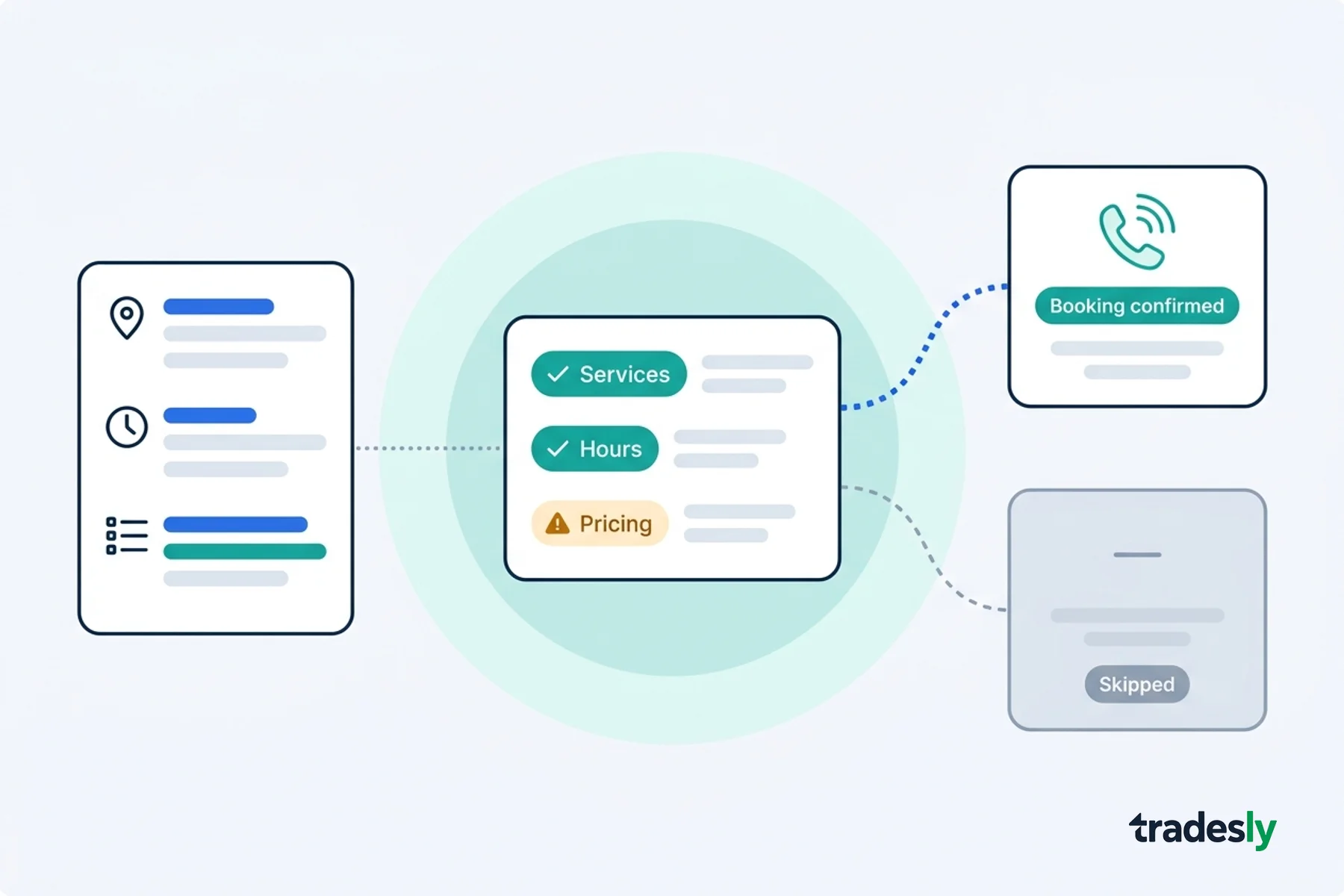
AI call qualification improves dispatch board efficiency by filtering out time-wasters and providing better job context before scheduling decisions are made. AI agents can qualify leads instantly by phone, SMS, or web, ensuring only legitimate service opportunities reach your board.
Here's what changes when you implement AI qualified leads into your workflow.
Pre-qualification creates higher-intent job assignments
AI qualification screens out the obvious time-wasters before they hit your board. Price shoppers who aren't ready to buy, DIY enthusiasts fishing for free advice, and "emergency" calls that can wait until Monday all get filtered appropriately.
What reaches your dispatch board are leads that have been screened for budget, timeline, and genuine need. Your techs show up to jobs where customers are actually ready to move forward.
Better data means smarter automated routing
Qualified leads come with better diagnostic information. Instead of "toilet won't flush," your AI provides "toilet won't flush, customer heard gurgling sounds for 3 days, attempted plunging, water level normal, likely drain blockage."
Your smart dispatch AI qualification strategies can now route this to a drain specialist instead of sending your most expensive plumber to a basic call.
The compound effect on technician utilization
When techs consistently arrive at qualified, ready-to-buy customers, several things improve:
- Job completion rates go up
- Average ticket size increases
- Callbacks decrease
- Tech morale improves
- Schedule adherence gets better
Better technician utilization compounds. Happy techs who close more jobs become your best techs. Your dispatch board optimization actually delivers the ROI it promised.
How do AI-qualified leads integrate with ServiceTitan Dispatch Pro?
ServiceTitan Dispatch Pro uses machine learning to run thousands of scenarios for optimal technician assignment, but those algorithms work exponentially better when fed AI-qualified lead data instead of raw, unscreened calls.
Here's how ServiceTitan dispatch board optimization changes when you add AI qualification to the mix.
How AI-qualified data enhances ServiceTitan's algorithms
ServiceTitan's dispatch algorithms make decisions based on job priority, technician skills, location, and availability. When your leads are AI-qualified, those algorithms get better inputs:
- Job priority reflects actual urgency, not customer panic
- Skills matching works with accurate problem diagnosis
- Duration estimates improve with better job scoping
- Revenue predictions become more accurate
I've watched shops see their ServiceTitan efficiency scores jump 30% after implementing AI call qualification. Same dispatch logic, better data.
Job Value Predictor with pre-qualified leads
ServiceTitan's Job Value Predictor tries to estimate revenue potential based on call information. With AI-qualified leads, those predictions become much more accurate because the AI has already determined:
- Customer budget range
- Timeline for decision-making
- Actual scope of work needed
- Competing priorities or quotes
Your ServiceTitan Dispatch Pro optimization can now prioritize truly high-value opportunities instead of guessing based on keywords.
Skills-based matching with better job context
When AI qualification provides better diagnostic information upfront, ServiceTitan's skills-based matching becomes surgical. Instead of sending a generalist to every call, you can route specific problems to specialists:
- Drain specialists for confirmed blockages
- Replacement experts for equipment at end of life
- Maintenance techs for tune-ups and inspections
- Senior techs for complex diagnostic work
Your AI dispatcher job assignment strategies complement ServiceTitan's native capabilities instead of fighting them.
The Jobber advantage: simplified dispatch with smarter inputs
Jobber's drag-and-drop interface displays team availability and customer history for efficient planning, and Jobber dispatch efficiency improves dramatically when dispatchers have AI-qualified lead context instead of raw phone messages.
Smaller teams running Jobber often can't afford dedicated qualification staff. AI fills that gap.
How AI qualification enhances Jobber's drag-and-drop interface
Jobber's simplicity is its strength, but simple tools need good data. When you drag a qualified lead to a tech's schedule, you know:
- The customer is ready to buy
- The problem scope is accurate
- The timeline fits your availability
- The job value justifies the dispatch
Instead of dispatchers playing phone tag to qualify leads manually, AI handles qualification automatically. Your team focuses on scheduling qualified opportunities efficiently.
Better customer context for faster scheduling decisions
Jobber shows customer history, but AI qualification adds current context. Your dispatcher sees not just what happened last time, but what the customer specifically needs right now and their readiness to move forward.
This speeds up scheduling decisions dramatically. No more "let me call the customer back to get more details." The details are already there.
Reducing manual qualification time for dispatchers
Small teams can't afford to have dispatchers spend 20 minutes qualifying every lead. AI qualification handles the screening automatically, so dispatchers spend their time on high-value activities like route optimization and customer communication.
Your Jobber workflow becomes: AI qualifies → dispatcher schedules → tech completes. Clean and efficient.
What's the difference between dispatch optimization and call qualification?
Dispatch optimization focuses on efficiently scheduling jobs that are already in your system, while call qualification determines which jobs deserve to be scheduled in the first place
Think of it this way: dispatch optimization is like organizing your toolbox perfectly, but call qualification is making sure you only put quality tools in the box. Define what constitutes a qualified lead for your business. Common qualification criteria include: Your AI system learns these criteria and applies them consistently to every inbound lead. Set up your AI qualification system to feed qualified leads directly into your FSM software. The integration should be seamless — qualified leads appear in your dispatch board with all the context your team needs. Most AI voice agent integration processes require some technical setup, but the payoff in data quality is immediate. Your dispatchers need to understand they're now working with pre-qualified leads. This changes how they approach scheduling: The learning curve is minimal because your team uses the same dispatch tools, just with better data. The key metrics for measuring AI qualification impact are dispatch board utilization efficiency, first-time job completion rates, and revenue per dispatched technician. Traditional dispatch metrics focus on schedule optimization, but qualification metrics measure whether you're scheduling the right jobs in the first place. Track these metrics to measure your AI qualification ROI: Measure how much of your scheduled capacity actually generates revenue. Before AI qualification, you might schedule 8 hours of calls but only complete 6 hours of billable work due to callbacks, cancellations, and low-value calls. After AI qualification, that ratio should improve dramatically. You're scheduling fewer total calls but more revenue-generating opportunities. This metric reveals qualification quality. Well-qualified leads result in higher first-time completion rates because: Track this metric monthly. I've seen shops improve from 70% first-time completion to 85%+ with proper AI qualification. This is the ultimate qualification metric. Your revenue metrics for trades businesses should show higher average ticket size and better conversion rates on dispatched calls. If AI qualification is working, you'll see fewer total dispatches but higher total revenue. Quality over quantity. Dispatch boards still have gaps despite optimization because most systems focus on efficient scheduling of all incoming leads instead of qualifying which leads deserve scheduling in the first place. Even perfect route optimization can't fix revenue gaps created by dispatching unqualified opportunities. The gap problem persists because operators confuse activity with results. A full dispatch board isn't successful if half those calls don't generate meaningful revenue. Start by auditing where unqualified leads are hurting your current dispatch efficiency. Look at your callbacks, cancellations, and low-value service calls. That's your AI qualification opportunity. Most home service businesses lose 20-30% of their dispatch efficiency to unqualified leads. Fix the input problem and your existing dispatch optimization suddenly works like it's supposed to. Pull reports on: These patterns reveal where better qualification would improve your dispatch outcomes. Select AI qualification technology that integrates with your current dispatch system. The best solutions work with ServiceTitan, Jobber, and other major FSM platforms without requiring you to change your core workflow. Your AI tools selection guide for trades businesses should prioritize integration compatibility over feature lists. Plan implementation to minimize disruption. Your dispatch team should see improved data quality, not workflow changes. The AI layer should be invisible to your existing operations while dramatically improving results. Proper field service AI integration means your current FSM software works better, not differently. The qualification layer feeds your existing dispatch logic with higher-quality inputs. Stop optimizing your dispatch board and start optimizing what gets on it. When AI qualification feeds your dispatch system properly qualified leads, your existing optimization efforts finally deliver the ROI they promised. Ready to see how AI call qualification transforms your dispatch efficiency? Book a demo and we'll show you exactly how pre-qualified leads change your dispatch game.Step 1: Set up AI qualification criteria
Step 2: Configure dispatch system data flows
Step 3: Train your team on the new workflow
What metrics measure AI qualification impact on dispatch operations?
Dispatch board utilization rates
First-time completion percentages
Revenue per dispatched job
Why do dispatch boards still have gaps despite optimization?
Getting started: your next steps
Audit your current dispatch inefficiencies
Choose your AI qualification approach
Integration planning with your existing stack