


Voice AI Expert Implementation: Why DIY Fails in Home Services
DIY voice AI projects fail in home services. Learn why generic solutions miss trade terminology, emergency handling, and high-ticket sales. Expert implementation saves time, money, and prevents $500K+ losses.

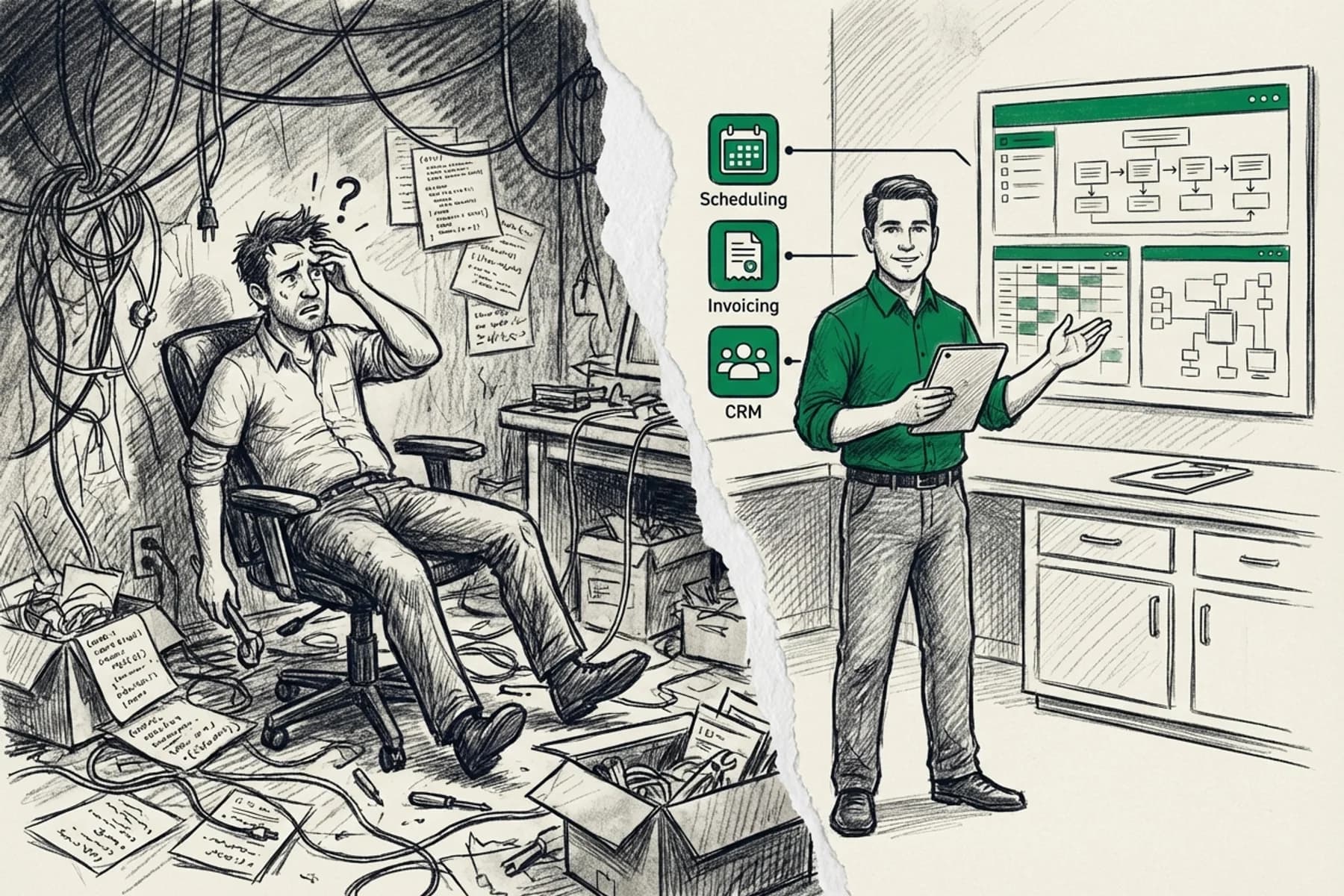
Most home service owners think voice AI is like installing a new CRM. Plug it in and watch the magic happen. I've watched dozens of these DIY projects crash and burn. The reality? Voice AI expert implementation home services requires specialized knowledge that generic platforms simply don't provide.
Voice AI Expert Implementation is the process of deploying AI-powered call handling systems using specialized knowledge of trade terminology, emergency protocols, and industry-specific workflows that generic DIY solutions cannot provide.
Here's what Gartner found: over 40% of agentic AI projects will be canceled by 2027 due to escalating costs and unclear business value. For home services specifically, that failure rate is even higher.
The stakes are real. A failed voice AI project doesn't just waste money. It costs you 12 to 24 months of competitive advantage while your competitors book jobs around the clock.
Why do DIY voice AI projects fail in home services?
DIY voice AI projects fail in home services because they lack specialized expertise in trade terminology, emergency call routing, and high-ticket sales conversations that only industry-specific solutions can provide. Generic platforms simply cannot handle the complex requirements of HVAC, plumbing, and electrical service calls.
The complexity behind "simple" voice AI is staggering. What looks like a straightforward chatbot interface actually requires:
- Models models trained on trade terminology
- Integration with FSM platforms like ServiceTitan and Jobber
- Emergency call routing protocols
- High-ticket sales conversation handling
- Compliance with industry regulations
Most off-the-shelf models struggle with trade terminology. When a customer says "My furnace is short-cycling," generic models might hear "short cycling" and completely miss the context. That's a $15,000 repair opportunity lost because the AI couldn't understand basic HVAC language.
Failed implementations cost $10K to $25k+ in sunk investments. But the real cost is opportunity cost. Every day your competitors answer calls faster while you're debugging your DIY system.
What expertise is needed for successful voice AI implementation?
Successful voice AI implementation requires expertise in seven critical areas: model tuning for trades, FSM integration, compliance handling, performance monitoring, conversation design, latency optimization, and escalation protocols. These areas demand specialized knowledge that DIY approaches cannot provide.
Voice AI implementation challenges in home services stem from the unique requirements of emergency response, trade terminology, and high-value sales conversations that generic solutions cannot handle effectively.
Emergency HVAC calls require different handling than routine maintenance bookings. A flooded basement at 2 AM needs immediate technician dispatch. A seasonal tune-up can wait until morning. Your voice AI needs to understand this difference and route accordingly.
Word Error Rates tell the real story. ASR systems in real-world situations can have error rates from 18% to over 60%. That means 1 in 5 to 3 in 5 words are misunderstood. Would you trust a system with those odds to handle your $25K HVAC installations?
High-ticket sales conversations require human expertise that AI must support, not replace. Our hybrid AI customer service for high-ticket trades approach uses AI for qualification while coaching humans through the complex sales process.
After-hours coverage gets complicated fast. Which calls go to emergency dispatch? Which can wait for morning callback? Which need immediate technician deployment? Generic voice AI platforms don't understand these nuances.
What are the risks of DIY voice AI for HVAC companies?
DIY voice AI risks for HVAC companies include failed speech recognition of technical terms, improper emergency call routing, integration failures with existing systems, compliance violations, and revenue loss from mishandled high-ticket sales opportunities.
Here are the seven critical expertise areas where DIY projects typically fail:
Model tuning for trades
Generic models choke on trade terminology. "Condenser coil," "heat exchanger," "capacitor" aren't in standard training datasets. Expert implementations use home services conversation data to train models specifically for trades.
Integration complexity
Your voice AI needs to talk to ServiceTitan, Jobber, or your existing FSM platform. This isn't a simple API call. It requires specialized middleware that understands how dispatch boards work. Our ServiceTitan integration took months to perfect.
Compliance and data handling
Home services handle sensitive customer data and emergency situations. Your voice AI needs to comply with local regulations while maintaining security standards. DIY platforms rarely address these requirements.
Performance monitoring
How do you know if your voice AI is working? Expert implementations track booking rates, call quality scores, and revenue metrics. Not just call deflection numbers.
Conversation design
Designing conversations for emergency scenarios versus routine bookings requires deep understanding of customer psychology and operational workflows. It's not just writing scripts. It's engineering trust.
Latency optimization
Interactive voice tasks break down when delays exceed 0.4 seconds. Achieving this response time requires specialized infrastructure and optimization that DIY projects rarely achieve.
Escalation protocols
When should the AI hand off to a human? How does it transfer context? Our warm transfer capabilities ensure no information gets lost when AI passes complex calls to human agents.
How do voice AI experts approach home services implementation?
Voice AI experts approach home services implementation by using industry-specific training data, implementing hybrid AI strategies that combine automation with human coaching, continuously optimizing based on real performance metrics, and focusing on business outcomes rather than just technical functionality.
Industry-specific training data makes all the difference. We feed our models thousands of actual HVAC, plumbing, and electrical service calls. The AI learns not just what customers say, but how they say it when their basement is flooded or their air conditioning dies in July.
Hybrid AI strategy is crucial. Experts understand that building vs buying voice AI agents isn't just about cost. It's about getting the strategy right. AI handles routine calls while coaching humans for high-value sales.
It's really a bad idea to try to set up an AI voice agent if you have no experience with prompt engineering or how AI agents work in general. A typical customer of ours is somebody that's either a business owner or they're running customer service operations.
What they are not is a prompt engineer. When they try to program an AI agent themselves, their results are terrible. Bad inputs equal bad outputs. Tradesly works one-on-one with customers to learn how they do business. Our prompt engineers turn those business rules into effective prompts. It takes more time up front, but you get an AI agent that performs 1,000 times better than DIY attempts. This level of home services AI expertise is what separates professional implementations from failed DIY projects.
Continuous optimization separates experts from amateurs. We monitor booking rates, call quality, customer satisfaction, and revenue impact. When performance drops, we know exactly where to adjust.
Business outcome focus means tracking what matters: revenue per lead, booking rate improvement, and customer satisfaction scores. Not just "how many calls did the AI answer."
How much does voice AI implementation cost for home services?
Voice AI implementation costs for home services range from $10K to $25K+ for expert implementation versus $500K to $2M+ for failed DIY projects when including sunk costs, recovery expenses, and lost opportunity costs over 12 to 24 months of delayed deployment.
Hidden DIY costs add up fast. You need developers, prompt engineers, infrastructure, compliance expertise, and ongoing maintenance. Building a custom voice agent takes 4 to 9 months before it's ready for real customer calls. Working with our expert team at Tradesly can get you up and running in half the time and at a fraction of the cost.
Expert implementation timeline is dramatically shorter. 4-8 weeks to go live versus 4 to 9 months for DIY. That's 6+ months of your competitors booking jobs while you're still in development.
ROI comparison shows the real difference. Expert implementations deliver measurable ROI within the first quarter. DIY projects that do succeed often take 12+ months to show positive returns if they ever do.
When DIY projects fail, recovery typically costs 30 to 50% of the original investment, but prevents 100% loss. Still, you've lost months of competitive advantage and customer trust.
How to Choose the Right Voice AI Expert for Home Services
Choosing the right voice AI expert requires evaluating their industry experience, technical capabilities, and implementation approach to ensure they understand the unique challenges of emergency response, trade terminology, and high-ticket sales processes.
Industry experience validation
Industry experience validation is your first filter. Has the vendor worked with ServiceTitan, Jobber, or your specific FSM platform? Do they understand the difference between emergency dispatch and routine booking? Can they show you actual home services implementations?
Technical capabilities assessment
Technical capabilities assessment goes deeper than marketing claims. Ask about Word Error Rates for trade terminology. Demand latency benchmarks. Verify their compliance and security standards. Our guide to choosing the right AI tools walks through the essential technical questions.
Implementation approach evaluation
Implementation approach evaluation reveals their strategy. Do they offer hybrid AI that enhances humans rather than replacing them? Can they warm transfer complex calls with full context? Do they focus on revenue metrics or just call deflection?
Look for proven experience with FSM integrations. Your voice AI needs to create jobs, schedule technicians, and update customer records in real-time. This isn't plug-and-play. It requires deep integration expertise.
Verify their understanding of after-hours emergency protocols. A flooded basement can't wait for business hours. Your voice AI specialist trades expert should understand emergency escalation procedures and have systems to handle urgent situations appropriately.
Ensure they grasp high-ticket sales processes. A $15K HVAC installation requires human expertise for financing discussions, system sizing, and complex objection handling. The AI should qualify and warm transfer, not try to close the sale.
Stop trying to become an AI expert overnight
Voice AI expert implementation home services isn't a weekend project. It requires specialized expertise in trade terminology, emergency protocols, FSM integrations, and revenue optimization that takes years to develop.
The smart move? Partner with experts who've already solved these problems. Get live in 4-8 weeks instead of struggling for 9 months. Focus on running your business while the experts handle your voice AI implementation.
Ready to skip the DIY disaster and go straight to expert implementation? Get a demo of Tradesly's voice AI platform built specifically for home services.
Keep reading
 AI Receptionist & Answering
Why AI Receptionists Lose Your $15K HVAC Calls
7 min read AI Receptionist & Answering
The Best HVAC Answering Service: 4 Tiers That Impact ROI
8 min read AI Receptionist & Answering
The Break-Even Point for an AI Receptionist: When Does Automation Pay for Itself in a Home Service Business?
7 min read