


AI Legal Intake: How to Improve Accuracy Without Losing the Human Touch
Misspelled names and missing callbacks lose matters. Learn how to set AI legal intake rules, sort calls and hand sensitive ones to a person. See the checklist.

Your Intake Accuracy Problem Is a Process Problem, Not an AI Problem
A prospective client calls your firm after a car accident. The intake note has a misspelled name ("Jon Smyth"), no matter type and no callback number. Nobody calls back, and the caller hires the next firm on the list.
That is a process failure, and AI legal intake will repeat it faster if you skip the rules. This guide gives you a five-part checklist and a rule for sorting calls.
What does accurate AI legal intake actually mean?
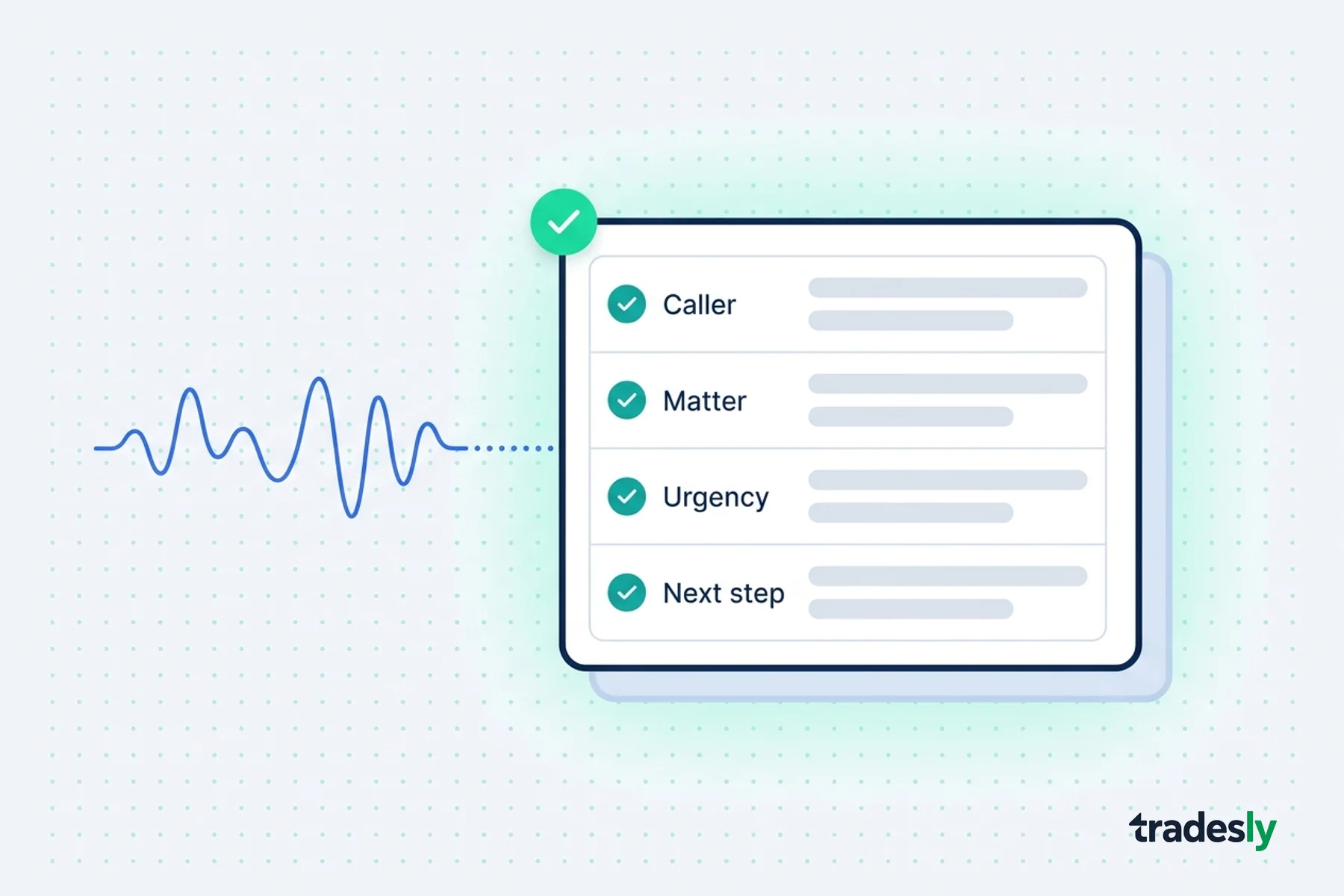
Accurate AI legal intake captures four things: correct caller details, correct matter type, correct urgency and a clear next step. Miss any one and the record fails the caller, however clean the transcript looks.
AI legal intake is the use of AI to answer prospective client calls, capture required details, screen for matter fit and book a consultation, with a person taking the calls that need judgment.
The four things every intake record needs
- Caller details: name spelling, callback number, best time to reach them.
- Matter type: one clear line, matched to what your firm takes.
- Urgency: a flag based on your written rules, not a guess.
- Next step: who calls, when, and what the caller was told.
See our overview of legal intake services.
What do missed and mishandled intake calls cost a law firm?
They cost you the prospective client, usually permanently. Per Clio's 2024 Legal Trends Report, the share of firms answering a prospective client's call fell from 56% in 2019 to 40% in 2024.
What the 2024 secret-shopper data showed
Of the firms that missed a call, only 20% returned it. And 64% of prospective clients got no follow-up by phone or email, as reported by the Oklahoma Bar Association.
Quantify it for your own firm
Use the calculator to estimate what missed or mishandled intake calls cost your firm.
Does AI legal intake have to follow confidentiality rules for prospective clients?
Yes, the duty attaches to how your firm handles prospective client information, whether a person or a tool answers the phone.
ABA Model Rule 1.18 in plain English
Under ABA Model Rule 1.18, a person who consults a lawyer about possibly forming a client-lawyer relationship is a prospective client. The lawyer generally must not use or reveal what they learned. A brief intake call counts.
What ABA Formal Opinion 512 adds for AI tools
Opinion 512 applies existing Model Rules to lawyers' use of generative AI. Washington State Bar News notes it extends the Rule 1.18(b) duty to AI tools used with prospective clients.
What should a law firm ask an AI intake vendor?
Before you sign for AI intake for law firms, ask four questions:
- Where is caller data stored?
- Does it train models?
- What disclosure does the caller hear?
- Who reviews escalations, and how fast?
If a vendor cannot answer plainly, it is not ready.
How can law firms improve intake accuracy with AI?
Prospective client intake accuracy comes from five disciplines: required fields, read-backs, written rules, escalation triggers and weekly review. Build your law firm intake process before you turn the tool on.
1. Required fields before the call ends
A call is not done until you have name, callback number, matter type, referral source, urgency and next step. This week: write the list down and use it on every intake path.
2. Read-back confirmation of name, number and matter
The agent repeats the name spelling, number and a one-line summary back to the caller. It catches the "Smyth" and "Smith" errors that kill callbacks. This week: add the read-back to your script.
3. Matter-type and urgency rules written down
Spell out which matters you take, which you refer out and what counts as urgent. This is firm policy, not legal advice. This week: get attorney sign-off on one page.
4. Conflict-sensitive and sensitive-topic triggers
Define the situations that route to a person immediately, such as a caller naming an opposing party or a caller in crisis. This week: list your top ten triggers.
5. Weekly review of real call records
Pull a sample of records every week and check them against the required fields and read-back rule.
For the empathy side of these calls, read about keeping empathy in AI-assisted conversations.
When should an AI intake call be handed to a person?
Hand the call to a person when the caller is distressed, the situation is time-critical, the matter is high-value or the caller asks for a lawyer or a human.
Which calls AI can own, and which need a person
The table sorts each call type.
| Call type | Who handles it | Why |
|---|---|---|
| General inquiry about the firm | AI | Simple, repeatable answers |
| Scheduling a consultation | AI | Clear steps, no judgment needed |
| After-hours capture of basic details | AI | Nobody else is available, and details must still be captured |
| Matter-fit screening | AI | Follows your written rules |
| Distressed or emotional caller | Person | Empathy and judgment |
| Time-critical situation | Person | A wrong call costs the caller |
| High-value matter | Person | Trust decides the signing |
| Caller asks for a lawyer by name or asks a sensitive question | Person | Beyond intake scope |
Illustrative framework, not legal advice.
What a warm handoff must include
A warm handoff must include four things: caller details, a matter summary, an urgency flag and what the caller was told. The person is briefed before they speak, so the caller never repeats the story.
The AI should never give legal advice or promise outcomes.
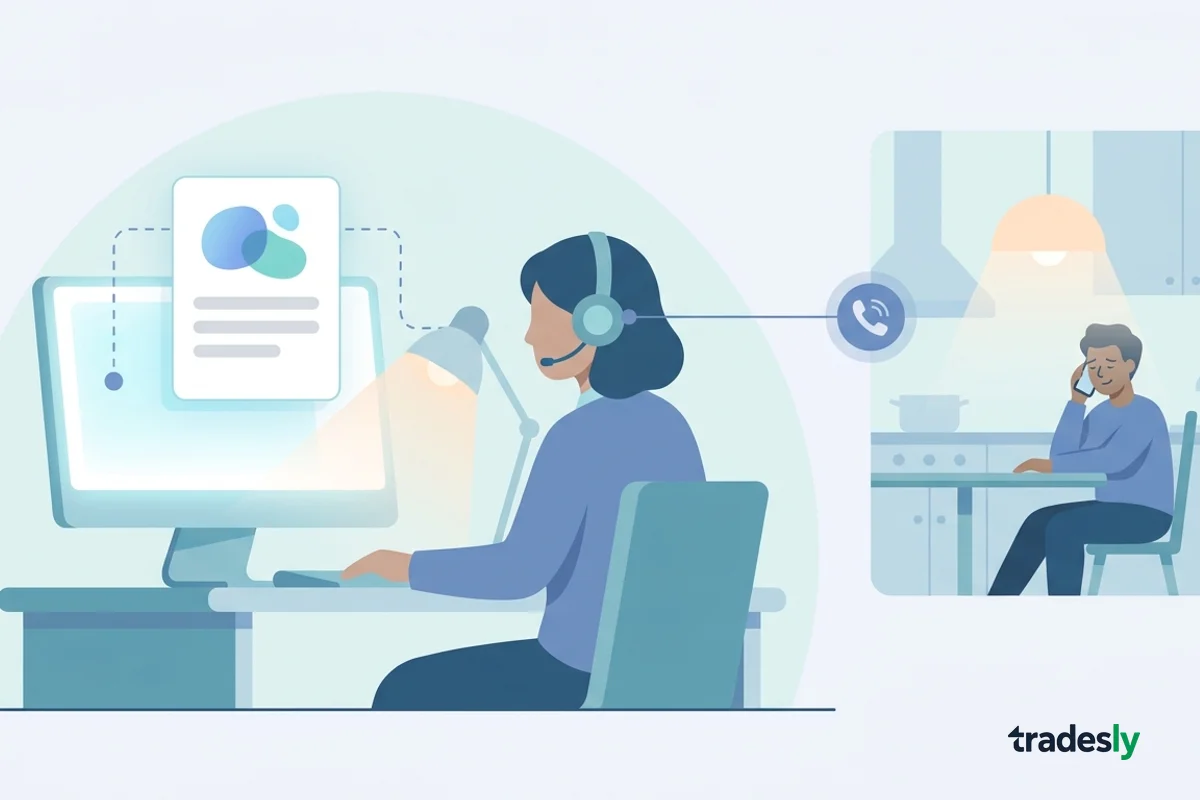
Tradesly's Full-Service CSRs use AI for routine and after-hours calls and Tradesly's own people for calls that need judgment. See how Tradesly supports law firms.
Why does after-hours AI legal intake break accuracy first?
Nights, weekends and peak hours are when details get dropped.
Set the rule for when a person takes over
The standard does not drop at 5 PM. After-hours calls need the same fields, read-back and triggers. Name who gets called if a trigger fires at midnight. By 10 AM the next business day, the named intake lead calls back every escalated or after-hours caller, with the matter summary, urgency flag and what the caller was told from the intake record.
Comparing options? Review law firm answering service options against this standard.
Key takeaway and next step
Key Takeaway: Set the rules first. Accuracy follows. Put a person on the calls that need judgment, with context already in hand.
- Define accuracy by four fields.
- Know your duties from the first call.
- Run the five-part checklist.
- Sort calls before they arrive.
- Hold after-hours to the same standard.
See how Tradesly handles legal intake. Get the demo.
This article is general information, not legal advice. Check your state's rules.
FAQ
Does AI intake have to follow the same confidentiality rules as a human receptionist?
Yes. ABA Model Rule 1.18 sets the baseline, and states vary.
How accurate is AI legal intake?
It is as accurate as the rules you set. Require fields, add read-backs and audit records weekly.
Do I have to tell callers they are talking to AI?
Disclosure depends on your state's rules, the tool and how it is used. Confirm the requirement with your ethics counsel before launch.
Keep reading
 AI Receptionist & Answering
Why AI Receptionists Lose Your $15K HVAC Calls
7 min read AI Receptionist & Answering
The Best HVAC Answering Service: 4 Tiers That Impact ROI
8 min read AI Receptionist & Answering
The Break-Even Point for an AI Receptionist: When Does Automation Pay for Itself in a Home Service Business?
7 min read