

Red Flags in the 'AI Employee' Revolution: 7 Questions to Ask Before You Replace Your Entire Front Office with a Bot
Most AI employee projects fail because businesses ask wrong questions. Get the 7-question framework to avoid costly implementation disasters.


Before You Replace Your Call Center with an AI Bot, Ask These 7 Questions
Every week, I see another home services company get burned by "AI Employee" implementations that promise the world and deliver chaos. The latest casualty? A 20-tech HVAC shop in Phoenix that spent six months and $40K building an AI voice system that couldn't transfer a flooded basement call to a human without hanging up on the customer.
Here's the brutal truth: most AI employee implementation projects fail not because the technology is bad, but because business owners ask the wrong questions upfront. Vendors sell replacement fantasies while glossing over the 47 ways your AI bot will torpedo customer relationships.
Stop drinking the Kool-Aid. Start asking the hard questions.
AI Employee Implementation is the process of deploying autonomous AI systems to handle customer service functions previously managed by human staff, often marketed as complete human replacement solutions.
The AI employee implementation promise vs. reality
AI vendors promise 24/7 availability, cost savings, and perfect consistency. Reality? 57% of failed AI initiatives stem from unrealistic expectations and 38% from poor data quality. The gap between demo and deployment is where dreams die.
What vendors promise:
- "Fire your entire call center"
- "Never miss another call"
- "Perfect customer service at 10% the cost"
What actually happens:
- Customers hang up when they realize they're talking to a bot about an emergency
- AI breaks down during complex conversations, leaving customers stranded
- Your most valuable calls (high-ticket installs, upset customers) get butchered by bots
The fundamental tension? Customers want control and understanding. AI systems want structured conversations and predictable inputs. When these clash—and they will—your revenue suffers.
I've analyzed dozens of AI voice agent implementation failures. The pattern is always the same: vendors oversell capabilities, businesses underestimate complexity, and customers pay the price.
The alternative? A hybrid AI approach that handles routine tasks while preserving human connection for revenue-critical moments.
What questions should I ask before implementing an AI employee?
Before you sign any AI employee contract, demand answers to these seven questions. Skip even one, and you're gambling with your customer relationships.
Question 1: What happens when your AI can't handle the call?
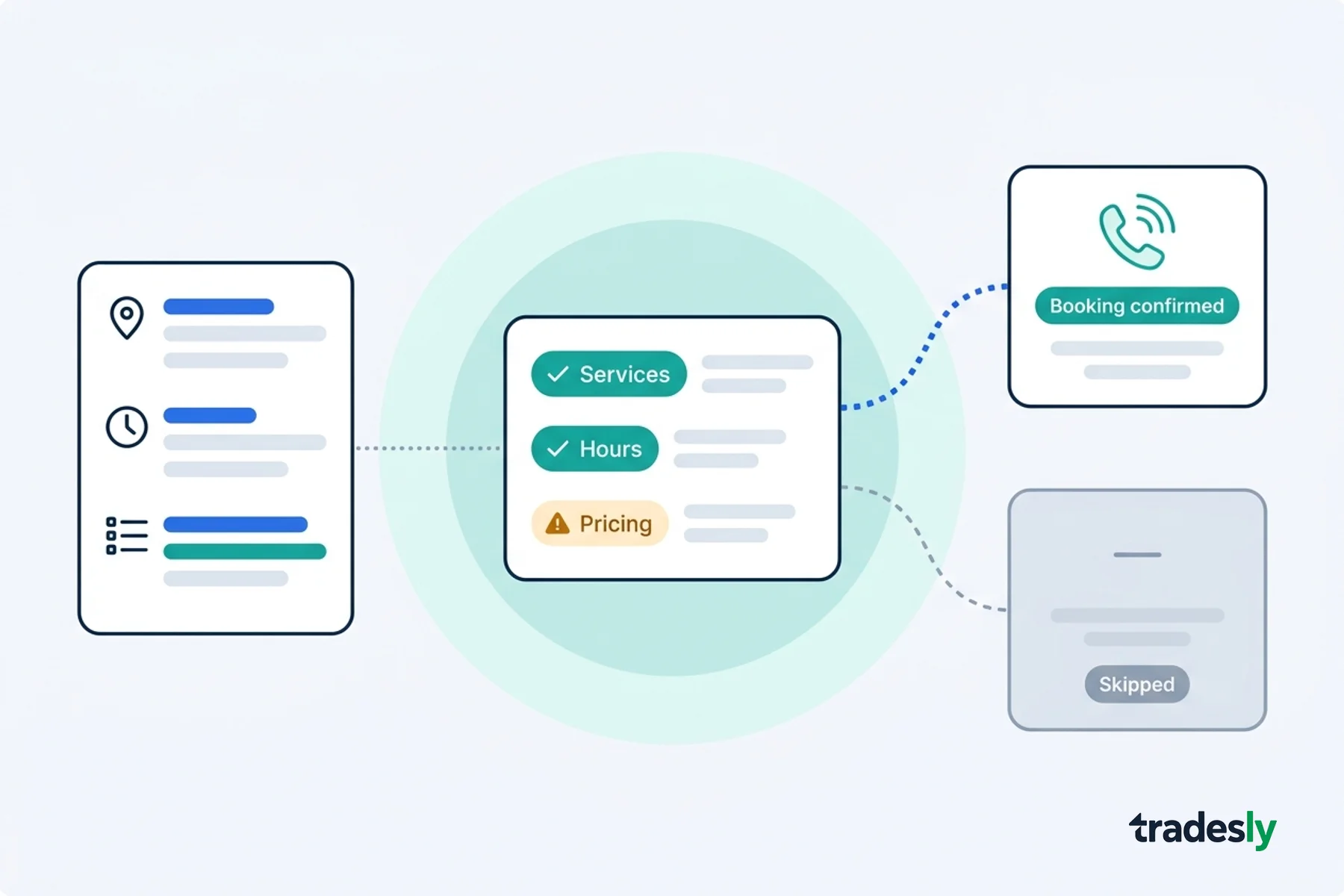
Every AI system hits its limits. The question is: what happens next? Most vendors demonstrate the 80% of calls that work perfectly. They don't show you the 20% where their bot fails spectacularly.
The escalation moment is everything. Bad AI systems do cold transfers—your customer repeats their entire story to a human who knows nothing about the conversation. 65% of customers say they frequently have to re-explain information to different representatives.
Good systems preserve context and do warm handoffs. Great systems know when to escalate before the customer gets frustrated.
Red flag: Any vendor who says "our AI handles 95% of calls perfectly" without explaining escalation paths. They're selling you a fantasy.
Question 2: How does it handle emotional or urgent calls?
Home service emergencies don't wait for business hours. When a customer calls at 2 AM with no heat and two crying kids, they need human empathy, not a chatbot cheerfully asking for their ZIP code.
AI systems struggle with emotional nuance. They can't detect the panic in a customer's voice when their basement is flooding. They can't make judgment calls about waiving service fees for a loyal customer who's clearly distressed.
Your highest-value customers—the ones with $25K HVAC installs or commercial service contracts—expect to talk to humans for complex issues. Route them to a bot, and they'll call your competitor. These AI customer service problems compound when emergency situations demand immediate human judgment.
Understanding AI customer service empathy limitations helps you design better escalation triggers.
Questions to ask:
- How does the system detect emotional distress?
- What's the protocol for emergency calls?
- Can it escalate based on customer tone, not just keywords?
Red flag: Vendors who claim their AI "handles emotions just like humans." It doesn't. Find out when it knows to step aside.
Question 3: What's your plan for the 20% it can't handle?
Even the best AI voice agents only handle routine interactions effectively. Contact center conversations are rarely linear, and brittle flows tend to break when the caller interrupts, changes the topic, or gives an incomplete answer.
Here's the kicker: that 20% of complex calls often represents 80% of your revenue. Emergency repairs, major installations, upset customers, commercial accounts—these high-value interactions require human judgment.
You still need human agents. The question is: how many, when do they intervene, and what happens to your service quality when your AI can't handle volume spikes? Planning for AI call center implementation means acknowledging these limitations upfront.
Questions to ask:
- What percentage of calls require human intervention?
- How do you staff for peak periods?
- What's the fallback when AI systems go down?
Red flag: Any vendor who can't give you specific numbers on escalation rates. They either don't know or don't want you to know.
Question 4: How will you maintain quality without human oversight?
Quality assurance gets harder with full AI replacement. Users deploying GoHighLevel's Voice AI report a major limitation: almost zero visibility into what went wrong on a call when a customer complains.
Many AI systems are black boxes. When a customer says "your bot was rude," can you review what happened? Can you fix it? Without feedback loops, AI performance degrades over time.
Questions to ask:
- Can you record and review every AI interaction?
- How do you track performance metrics?
- What's your process for continuous model improvement?
We built AI call quality monitoring specifically because most systems can't tell you why they failed.
Question 5: What happens when it makes a mistake?
AI mistakes in home services aren't just embarrassing—they're expensive. Wrong scheduling costs you truck rolls. Misquoted prices cost you margin. Missed emergencies cost you customers.
Recovery from AI errors is often harder than preventing human errors. When a CSR screws up, they can apologize and fix it immediately. When AI screws up, customers get frustrated with "the system" and blame your company. Understanding AI replacement risks means planning for error recovery from day one.
Brand reputation damage from bad AI interactions spreads faster on social media than good human service ever could.
Questions to ask:
- What's your error recovery protocol?
- Who's liable when AI makes costly mistakes?
- How do you prevent repeated errors?
Understanding AI agent liability before deployment can save you thousands in legal headaches.
Question 6: How much will implementation really cost?
"Low monthly fee" marketing hides the real costs. Most solutions require 3-6 months of setup and integration work. Most AI voice deployment failures come from weak workflow selection, poor escalation design, production audio issues, latency, governance gaps, and scaling too early.
Hidden costs include system integration, custom prompt engineering, ongoing model training, and technical support staff.
Questions to ask:
- What's the total cost of ownership for year one?
- Who handles technical integration?
- What ongoing maintenance is required?
Read our build vs buy AI voice agents analysis to understand the real economics.
Question 7: Is this really better than coaching your existing team?
Here's the question most vendors hate: what if you invested that AI budget in training your existing team instead?
Real-time AI coaching of human agents often delivers better results than full replacement. Your CSRs keep the empathy and judgment. AI provides the consistency and script guidance.
The choice isn't human vs. AI—it's bad humans vs. coached humans vs. autonomous AI. Coached humans win for high-value interactions every time.
We've seen shops improve booking rates by 40% using CSR coaching with AI without replacing a single human.
Why do AI voice agents fail in customer service?
AI voice agent failures happen because vendors sell fantasies while ignoring fundamental limitations. Autonomous AI works for routine tasks but breaks on emotional, complex, or high-value interactions—exactly where home service businesses make their money.
The smarter alternative: AI that enhances instead of replaces
The best AI voice solutions handle routine tasks and empower humans for complex interactions. This isn't about choosing sides in the human vs. robot war. It's about putting the right tool in the right place.
Hybrid AI systems work because they recognize their own limitations. Routine scheduling, basic questions, after-hours messages? Perfect for AI. Emergency repairs, upset customers, $20K installations? That's human territory.
Triage-based systems capture every call while preserving high-touch service for valuable customers. You get the 24/7 coverage without sacrificing the relationships that drive revenue.
Success comes from knowing what NOT to automate, not from automating everything. The shops winning with AI use it strategically—bots handle the busywork so humans can focus on the big jobs.
Ready to see how hybrid AI customer service works in practice?
What's better: AI replacement or AI coaching?
AI coaching consistently outperforms full replacement for high-value home service interactions. Coaching preserves human empathy while adding AI consistency, delivering better customer satisfaction and revenue results with lower implementation risk.
Stop gambling with your customer relationships. The AI employee revolution isn't about replacing humans—it's about making humans better.
Ask the hard questions. Demand real answers. And remember: the goal isn't to be the first shop to go full AI. It's to be the shop that's still growing while competitors dig out from implementation disasters.
Try Tradesly's hybrid approach and see how AI can enhance your team without replacing your customer relationships.