


CSR Compensation Model: AI-Backed Pay That Cuts Turnover
Stop guessing on CSR pay. Learn the 3-part compensation framework and how AI call scoring makes performance metrics objective, transparent, and fair. Download templates.
 Vincent WongFounder & Editor-in-Chief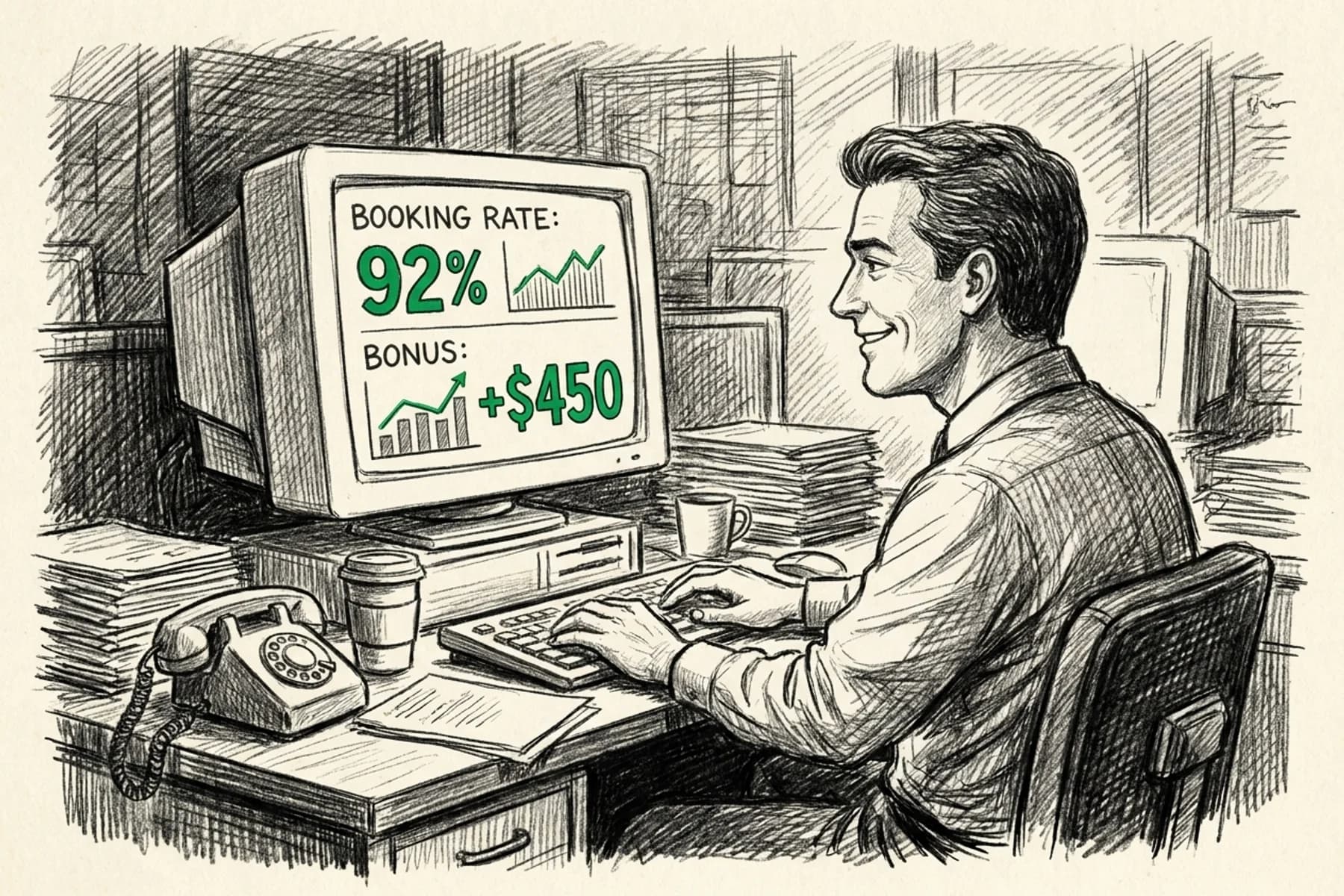
Your plumbing CSRs are losing you money, but not because they're lazy. They're losing you money because your plumbing CSR compensation model is broken. Most CSR pay structures rely on subjective "performance reviews" that feel arbitrary to employees and create more disputes than results.
I've watched shops try everything from flat hourly rates to complex commission structures. The problem isn't the pay amount. It's the measurement system. When CSRs can't see exactly why they earned (or didn't earn) a bonus, the whole system breaks down.
AI-powered call scoring fixes this by making every compensation decision objective and transparent. No more arguments about "who's performing better." No more CSRs claiming the system is rigged. Just clear data that shows exactly how each call contributed to booked revenue.
AI-Powered CSR Compensation is a performance-based pay system that uses artificial intelligence to score 100% of customer service calls objectively, eliminating subjective performance reviews and creating transparent, defensible compensation decisions based on actual booking rates and call quality metrics.
The CSR compensation crisis: why most models fail
CSR turnover costs up to two times their annual salary to replace. For a CSR making $32,000, that's $64,000 in hiring, training, and lost productivity costs. Yet most shops still use compensation models that guarantee turnover.
The problem starts with subjective performance reviews. Managers say "Sarah's booking rate is good, but she needs to work on her attitude." Sarah hears "my performance is being judged on things I can't control." Trust breaks down. Sarah starts looking for another job.
The trust gap between managers and CSRs over 'performance'
CSRs want clear, objective metrics. Managers want flexibility to account for "intangibles." This gap creates disputes over every bonus decision. I've seen CSRs quit over $50 bonuses they felt they earned but didn't receive.
The real problem: Without objective call scoring, performance pay feels arbitrary. CSRs don't trust it. Managers can't defend it. The whole system becomes a source of friction instead of motivation.
Why subjective reviews kill motivation
When performance reviews rely on manager opinion instead of data, CSRs optimize for the wrong things. They focus on appearing busy instead of booking jobs. They avoid difficult calls instead of learning to handle objections.
The real reason CSR turnover is so high isn't pay. It's unclear expectations and unfair evaluation.
Entry-level CSRs earn an average of $15.47 per hour. But the best performers can book 2x more jobs than average performers. Without objective measurement, you're paying top performers the same as bottom performers. That's not sustainable.
How should I structure CSR compensation for my plumbing company?
CSR compensation should include three parts: base rate ($18-24/hour), booking bonuses ($25-50 per appointment), and team incentives. Here's what we've seen work across hundreds of home service companies:
Base hourly rate structure: $18-24/hour for entry level, $22-28/hour for experienced CSRs. This covers basic job responsibilities—answering phones, data entry, scheduling callbacks.
Performance bonuses tied to booking rates: $25-50 per booked appointment above your baseline target. If your shop averages 45% booking rate, set the bonus threshold at 55%. Pay $30 for every booking above that level.
Team incentives for overall metrics: Monthly bonuses when the entire CSR team hits department targets—total bookings, customer satisfaction scores, or revenue per call.
What booking rate should I expect from my home services CSRs?
Home services CSRs should achieve 62-70% booking rates for top performance. Emergency calls should book at 70% or above, maintenance calls at 80%+. Top-performing HVAC operations book 62 to 70% of answered calls.
Most shops get stuck at 40-45% because they're measuring wrong. They count all calls the same way. A quote request for a $15,000 HVAC replacement shouldn't have the same booking target as a seasonal tune-up call.
Break down your targets by call type. Use our CSR booking rate benchmarks and metrics to set realistic but challenging goals for each category.
How do I measure CSR performance objectively without disputes?
AI scores 100% of calls using consistent criteria. No manager bias. No sampling errors. No disputes over "what really happened on that call."
Traditional QA programs listen to 5-10% of calls. Managers cherry-pick examples that support their predetermined opinions about each CSR. This creates arguments, not improvement.
Why call recordings aren't enough
Recording calls without scoring them is like filming basketball games without keeping score. You have data but no actionable insights. CSRs need to know: Did I handle that price objection correctly? Did I follow the script? Did my tone sound professional?
Call recordings show what happened. Call scoring shows whether what happened was good or bad for your business.
AI call scoring eliminates subjectivity
AI measures specific, objective criteria: booking rate, script adherence, objection handling, call duration, customer satisfaction cues. Every CSR gets scored on the same metrics using the same standards.
Instead of arguing about "attitude" or "effort," you're discussing concrete data points. "Sarah, your booking rate was 73% this month, above our 65% target. But you missed the upsell question on 40% of calls. Here's the training to fix that."
Our AI call quality monitoring with 100% coverage system catches every missed opportunity and coaching moment. CSRs can see exactly which calls contributed to their bonus calculations.
Real-time coaching prevents problems before they cost money
AI doesn't just score calls after the fact—it coaches CSRs during the call. When a customer says "that seems expensive," AI prompts the CSR with the exact objection-handling script. The CSR recovers the booking instead of losing it.
Traditional coaching happens days or weeks after the call. By then, the revenue is already lost. Real-time AI coaching for CSRs fixes problems while the customer is still on the line.
CSR compensation templates (download)
Here are three proven models we've tested across 200+ home service companies:
Template 1: Hourly + Booking Bonus Model
- Base rate: $20/hour (covers all basic duties)
- Bonus: $30 per booking above 65% monthly rate
- Example: CSR books 45 jobs out of 60 calls (75% rate). Target was 39 bookings (65%). Bonus: 6 extra bookings × $30 = $180
Template 2: Tiered Performance Structure
- Level 1: $18/hour (0-59% booking rate)
- Level 2: $22/hour (60-69% booking rate)
- Level 3: $26/hour (70%+ booking rate)
- Reviews every 90 days based on AI scoring data
Template 3: Team-Based Incentive Add-On
- Individual base + booking bonuses as above
- Team bonus: $200 per CSR when department hits 68% booking rate
- Quality bonus: $100 per CSR when team averages 4.5+ customer satisfaction score
Download the complete compensation templates including calculation spreadsheets and implementation guides. Use our dispatcher SOP templates to structure the rollout process.
Implementation: rolling out AI-backed performance pay
Start with a 30-day pilot program using AI scoring to establish baseline performance data. Don't change compensation immediately—just measure everything.
This eliminates the "moving the goalposts" problem. CSRs see their current performance scored objectively before any pay changes happen. They understand exactly what behaviors drive bonuses.
Getting CSR buy-in for the new system
Frame it as fairness, not scrutiny. "We're implementing AI scoring so everyone gets evaluated on the same criteria. No more subjective reviews. Your performance data will be transparent and available to you in real-time."
Show them the AI dashboard during training. Let them see their own call scores. Most CSRs prefer objective measurement over manager opinion—they just want the system to be fair and transparent.
Setting realistic benchmarks and targets
Use your 30-day baseline data to set achievable targets. If your current average booking rate is 42%, don't set the bonus threshold at 70%. Set it at 55% and increase it quarterly as performance improves.
Performance goals can be individual, team-based, or tied to broader company objectives. Mix all three for maximum impact. Individual goals drive personal accountability. Team goals encourage collaboration. Company goals align everyone with business results.
Monthly review and adjustment process
Schedule monthly one-on-ones with each CSR using their AI performance data. Review booking rates, call quality scores, and improvement trends. This isn't disciplinary—it's developmental.
Use our 30-day CSR transformation framework to structure these conversations around specific, measurable improvements rather than vague feedback.
The AI advantage: why objective scoring changes everything
Transparent AI scoring eliminates the "favoritism" problem that kills team morale. Every CSR can see exactly how they're being measured and compare their performance to clear, consistent standards.
CSRs stop guessing what managers want and start focusing on what actually drives results. Real-time feedback helps them improve during calls instead of waiting for monthly reviews.
Eliminating compensation disputes
Data-backed decisions protect against discrimination claims and grievances. When a CSR questions their bonus calculation, you show them the call-by-call breakdown. The conversation shifts from opinion to facts.
"Why didn't I get the team bonus this month?" becomes "Here's our team booking rate data. We hit 63% but needed 68%. Here are the specific calls that missed and why. Let's work on improving those scenarios."
CSRs can see exactly how to improve
Instead of vague feedback like "be more professional," AI provides specific coaching: "You missed the upsell question on 6 calls this week. Here's the script reminder. Practice it during tomorrow's role-play session."
CSRs become partners in their own development instead of passive recipients of manager judgment. They can track their improvement in real-time and predict their bonus earnings based on current performance trends.
Managers can defend pay decisions with data
Our hybrid AI customer service model gives managers the documentation they need for any compensation decision. Performance reviews become collaborative discussions about data instead of adversarial negotiations.
This eliminates the biggest source of manager-CSR conflicts and creates a culture focused on continuous improvement rather than blame and defensiveness.
Stop guessing about CSR performance
Fair compensation starts with objective measurement. AI call scoring eliminates the subjectivity that creates disputes and demotivates your best performers.
Your CSRs want to succeed. Give them clear targets, real-time feedback, and transparent evaluation criteria. The right plumbing CSR compensation model combined with AI measurement tools turns your call center into a profit center.
Ready to implement objective CSR compensation? See how AI-powered call scoring makes performance measurement transparent and defensible. Book a demo to watch the system score live calls and calculate bonuses automatically.
Keep reading
 Pricing & Revenue
The 'Waive the Trip Charge' Objection: How to Train Your Team to Protect Your Service Fees
7 min read Pricing & Revenue
The Contractor’s Job Costing Cheatsheet: A 5-Step Template to Guarantee Profit on Every Job
11 min read Pricing & Revenue
The Contractor's Flat-Rate Playbook: How to Build a Price Book That Sells Itself
7 min read