


Home Services Marketing Funnel Starts When Your Phone Rings
Your marketing funnel ends where revenue actually begins. Home services companies lose 27% of calls and $1,200+ per miss. Learn how to fix call handling and reclaim your ROI.


What is the most important part of the home services marketing funnel?
The most important part of the home services marketing funnel 2026 is the 30-second window after someone calls your business. This moment determines whether your marketing spend becomes revenue or waste. Not your ad copy, landing page, or LSA ranking.
I've watched businesses hemorrhage cash chasing cheaper leads while their phones ring unanswered. The real marketing funnel doesn't end when someone clicks your ad. It starts when they dial your number.
Call-First Marketing is a model where the phone call becomes the primary conversion event, with all marketing efforts measured by call answer rate, booking rate, and revenue per answered call rather than traditional lead generation metrics.
How to audit your current marketing funnel performance
Start by tracking your call answer rate and measuring revenue per answered call across all marketing channels. This reveals which sources actually generate bookings versus just leads.
Traditional marketing funnels are broken. They end at lead capture, treating the phone call as an afterthought. The old model looks like this: awareness, interest, consideration, lead capture, done.
That's where most marketers pat themselves on the back and call it success.
But the reality is simple: home services businesses miss 27% of incoming calls. Your expensive Google Ads aren't failing because of your keyword strategy. They're failing because nobody answers the phone.
The real funnel starts when that phone rings. Everything before is just expensive marketing theater.
Step 1: Calculate your 30-second window impact
Speed matters more than anything else in home services. 78% of customers buy from the first company that responds. Not the best company. Not the cheapest company. The first one to pick up the phone.
I've seen HVAC shops lose $15K installs because their CSR was at lunch and the call went to voicemail. The customer called the next company on Google. Job gone. Forever.
Your competitors aren't winning because they have better ads. They're winning because they answer faster.
How much revenue do home services companies lose from missed calls?
Home services companies lose approximately $1,200 per missed call in potential revenue. For a typical plumbing or HVAC business missing 27% of calls, this adds up to massive losses that often exceed their entire marketing budget.
Step 2: Calculate your cost per missed call breakdown
Here's the math on what missed calls actually cost:
- Average home service job value: $850
- Booking rate when answered: 35%
- Expected revenue per answered call: $297
- Lifetime customer value: $1,200
When you miss a call, you're not just losing one job. You're losing a customer who could have generated $1,200 over three years. Plus the referrals they would have sent.
Industry-specific revenue impact
Emergency calls hurt the most. HVAC and plumbing businesses see higher losses because customers with broken systems will call the next company immediately. No one waits for a callback when their basement is flooding.
I tracked this at a Phoenix HVAC company. They were spending $8,000/month on Google Ads but missing 30% of calls. That's $2,400 in wasted ad spend monthly, plus $10,800 in lost revenue from missed calls.
The typical home services company loses $126,000 annually to missed calls alone. That's not including poorly handled calls that could have converted.
Why do home services leads not convert into jobs?
Home services leads fail to convert because most companies focus on lead quality instead of call quality. The problem isn't bad leads. It's bad call handling that turns good leads into lost revenue.
Step 3: Fix the last-click attribution fallacy
Your CRM shows Google Ads generated 50 leads this month. Facebook generated 20. You double down on Google, thinking it's your best source.
But what if Google's leads convert at 15% while Facebook converts at 45%? You're optimizing for volume, not revenue.
Phone leads convert at 46% while other channels lag significantly, yet most businesses treat all leads equally.
Hidden conversion killers
The biggest conversion killers happen on the phone:
- Poor call scripts: CSRs wing it instead of following proven frameworks
- No objection handling: Price shoppers get quoted instead of qualified
- Wrong questions: Focusing on scheduling instead of problem urgency
- No follow-up system: "I'll think about it" calls disappear forever
We implemented call center QA with AI at a Dallas plumbing company. Their booking rate jumped from 28% to 41% in six weeks. Same leads. Same techs. Better calls.
What is the best marketing attribution model for home services?
The best marketing attribution model for home services is call-first attribution, which measures cost per booked job and revenue per answered call rather than traditional cost-per-lead metrics that ignore conversion quality.
Step 4: Redefine your funnel stages
Stop measuring vanity metrics. Here's what actually matters:
- Old way: Cost per lead, click-through rate, form submissions
- New way: Cost per booked job, call answer rate, revenue per answered call
I helped a Scottsdale HVAC company switch from cost-per-lead thinking to revenue-per-call optimization. They cut their marketing spend by 30% while increasing booked revenue by 60%.
The true cost per customer calculation
Here's the formula that matters:
True Customer Acquisition Cost = Total Marketing Spend ÷ Actual Booked Jobs
Not leads. Not clicks. Booked jobs that show up on your dispatch board.
Most home services companies discover their "cheap" lead sources are actually the most expensive when you track this correctly. That $30 LSA lead that never books costs infinite dollars per customer.
How can home services companies improve their marketing ROI in 2026?
Home services companies can improve their marketing ROI in 2026 by treating the phone call as the primary conversion event and optimizing for call answer rates, booking rates, and revenue per call rather than lead generation volume.
Step 5: Set up essential call tracking
Your call tracking needs to integrate with your CRM for true marketing ROI attribution. Track these metrics:
- Call source: Which marketing channel drove the call
- Call outcome: Booked, quoted, no-show, callback scheduled
- Job value: Revenue generated from that specific call
- Call quality: Did the CSR follow the script and handle objections
AI-powered call optimization
AI changes everything about call handling in 2026. Responding within 60 seconds can increase conversions by 391%, and AI makes this possible 24/7.
The winning combination is hybrid AI customer service:
- AI handles routine calls: Hours, pricing, appointment availability
- Humans handle high-value calls: Emergency repairs, system replacements, complex diagnoses
- AI coaches humans in real-time: Script prompts, objection handling, pricing guidance
We've seen booking rates increase 40-60% when CSRs get real-time call coaching through AI. The technology exists. Use it.
Step 6: Build integration requirements
Your marketing stack needs to talk to your dispatch system. CRM and FSM integration lets you track revenue from call to completion.
Key integrations:
- Call tracking to CRM: Attribution and lead scoring
- CRM to Dispatch: Job creation and technician assignment
- Dispatch to Accounting: Revenue tracking and profitability
Building your call-optimized marketing stack
After-hours coverage becomes your biggest competitive advantage. Your competitors sleep. Your AI doesn't.
I worked with a Phoenix plumbing company that captured 35% more jobs by offering 24/7 AI coverage. Customers with emergencies don't wait until 8 AM. They call whoever answers first.
AI voice agent warm transfers ensure complex calls reach humans with full context. The AI qualifies, the human closes.
Your 90-day call optimization action plan
Week 1-2: Audit current performance
Calculate your missed call revenue loss:
- Install call tracking on all marketing channels
- Record answer rate for one week
- Calculate: (Missed calls × $1,200) = Monthly revenue loss
- Compare to your marketing spend
Week 3-6: Implement tracking
Set up proper attribution:
- Connect call tracking to your CRM
- Track call outcomes, not just call volume
- Measure revenue per call source
- Identify your highest-converting channels
Week 7-12: Optimize and scale
Improve call handling quality:
- Implement call monitoring and review systems
- Train CSRs on proven scripts and objection handling
- Add AI coaching for real-time guidance
- Test after-hours coverage to capture competitor overflow
Stop wasting marketing dollars on the wrong funnel
Your marketing funnel 2026 starts when the phone rings, not when someone clicks your ad. Every dollar you spend driving leads is wasted if nobody answers the call or fumbles the conversation.
The companies winning in home services aren't running better ads. They're answering every call, booking every qualified lead, and turning their phone system into their biggest competitive advantage.
Stop optimizing for lead cost. Start optimizing for revenue per call.
Ready to fix your marketing funnel where it actually matters? Stop guessing about why your leads don't convert. Get a demo and see exactly where your revenue is leaking: https://try.tradesly.ai/
Keep reading
 Marketing & Lead Gen
Google Ads Call Tracking for Home Services: The Step-by-Step Setup Guide
14 min read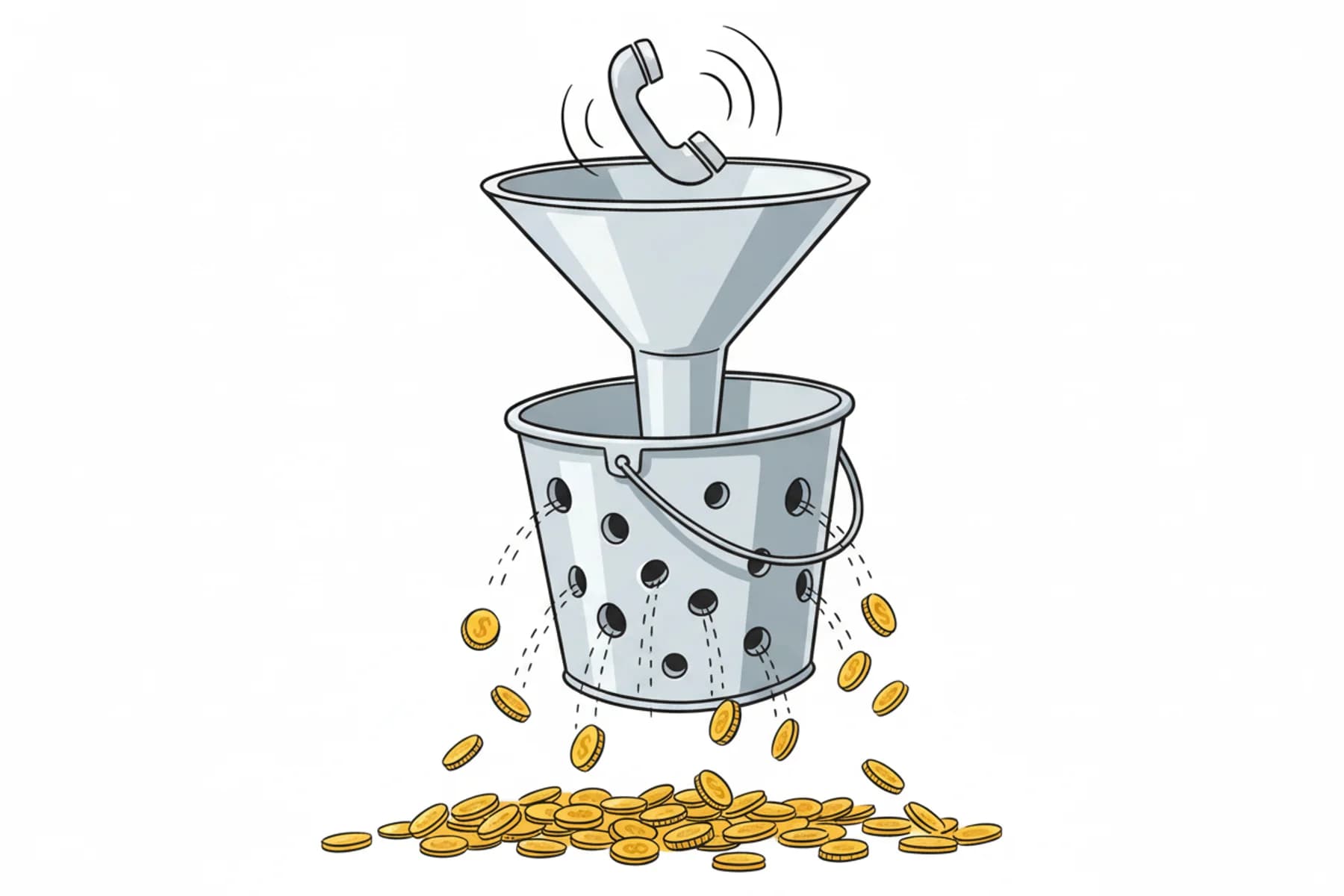 Marketing & Lead Gen
The Google LSA Math: How Much is a Poor Call-Intake Process Costing Your HVAC Shop?
14 min read Marketing & Lead Gen
Google To Charge Local Businesses For Missed & Subsequent Calls On LSAs
11 min read