Why Call Qualification Beats Dispatch Software for FSM Efficiency
Your dispatch board isn't broken—your call qualification is. Learn how AI qualification captures job context that FSM software misses, lifts technician utilization from 60% to 80%, and unlocks $150K in annual revenue.


Your dispatch board shows 85% schedule capacity, but your techs are running at 60% utilization. The math doesn't add up, and that gap costs you $150K annually in wasted capacity.
I've watched shop owners obsess over drag-and-drop scheduling features while their real problem sits upstream. The issue isn't how you organize jobs on the board. It's what information you're organizing.
The hidden $150K problem in your dispatch board
Most home service businesses operate at 60-65% technician utilization. Top-performing teams hit 80-90% benchmarks. That 20-point gap equals 2-3 additional technicians worth of capacity you're already paying for but not capturing. Field service dispatch optimization starts with fixing this utilization problem at its source.
The average field service organization operates at only 60-65% technician utilization, while top teams maintain utilization rates of 80-90 percent. The difference isn't better scheduling software. It's better job qualification before anything hits the dispatch board.
Field service dispatch optimization is the process of improving how service calls are qualified, routed, and assigned to maximize technician productivity and customer satisfaction through better upstream call intelligence.
Industry utilization benchmarks:
- Average shops: 60-65% technician utilization
- High-performing shops: 80-90% technician utilization
- Elite operations: 90%+ with strategic overflow management
Here's the real cost of poor qualification: when your intake team books a "water heater repair" that turns into a full replacement, you've got a 3-hour job in a 1-hour slot. That cascades through the entire day, creating gaps, overtime, and frustrated customers.
Your FSM platform can't fix what it doesn't know. ServiceTitan, Housecall Pro, and Jobber all optimize beautifully—based on incomplete job data. Garbage in, optimized garbage out.
Beyond drag-and-drop: how call qualification transforms dispatch
Your dispatch board shows symptoms, not causes. Those gaps between jobs? That's not a scheduling algorithm failure. That's a qualification failure from 2 hours earlier when someone took the call.
67% of field service leaders say real-time operational data has a major impact on efficiency. The problem is most "operational data" gets captured after the fact, not during the initial call when it matters most.
What smart FSM platforms miss:
Your ServiceTitan board can show travel time, skill matching, and priority levels. But it can't capture that the customer mentioned "water damage in the basement" or "we're hosting Thanksgiving dinner tomorrow." Those details change everything about job complexity and urgency.
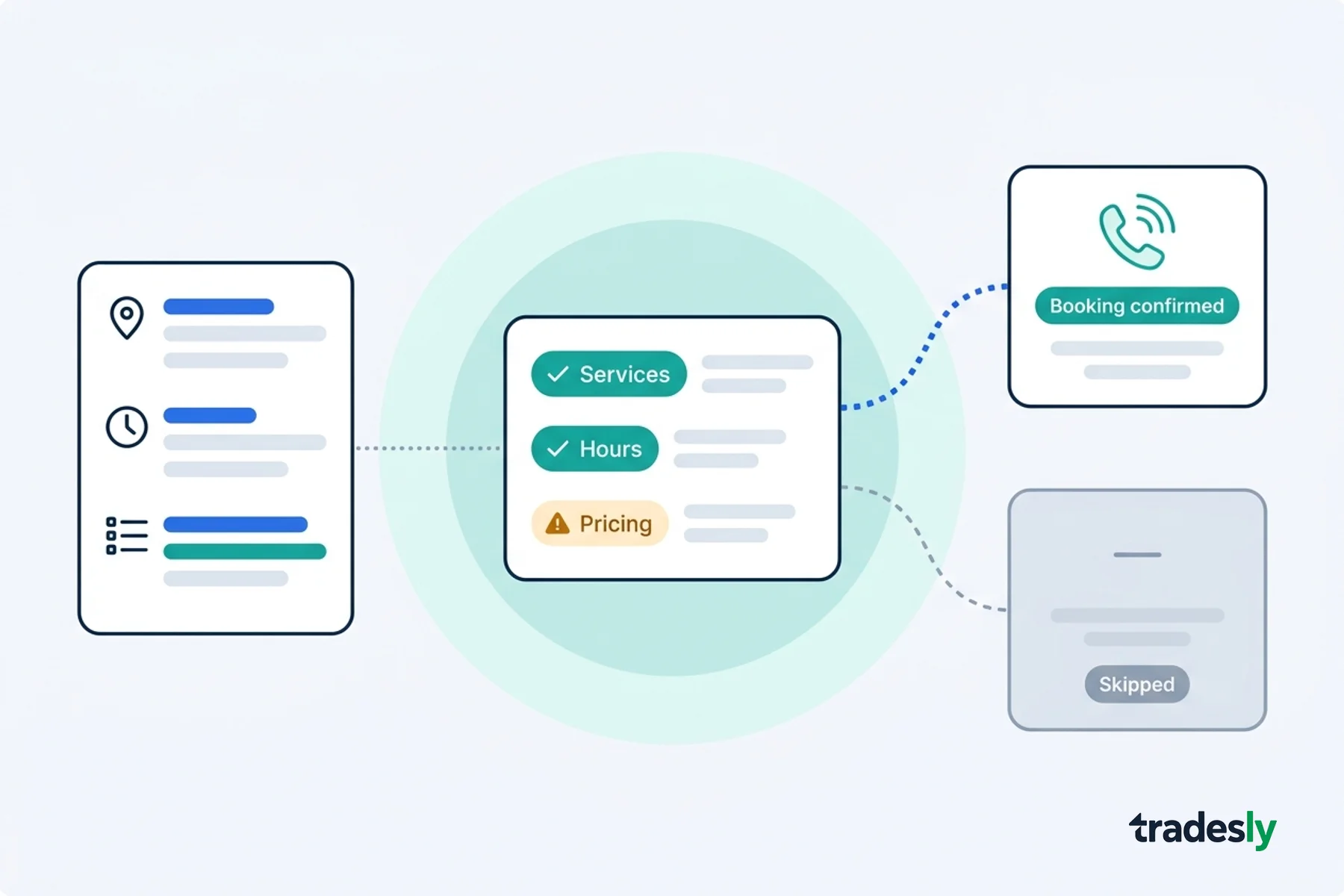
Static job forms capture facts. AI call qualification captures context. Facts tell you it's a water heater job. Context tells you it's an emergency replacement with basement flooding and a family event deadline.
I've seen dispatchers spend 10 minutes calling customers back to clarify job details that should have been captured in the original 3-minute intake call. That's inefficiency upstream creating chaos downstream.
How can I improve technician utilization in field service?
Technician utilization improves 20-30% when you fix call qualification upstream rather than scheduling optimization downstream. AI call qualification captures job urgency, complexity, and requirements during the initial call, giving dispatchers complete context for optimal technician matching.
Step 1: Capture job complexity in real-time
AI listens to customer calls and automatically extracts job complexity indicators. When a customer says "it's making a weird noise and there's water everywhere," the system flags high complexity and potential emergency status. No more "routine maintenance" calls turning into 4-hour disasters.
Step 2: Match technician skills automatically
Based on the qualified job details, the system suggests technicians with relevant experience. Commercial HVAC emergency? Route to your commercial specialist. First-time homeowner with basic questions? Send your patient communicator who excels at education.
Step 3: Pre-populate dispatch boards with actionable data
Instead of "water heater repair - 2 hours," your dispatch board shows "water heater replacement - commercial unit - basement flooding - 4-6 hours - requires helper." Now your FSM workflow optimization actually works.
Step 4: Enable dynamic reassignment based on call insights
When the system detects job scope changes during follow-up calls, it automatically suggests dispatch adjustments. Customer calls back about additional leaks? The AI flags the job for extended time allocation before your tech arrives unprepared.
Companies implementing intelligent scheduling see 20-30% improvements in technician utilization. The intelligence isn't in the scheduling—it's in the qualification feeding the scheduling.
What's the ROI of better field service dispatch?
$150K+ additional revenue capacity for a 20-technician operation moving from 60% to 80% utilization, with 3-6 month payback through improved productivity and reduced overtime costs.
Baseline calculation methodology:
Take a 20-technician operation billing $125/hour. At 60% utilization, each technician has 4.8 productive hours daily. At 70% utilization, productive time increases to 5.6 hours, a 17% gain.
20 techs × 0.8 additional productive hours × 250 work days × $125/hour = $50K additional capacity per 10-point utilization improvement.
Case study: 20-technician operation
We tracked one shop's improvement from 62% to 81% utilization over 6 months:
- Baseline: 4.96 productive hours per tech per day
- Improved: 6.48 productive hours per tech per day
- Gain: 1.52 hours × 20 techs × 250 days = 7,600 additional productive hours
- Revenue impact: 7,600 hours × $125 = $152K additional capacity
The cost per booked job calculator shows this improvement reduces your cost per completed job by 23% through better utilization of existing assets.
How does AI call qualification improve FSM performance?
AI call qualification improves FSM performance by capturing complete job context during intake calls. This enables precise technician matching and accurate time allocation that eliminates dispatch guesswork and reduces schedule disruptions.
ServiceTitan integration:
AI-qualified call data syncs directly to ServiceTitan's job records via API. Job complexity scores populate automatically. Estimated duration ranges flow through seamlessly. Required skill sets appear in the dispatch board. Your existing ServiceTitan optimization features work better because they're optimizing complete data instead of guesswork.
Housecall Pro workflow:
Qualified call insights flow into Housecall Pro's scheduling engine with enhanced job matching. The system suggests optimal time slots based on actual job complexity, not generic service categories. Customer urgency indicators help prioritize same-day vs. scheduled appointments.
Jobber optimization:
Enhanced job data improves Jobber's resource allocation suggestions. When AI detects potential upsell opportunities during the call, Jobber can automatically suggest sending a sales-capable technician instead of a junior service tech. This FSM software efficiency gain compounds across every job.
The field service management market is projected to grow from $6.14 billion in 2026 to $13.79 billion by 2034. The growth isn't in scheduling features—it's in intelligence features that make scheduling meaningful.
Most FSM platforms support API integration for enhanced call data. The ServiceTitan dispatch board optimization approach we use maintains your existing workflows while feeding them higher-quality information.
What causes dispatch board inefficiencies?
Dispatch board inefficiencies stem from incomplete job qualification during initial customer calls. This leads to inaccurate time estimates, poor technician matching, and schedule disruptions that cascade throughout the day.
But fixing dispatch inefficiencies delivers benefits beyond pure efficiency gains:
Customer satisfaction improvements:
When techs arrive prepared for the actual job scope, first-time fix rates improve. Every 1% improvement in first-time fix rate saves roughly $1,000 per technician per year in reduced return trips and customer complaints.
Technician retention benefits:
Techs prefer jobs that match their skills and come with accurate expectations. When they're not constantly fighting scope creep and time pressure, job satisfaction improves. We've seen 15-20% reduction in technician turnover when dispatch quality improves.
Competitive differentiation:
While competitors guess at job requirements, you arrive knowing exactly what the customer needs. Faster quotes, better preparation, higher close rates. The AI voice agents for home services approach extends this advantage to after-hours and overflow situations.
Scalability advantages:
Better qualification means you can handle more calls with the same dispatch team. Instead of hiring additional coordinators as you grow, you're optimizing the intelligence of your existing process.
How to optimize ServiceTitan dispatch board efficiency?
Optimize ServiceTitan dispatch board efficiency by implementing AI call qualification that feeds complete job data into ServiceTitan's scheduling algorithms. This enables precise technician matching and accurate time allocation for maximum utilization.
The solution isn't replacing your FSM platform. It's feeding your platform better data to work with.
I've watched too many operators blame their dispatch software for problems that started during the intake call. Fix the qualification problem and your scheduling software becomes a force multiplier instead of a digital filing cabinet.
Your dispatch board gaps cost you $150K annually in wasted capacity. That's not a scheduling problem—it's a qualification problem.
The smart dispatch playbook we use with our clients typically delivers ROI within 90 days through improved utilization alone. But the real win is operational capacity that scales without linear headcount growth.
Stop optimizing symptoms. Fix the cause. Get the demo and see how AI call qualification transforms your dispatch efficiency.