AI Call Qualification: Stop Wasting $1K Per Truck Roll
14% of service visits are unnecessary. AI call qualification eliminates wasted truck rolls by capturing accurate job details and pre-screening customers. See how to fill your dispatch board.


Your dispatch board looks full, but your techs are burning cash on jobs that shouldn't exist. Here's the brutal truth: 14% of your service visits are completely unnecessary, and each wasted truck roll costs you around $1,000. That's not a scheduling problem or a routing problem. It's a call qualification problem.
I've watched shops run 1,000 monthly work orders and hemorrhage $15K to $100K every month on preventable truck rolls. The fix isn't more efficient dispatching. It's fixing what happens in the first 60 seconds when the phone rings.
AI Call Qualification is a system that uses machine learning to pre-screen customers, capture accurate job details, and determine if a service visit is necessary before dispatching a technician.
The Hidden Cost of Poor Call Qualification
Poor call qualification creates a $1,000 leak every time your CSR books a job without proper screening. Industry data shows 14% of total service visits are unnecessary, and each individual truck roll costs around $1,000 when you factor in labor, fuel, equipment, and opportunity cost.
Most operators focus on filling dispatch boards. Wrong approach. The problem starts at call intake.
The $1,000 truck roll problem
Every unnecessary truck roll hits your P&L three ways:
- Direct costs: Technician wages, fuel, vehicle wear
- Opportunity costs: Tech could've been on a revenue-generating job
- Customer frustration: Damages your reputation and referral pipeline
Run 1,000 monthly service calls? You're looking at 140 wasted truck rolls costing $140K. That's real money walking out the door.
Why 14% of service visits are completely unnecessary
I've seen the same pattern at dozens of shops:
- CSR doesn't ask diagnostic questions
- Customer describes symptoms poorly
- Wrong technician gets dispatched for the job type
- Tech arrives to find a simple fix that could've been handled over the phone
The diagnostic conversation should happen during call intake, not at the customer's door.
How dispatch board gaps actually start at the phone
Empty dispatch slots aren't a capacity problem. They're a qualification problem. When your CSRs can't properly screen calls, you get:
- Mismatched technician skills to job complexity
- Multiple visits for jobs that should be one-and-done
- Callbacks eating into available dispatch slots
- Technicians carrying wrong parts or tools
Fix the call intake. Fix the dispatch board.
What AI call qualification actually does
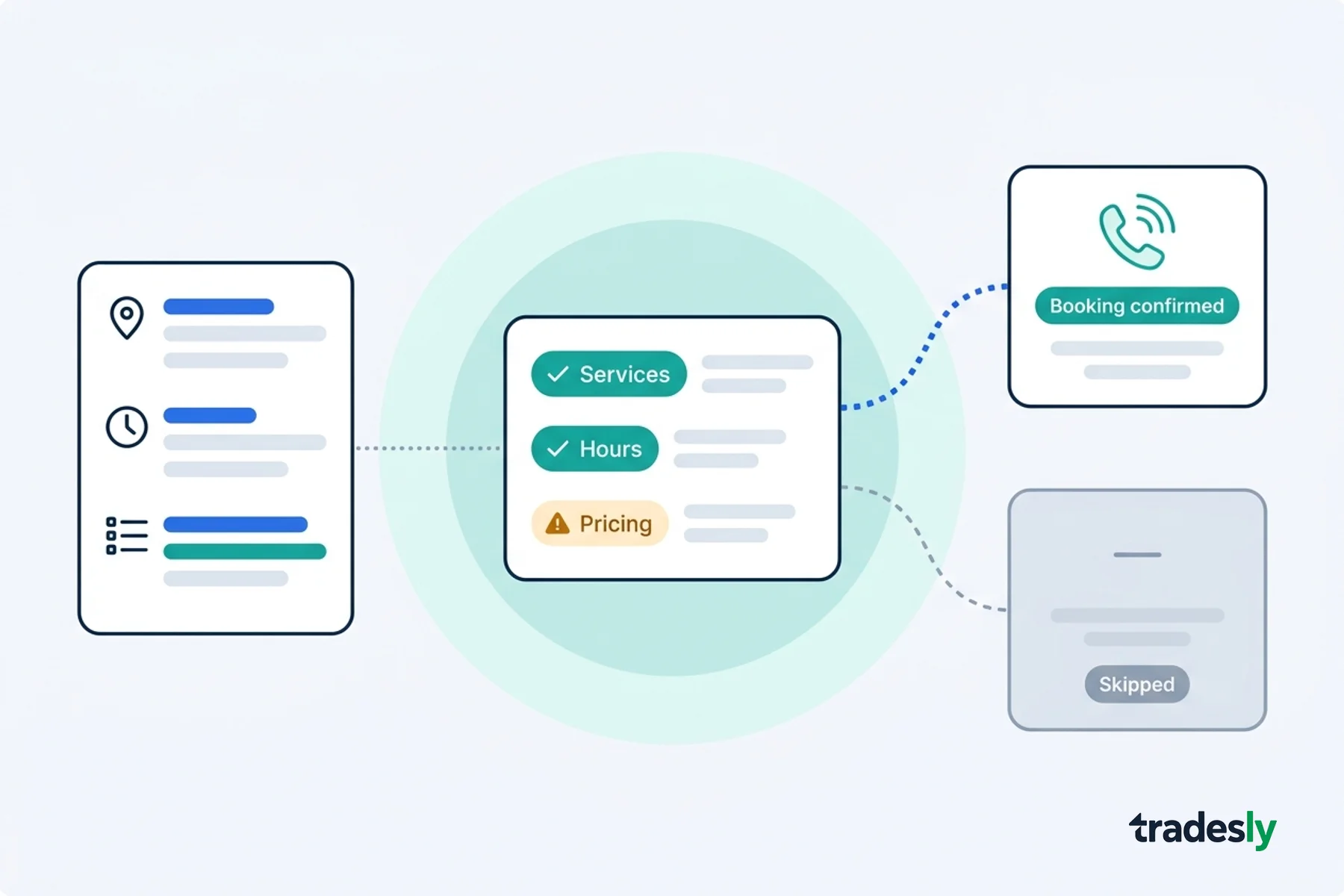
AI call qualification determines if the caller is in your service area, if you perform the requested work, and captures 98% accurate job details before any technician leaves the shop. Machine learning ensures data captured is 98% accurate, eliminating the guesswork that leads to wasted truck rolls.
Pre-screening customers for service area and job type
The AI asks the right questions upfront:
- "What's your zip code?" — Confirms service area
- "Describe what's happening with your system" — Initial diagnosis
- "When did this problem start?" — Urgency assessment
- "Have you tried any troubleshooting steps?" — Rules out simple fixes
No more dispatching a plumber to a job that needs an electrician.
Capturing accurate job details to prevent rework
AI doesn't get tired, doesn't skip steps, doesn't forget to ask about system age or warranty status. Every call gets the same thorough screening.
The result? Your technicians show up with the right parts, the right tools, and a clear understanding of what they're walking into.
Matching job complexity to technician skill level
AI qualification identifies whether a job needs:
- Entry-level tech for routine maintenance
- Senior tech for complex diagnostics
- Specialist for specific equipment types
- No truck roll at all (phone support sufficient)
This matching process happens before dispatch, not after the wrong tech arrives on-site.
Automatic scheduling based on real availability
AI integrates with your FSM system to check real-time technician availability and skill sets. No more double-booking or scheduling conflicts.
For more detailed implementation strategies, check out our guide on AI call qualification strategies.
How better call qualification improves dispatch board efficiency
Proper call qualification improves first-time fix rates from the industry average of 75% to top-performer levels of 85%. Industry research shows average first-time fix rate sits near 75%, but moving from 75% to 85% cuts follow-up visits from 25% to 15%.
Why technician utilization improves with qualified leads
When AI screens calls properly, your techs spend time on jobs that actually need fixing:
- Fewer diagnostic dead ends
- Right parts loaded on first visit
- Accurate time estimates for scheduling
- Better job-to-skill matching
I've tracked technician productivity across multiple shops. Qualified calls consistently generate 0.3 to 0.5 additional completed jobs per technician per day.
How accurate job details prevent repeat visits
When your CSR (or AI) captures accurate system details, equipment models, and problem symptoms, your tech arrives prepared. No more "I need to go back to the shop for parts" situations.
This is basic field service math, but most shops still get it wrong.
The connection between first-time fix rate and call quality
Every percentage point improvement in first-time fix rate directly correlates with better call qualification. You can't fix what you can't diagnose, and you can't diagnose what wasn't captured during the initial call.
Our technician utilization strategies dive deeper into this connection.
How does AI call qualification integrate with ServiceTitan and other FSM systems?
AI call qualification connects directly to ServiceTitan, Housecall Pro, and other major FSM platforms through API integration, typically requiring 1-2 weeks for full setup and business-specific training. Setup typically takes 1-2 weeks with proper configuration.
Integration with existing FSM systems
The AI doesn't replace your current system—it feeds qualified data into it:
- ServiceTitan: Jobs auto-populate with customer details, problem description, and skill requirements
- Housecall Pro: Appointments sync with captured job specifications and priority levels
- Jobber: Lead qualification data flows into job cards with technician matching
No manual data entry. No transcription errors.
Training the AI on your service offerings
Every home service business is different. The AI learns your specific:
- Service area boundaries
- Equipment brands you service
- Types of jobs you handle vs. refer out
- Emergency vs. routine prioritization rules
This business-specific training is what separates real AI qualification from generic chatbots.
Setting up escalation rules for complex situations
AI handles routine qualification, but complex situations get escalated to humans:
- Multi-system problems requiring expert diagnosis
- Commercial jobs outside normal parameters
- Warranty claims needing manual verification
- Upset customers requiring human touch
The key is knowing when to escalate—and AI gets better at this decision over time.
Measuring success with dispatch efficiency metrics
Track these KPIs to measure AI call qualification impact:
- Truck roll reduction: Target 10-15% decrease in unnecessary visits
- First-time fix rate: Aim for 85%+ industry-leading performance
- Technician utilization: Jobs completed per tech per day
- Dispatch board fill rate: Percentage of available slots utilized
For comprehensive integration planning, review our FSM integration strategies.
What is the ROI of implementing AI call qualification for dispatch operations?
Eliminating 14% of unnecessary truck rolls saves $15,000-$100,000 monthly on a base of 1,000 work orders, while improved first-time fix rates increase technician capacity by 0.3-0.5 jobs per day. On 1,000 monthly work orders, improving first-time fix rate by 10 points eliminates roughly 100 truck rolls, yielding $15,000 to $100,000 in monthly savings.
Cost savings from eliminated unnecessary truck rolls
Here's the math on a 1,000 monthly work order operation:
- Current unnecessary truck rolls: 140 per month (14%)
- Cost per truck roll: $1,000
- Monthly waste: $140,000
- AI qualification reduction: 75% of unnecessary rolls
- Monthly savings: $105,000
Even conservative estimates show $50K+ monthly savings for mid-size operations.
Revenue increase from better technician utilization
When technicians complete 0.5 additional jobs per day due to better qualification:
- 5 technicians: +2.5 jobs per day
- Monthly increase: +50 jobs (20 working days)
- Average job value: $400
- Additional monthly revenue: $20,000
This revenue increase compounds because it uses existing capacity more efficiently.
Customer satisfaction improvements from first-time fixes
Higher first-time fix rates drive:
- Better online reviews and ratings
- Increased customer retention
- More referral business
- Premium pricing opportunities
These soft benefits often exceed the hard cost savings within 12 months.
Calculate your specific savings with our cost per booked job analysis.
Stop the $1,000 truck roll leak
Your dispatch board problems start with your phone calls. Fix call qualification and you fix everything downstream—technician utilization, first-time fix rates, customer satisfaction, and profitability.
AI call qualification isn't about replacing your team. It's about giving them the tools to screen calls like veterans from day one. The result? Full dispatch boards with qualified jobs that actually need fixing.
This kind of home services dispatch optimization is what separates top-performing shops from the rest. Stop burning cash on preventable truck rolls.
Ready to eliminate wasted truck rolls? Get a demo of AI call qualification and see exactly how much you're losing to poor call screening.