AI Trust Score: Why Home Services Miss 60% of AI Leads
Homeowners now ask AI who to hire. Your business needs an AI trust score to be recommended. Learn what GEO is, why traditional SEO fails, and the hybrid strategy that wins.

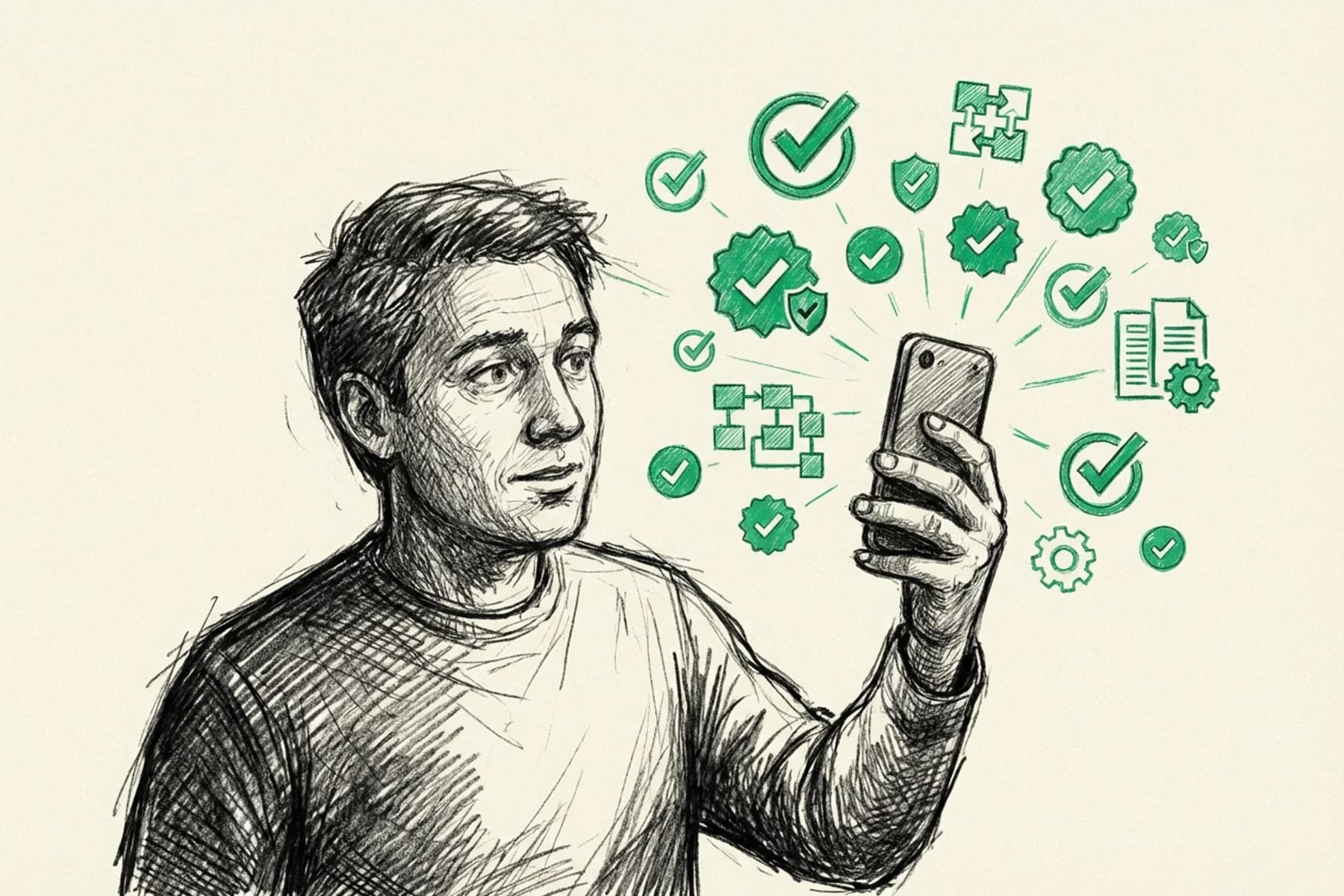
Your Google Ads are working. Your SEO is solid. But homeowners are finding your competitors through ChatGPT instead of calling you.
The game changed. 65% of local searches are now voice-activated, and 22% of homeowners use AI tools to research service providers. They're not typing "HVAC repair near me." They're asking: "Who should I call for emergency furnace repair?"
If AI systems don't trust your business enough to recommend you, you're invisible. Here's how to build an AI trust score for local business visibility that gets you recommended. Keep humans in the loop for the jobs that matter.
The search revolution you didn't see coming
Traditional search behavior is dead. Homeowners stopped clicking through 10 blue links to compare contractors.
The death of traditional search behavior
60% of searches end without clicks because AI provides direct answers. When someone's water heater fails at 11 PM, they don't research. They ask ChatGPT: "Best 24-hour plumber in Denver with emergency service."
The AI either recommends you or it doesn't. There's no second page of results.
Rise of conversational AI queries
Voice searches are longer and more specific than typed queries. Instead of "plumber Phoenix," homeowners ask: "Which Phoenix plumber can fix a burst pipe under my kitchen sink tonight and won't charge me $500 just to show up?"
AI systems parse these conversational queries and recommend businesses based on trust signals, not keyword density.
Impact on home services discovery
Your competition isn't just other contractors anymore. It's every business fighting for AI recommendation slots.
Smart contractors are already adapting their content and call handling for AI-powered lead generation systems. The ones who don't will become invisible by 2027.
What is an AI trust score for local businesses?
AI trust score for local business rankings works like domain authority for recommendation engines. The higher your score, the more likely ChatGPT, Perplexity, and Google's AI summaries recommend your business to homeowners looking for services.
AI Trust Score is how AI systems measure and rank business credibility based on structured data, consistent reputation signals, and entity validation across the web.
Understanding AI recommendation algorithms
AI systems validate businesses as real entities, not just websites. They cross-reference your business information across multiple sources: Google Business Profile, directory listings, review platforms, social media, and your website's structured data.
Inconsistent information hurts your AI trust score. If your hours differ between your website and Google, AI systems flag you as unreliable.
Trust signals that matter to AI
AI systems prioritize businesses that demonstrate:
- Entity consistency: Same business name, address, phone across all platforms
- Structured data: LocalBusiness schema, FAQ markup, HowTo content
- Authority citations: References from legitimate local sources
- Response reliability: Consistent call answering and customer communication
- Operational transparency: Clear pricing, service areas, and availability
Citation authority compounds over time like domain authority. The earlier you start building AI trust signals, the harder you become to displace.
Why traditional SEO fails in AI search
Keyword stuffing actually hurts GEO performance. AI systems detect and penalize content written for search engines instead of humans.
Your "HVAC repair services Phoenix Arizona" pages won't get recommended. Your "What to do when your furnace won't start" guides will—if they're structured correctly.
AI systems favor conversational, helpful content that answers real questions. The shift from keywords to conversations changes everything.
How does GEO differ from traditional SEO for contractors?
GEO (Generative Engine Optimization) and AEO (Answer Engine Optimization) replace traditional SEO tactics with AI-first strategies that get your business recommended rather than just ranked.
GEO and AEO Marketing are optimization strategies designed to get your business cited and recommended by AI systems like ChatGPT, Perplexity, and Google AI Overviews instead of just ranking in traditional search results.
GEO: Getting cited by ChatGPT and Perplexity
Generative engines like ChatGPT recommend businesses based on authoritative, structured content. Structured content with statistics and citations performs 22% better in AI responses.
Write content that answers specific questions:
- "How much does emergency HVAC repair cost in [city]?"
- "What should I look for when hiring a plumber?"
- "How do I know if my electrical panel needs replacement?"
Include real data, local context, and clear expertise markers. AI systems trust businesses that demonstrate knowledge, not just availability. For HVAC companies specifically, answer engine optimization HVAC content should focus on troubleshooting guides and maintenance advice.
AEO: Optimizing for Google AI Overviews
Google's AI Overviews pull content from pages that directly answer search queries. Your content needs to be scannable and definitive.
Format answers in numbered steps, bullet points, and comparison tables. Use FAQ sections with LocalBusiness schema. Make it easy for AI to extract and cite your information.
Content that AI systems trust
Local services lag behind at 3-7% AI traffic adoption vs 18-25% for other industries. Most contractors haven't adapted yet—which means opportunity for generative engine optimization plumbing and HVAC businesses.
AI systems trust content that includes:
- Real statistics with source citations
- Local expertise and area-specific information
- Step-by-step guides and troubleshooting advice
- Clear business information and service transparency
- Consistent messaging across all touchpoints
Your content strategy needs AI search optimization local business principles built into every page, guide, and FAQ section.
Why do AI systems recommend some plumbers over others?
AI systems recommend businesses that demonstrate consistent expertise and reliability through structured, helpful content and clear operational transparency—not just marketing promises.
When AI should handle the call
AI excels at routine inquiries: appointment scheduling, basic pricing questions, service area verification, and after-hours lead capture.
Every missed call hurts your AI trust score. Homeowners expect immediate response. If your phone goes to voicemail while your competitor's AI answers instantly, guess who gets recommended next time?
AI CSR for after-hours coverage ensures you never miss a lead, even when your team sleeps.
When humans must close the deal
Homeowners want humans for high-stakes conversations: emergency repairs, major installations, and anything over $5,000.
A flooded basement or broken furnace in winter isn't a chatbot conversation. These are emotional, urgent situations where human empathy and expertise close deals.
Hybrid AI customer service captures every lead with AI, then seamlessly transfers complex situations to trained humans.
Building trust through consistent performance
Consistent call handling builds the trust signals AI systems measure. Every interaction—AI or human—needs to reinforce your expertise and reliability.
Real-time call coaching ensures every human conversation meets the same quality standards your AI assistant maintains.
When AI systems analyze your business, they look at response consistency, call resolution rates, and customer satisfaction patterns. Mixed performance hurts your AI trust score.
How can HVAC companies optimize for AI search in 2026?
HVAC companies optimize for AI search by implementing structured data markup, creating definitive troubleshooting content, and ensuring consistent business information across all platforms while maintaining hybrid AI-human call handling for complete lead coverage.
Week 1: Audit your current AI visibility
Day 1-3: Test AI recommendations
- Ask ChatGPT: "Best [your service] company in [your city]"
- Query Perplexity: "Who should I call for emergency [your service] in [location]?"
- Check Google AI Mode for your key services
- Document which competitors get recommended and why
Day 4-7: Audit your business information
- Verify name, address, phone consistency across all platforms
- Update Google Business Profile with complete information
- Check directory listings for accuracy
- Review your website's structured data markup
Week 2-3: Implement structured data and content optimization
Week 2: Technical foundation
- Add LocalBusiness schema to your website
- Implement FAQ structured data for common questions
- Create HowTo markup for service guides
- Optimize your Google Business Profile with photos, posts, and complete service descriptions
LocalBusiness schema is foundational for AI-era local SEO. Without it, AI systems struggle to understand your business entity.
Week 3: Content creation
- Write definitive guides answering your most common customer questions
- Include local pricing context and area-specific advice
- Add FAQ sections to service pages
- Create comparison content ("Gas vs electric water heaters: Which is better for Phoenix homes?")
- Publish step-by-step troubleshooting guides
Week 4: Deploy hybrid AI systems for lead capture
Set up AI call handling
- Deploy AI for routine calls: scheduling, pricing questions, service area verification
- Configure smart escalation rules for complex situations
- Train human team for high-value call scenarios
- Test AI call escalation workflows
Monitor and optimize
- Track response times and call resolution rates
- Monitor AI recommendation mentions weekly
- Adjust content based on AI citation patterns
- Continuously update business information across platforms
The hybrid advantage: AI + humans win high-ticket jobs
Full AI replacement loses high-value customers. Full human handling misses after-hours leads.
The winning strategy: AI handles routine inquiries flawlessly while humans close complex, high-ticket opportunities. This consistent quality across all touchpoints builds the AI trust score that gets you recommended.
Your business needs both AI visibility and human expertise. The companies that master this hybrid approach will dominate local recommendations while competitors argue about whether AI will replace their teams.
Key Takeaway: Stop chasing keywords. Start building AI trust through consistent, structured, helpful content and reliable customer interactions. The future of local search is conversational, not transactional.
Ready to build your AI trust score? Get the demo and see how hybrid AI systems capture every lead while your human team closes the big jobs.
Keep reading
 Marketing & Lead Gen
Google Ads Call Tracking for Home Services: The Step-by-Step Setup Guide
14 min read Marketing & Lead Gen
The Google LSA Math: How Much is a Poor Call-Intake Process Costing Your HVAC Shop?
14 min read Marketing & Lead Gen
Google To Charge Local Businesses For Missed & Subsequent Calls On LSAs
11 min read