


2026 HVAC Dispatcher Salary Guide: What It Really Costs (Base Pay, Overtime & Turnover)
Your HVAC dispatcher's base pay isn't the problem. Overtime and turnover are. Get the real numbers and a summer coverage blueprint that stops the bleed.

The Overtime Trap: Why Paying Your Dispatcher Time-and-a-Half Is Actually Your Cheapest Option
It's 9 PM on a Tuesday in July. Your dispatcher is answering emergency HVAC calls off their personal cell phone. You think that's loyalty. It isn't. It's a warning sign — and if you don't fix the underlying problem, you'll be posting a job listing for a new dispatcher before August.
The HVAC dispatcher salary isn't what's killing your margins this summer. Overtime is. Turnover is worse. And most $1M–$2M shops are one bad season away from losing both at once.
This guide gives you the real cost benchmarks and a coverage blueprint to stop paying for the same labor twice.
What is the average HVAC dispatcher salary in 2026?
For a mid-market HVAC shop, budget $45K–$55K in base pay for a solid dispatcher. Senior dispatchers in high cost-of-living metros push $65K+. Here's where those numbers come from.
Home services dispatcher pay benchmarks: what the data actually says
The Bureau of Labor Statistics OEWS May 2025 data (SOC 43-5032, Dispatchers Except Police/Fire/Ambulance) puts the national median at $50,340, with a mean of $54,740. The 25th-percentile floor sits at $42,750. That's your government anchor — the broadest and most structurally reliable number available.
HVAC-specific active posting data from ZipRecruiter active posting data (HVAC-specific) tells a tighter story: middle-50% range of $35,500–$49,500, national average near $45,823, with top earners at the 90th percentile hitting $60,500. That's the market reality for shops in the Tradesly ICP range.
Glassdoor self-reported figures run $63K–$76K — skewed by senior respondents and large-market overrepresentation, so don't anchor your comp decisions there.
| Source | Low | Midpoint | High | Notes |
|---|---|---|---|---|
| BLS OEWS 2025 (SOC 43-5032) | $42,750 (25th %ile) | $50,340 (median) | $54,740 (mean) | Government data; broadest sample |
| ZipRecruiter (HVAC-specific) | $35,500 | $45,823 | $60,500 (90th %ile) | Active postings; closest to ICP market |
| Glassdoor (self-reported) | $63,000 | — | $76,000 | Skewed senior/large-market; use with caution |
| Tradesly planning range | $45,000 | $50,000 | $55,000 | Midmarket shops; add $10K+ for high-COL metros |
For deeper context on how these benchmarks play out by region and experience level, see our 2026 HVAC dispatcher salary benchmarks.
Why Don't HVAC Dispatcher Salary Numbers Agree — and Which Should You Use?
Here's the honest disclosure: no BLS SOC code exists specifically for "HVAC Dispatcher." The ZipRecruiter and Glassdoor figures are job-posting and self-report aggregations, not government data. They're useful directional signals, not precise benchmarks.
Use the BLS OEWS figures as your structural floor. Use ZipRecruiter's HVAC-specific postings to calibrate for your market. The spread is real and it matters when you're budgeting for peak season.
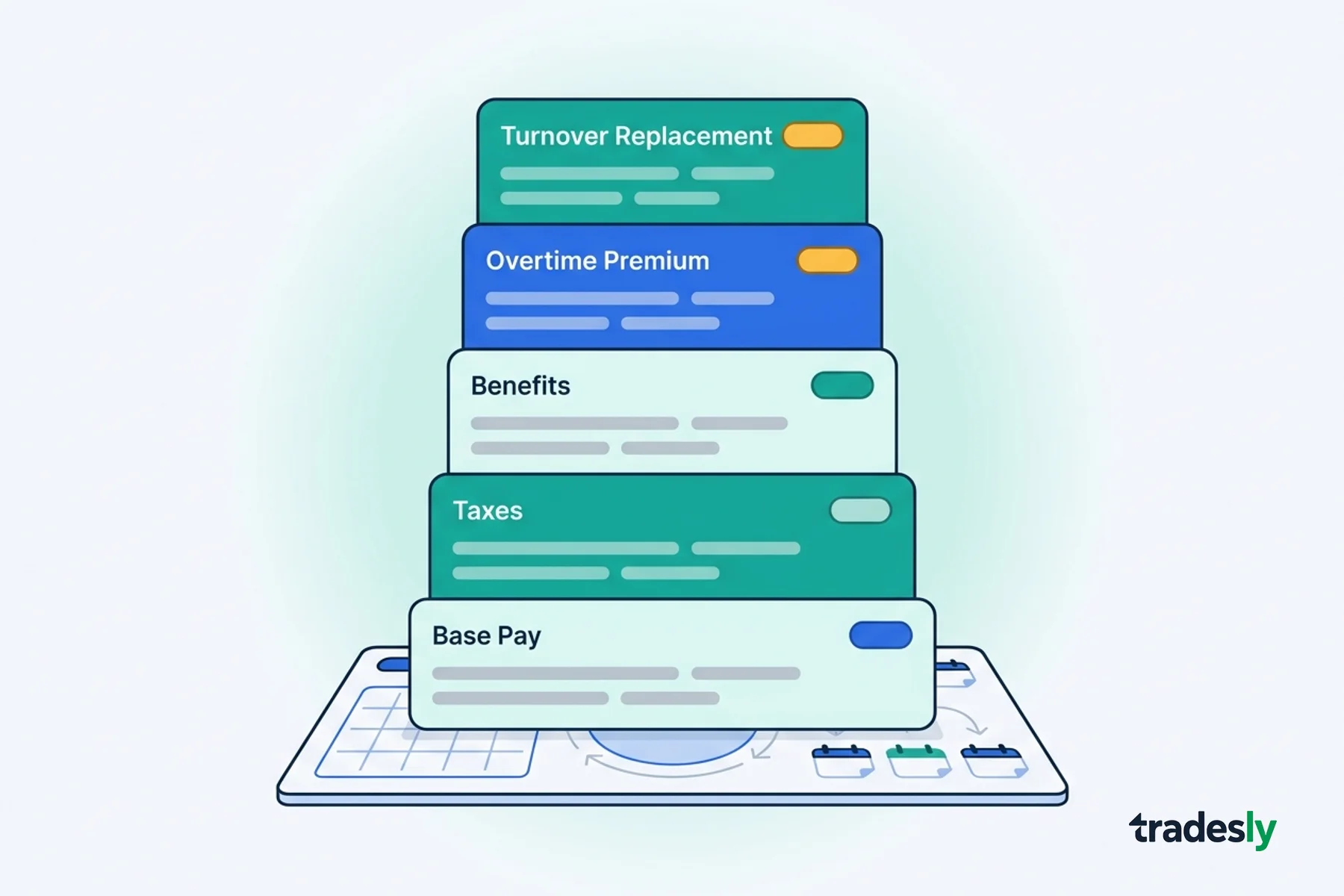
HVAC Dispatcher Total Labor Cost is the full expense of employing a dispatcher: base salary plus payroll taxes (7.65% FICA), benefits burden (health, PTO, workers comp — typically 20–30% of base), overtime premium (1.5x for all hours over 40), and turnover replacement cost if they leave. Base pay is the smallest variable in this stack.
What is the true total cost of an in-house HVAC dispatcher including benefits and turnover?
A $48K dispatcher costs you well over $65K when you factor in taxes, benefits, and a single summer surge. Add turnover and you're looking at $72K–$96K in realized annual cost — often more than double what owners budget.
The overtime math you're not running — your real HVAC dispatcher overtime cost
Take a dispatcher earning $48K annually — roughly $23/hr. Ten hours of overtime per week over a 12-week summer surge generates $4,140 in overtime premium alone. That's pure margin bleed, on top of their regular salary, for coverage that still stops at 5 PM.
Stack that against the full cost picture:
- Base pay: $45K–$55K (midmarket range)
- Payroll taxes: 7.65% FICA on top of base
- Benefits burden: 20–30% of base (health, PTO, workers comp)
- Summer OT premium: $4K+ for 10 hrs/week over 12 weeks
| Cost Component | Amount | Cumulative Total |
|---|---|---|
| Base salary | $48,000 | $48,000 |
| Payroll taxes (7.65% FICA) | $3,672 | $51,672 |
| Benefits burden (25% of base) | $12,000 | $63,672 |
| Summer OT premium (10 hrs/wk × 12 wks) | $4,140 | $67,812 |
| Turnover replacement (if they leave) | $24,000–$48,000 | $91,812–$115,812 |
A $48K dispatcher all-in costs you $65K–$75K in a normal year. During peak season, that number climbs fast. If you want to run your specific numbers, download our breakdown of the real cost of a remote HVAC dispatcher.
The turnover bill nobody budgets for
Losing a dispatcher mid-summer isn't just a morale hit. Replacement cost — recruiting, onboarding, lost productivity during ramp — runs 50–100% of annual salary by conservative industry estimates. On a $48K dispatcher, that's $24K–$48K in realized cost. Often more than your entire summer OT budget.
And it compounds. When you run your best people into the ground every July, you don't just risk one bad season. You lose institutional knowledge that took years to build. We've seen dispatcher burnout driving turnover costs higher than the overtime itself — and it's more common than owners want to admit.
The summer overtime bill isn't a dispatcher problem. It's a coverage architecture problem.
The summer surge problem most shops refuse to solve
HVAC dispatch scheduling peak season is the one operational test most $1M–$2M shops never prepare for — and 65% fail it by simply making existing staff work longer hours. It breaks down because most shops never designed it for volume. Summer call volume spikes 30–40% for the average HVAC company. Some operations see surges of 5–8x — going from 30 calls per day to 200+. According to Raft Labs (April 2026), 65% of HVAC companies respond to peak demand by making existing staff work longer hours. No additional systems. No backup plan. Just willpower and loyalty until someone breaks.
That approach has a ceiling. And the ceiling is your dispatcher's breaking point.
The after-hours gap is where real revenue leakage starts. When your dispatcher clocks out — or stops answering their personal phone at 9 PM because they've had enough — calls go to voicemail.
What actually happens to revenue when after-hours calls go unanswered is a number most owners don't want to run: scheduling failures during a major heat wave can cost $120,000–$250,000 in lost revenue. Even at a fraction of that, it's not a rounding error.
The false choice is: overtime burns your margins and your people. Voicemail burns your revenue. Neither is acceptable at scale. There's a third option.
How do I provide 24/7 dispatch coverage without paying overtime?
Stack three things: structured shift design to eliminate improvised overtime, tiered triage to protect senior dispatcher capacity, and AI-augmented after-hours coverage for routine calls. No single fix solves it. All three together get you to 24/7 coverage without a single dispatcher running on fumes.
Option 1: structured shift design
Stop treating summer as a sprint. Start treating it as a two-shift operation.
Split dispatch into a morning block (7 AM–3 PM) and an afternoon block (11 AM–7 PM) with overlap during peak mid-day call volume. Overtime drops sharply when coverage is designed, not improvised. A part-time afternoon dispatcher costs significantly less than 10 hours of OT per week across your full-time team. This isn't about hiring more people. It's about distributing existing labor correctly.
Option 2: tiered triage — route by call type, not by whoever picks up
Not every call needs your senior dispatcher. Segment inbound volume: emergency diagnostic calls go to your best person. Routine scheduling, follow-ups, and estimates can be handled by a trained junior or routed systematically. Knowing how to train HVAC dispatchers for call triage is what separates shops that scale from those that scramble.
Watch the offshore VA failure mode. If you're evaluating remote dispatch support, domestic fluency and CRM integration are non-negotiable.
Option 3: AI-augmented after-hours coverage
After-hours HVAC dispatch coverage doesn't require a second hire. The after-hours slot is where AI earns its place. Routine calls — appointment booking, status updates, basic qualification — don't need a human at 10 PM. An AI receptionist handles the routine, captures the lead, and your dispatcher reviews the dispatch board in the morning instead of fielding calls off their personal phone at night.
For high-value calls — emergency replacements, complex diagnostic triage — a warm handoff to a human still matters. The AI needs to know when it's out of its depth and escalate with context, not just drop the caller. That's the difference between a coverage tool and a liability.
Before peak season, triage your call volume before the next heatwave hits — that's the operational playbook for mapping your call types and building the routing logic before July makes the decision for you.
| Coverage Option | What It Solves | Cost vs. Overtime | Best For |
|---|---|---|---|
| Structured shift design | Eliminates improvised OT; distributes load | Part-time hire vs. 10+ OT hrs/wk | Shops with predictable surge windows |
| Tiered triage | Protects senior dispatcher capacity; routes by priority | No extra headcount required | Any shop routing all calls to one person |
| AI after-hours coverage | Closes the 5 PM–10 PM revenue gap | Fraction of an FTE; no OT rate | Shops losing leads to voicemail after hours |
| All three stacked | Full 24/7 coverage with no one running on fumes | Lowest realized cost per covered hour | $1M–$2M shops during peak season |
Key Takeaway: Structured shifts cut base OT. Tiered triage protects senior capacity. AI covers the after-hours gap. All three together = 24/7 coverage with no dispatcher running on fumes.
What causes HVAC dispatcher burnout and how do I prevent it?
HVAC dispatcher burnout is caused by structural overload — too many call types routed to one person, no shift boundaries, and no after-hours backup — and it is prevented by segmenting call types, building shift structure before peak season, and using AI to absorb routine after-hours volume. Prevent it by segmenting call types (tiered triage), building shift structure before peak season, and using AI to absorb routine after-hours volume so your dispatcher isn't the last line of defense at 10 PM.
Your HVAC Dispatcher Salary Budget Is Incomplete — Stop Waiting for July to Fix a January Problem
HVAC dispatcher salary benchmarks give you a planning anchor. Dispatcher salary home services owners can benchmark using BLS data as the floor — but the operators who win peak season don't just know the numbers. They build a system around them before the board blows up.
Here's the full cost picture in one place:
- Base pay: $45K–$55K midmarket, $65K+ in high-COL metros (add $4K+ OT premium during peak season)
- Benefits burden: 20–30%
- Turnover replacement: 50–100% of annual salary
Being prepared is not the same as wanting. Every HVAC owner wants to handle summer surge. The ones who actually do built a system for it — shift structure, triage protocol, AI backup for after-hours — so July feels like a managed operation, not a controlled emergency.
The coverage blueprint isn't one option. It's a stack. Structured shifts reduce base OT. Tiered triage protects senior capacity. AI covers the after-hours gap. All three together and you stop choosing between overtime and voicemail.
Stop guessing. See how Tradesly covers your after-hours dispatch without adding headcount. Book a demo.
Keep reading
 Salary & Workforce
Revenue Per Technician: The Ultimate Guide to Benchmarking and Increasing Your Team's Output
7 min read Salary & Workforce
The Ultimate 2026 HVAC Technician Salary Guide (State-by-State Data)
7 min read Salary & Workforce
Your Best Techs Are Quitting Because Your CSRs Are Booking Bad Jobs
7 min read